Systematic method for developing tailored strategies for implementing point-of-care procalcitonin testing to guide antibiotic prescribing in Swiss primary care: a protocol for a mixed-methods participatory approach
Aline Wolfensberger, Sophie CL Gendolla, Jelena Dunaiceva, Catherine Plüss-Suard, Anne Niquille, Anna Nicolet, Joachim Marti, Byron J Powell, Rahel Naef, Noémie Boillat-Blanco, Yolanda Mueller, Lauren Clack

TL;DR
This study outlines a method to develop strategies for using a quick test to guide antibiotic use in Swiss primary care, aiming to reduce unnecessary prescriptions.
Contribution
A systematic, participatory approach to tailor implementation strategies for point-of-care procalcitonin testing in primary care.
Findings
The study uses a four-phase mixed-methods approach to identify and prioritize implementation barriers and facilitators.
Expert and stakeholder input will guide the selection and refinement of implementation strategies based on APEASE criteria.
Results will be shared through scientific publications and conferences to support antimicrobial stewardship.
Abstract
Antimicrobial resistance is a major global health threat, driven largely by the misuse and overuse of antibiotics. Point-of-care (POC) tests for inflammatory biomarkers like procalcitonin (PCT) have shown promise in reducing unnecessary antibiotic prescriptions. The hybrid type II ImpPro trial aims to evaluate the implementation and effectiveness of POC-PCT on antibiotic prescriptions by primary care physicians (PCP) in French-speaking Switzerland. Implementation is planned to include a multifaceted strategy delivered mainly, but not exclusively, via PCP quality circles. Currently, little guidance exists on how to best tailor the implementation strategies to a specific context. This study protocol describes the comprehensive approach taken within ImpPro to develop a multifaceted and multilevel strategy for POC-PCT implementation. Our mixed-methods participatory implementation research…
Genes, proteins, chemicals, diseases, species, mutations and cell lines named across the full text — each resolved to its canonical identifier and authoritative record.
Click any figure to enlarge with its caption.
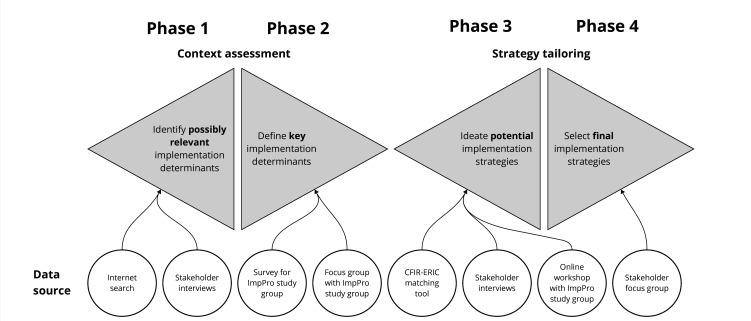 Figure 1
Peer Reviews
No public reviews on file for this paper yet. If you reviewed it on a platform where reviews are public (OpenReview, ICLR, NeurIPS, ICML), you can paste yours below so the community can read it here.
Videos
No videos yet. Explain this paper in a talk, walkthrough, or lecture? Add one.
Taxonomy
TopicsSepsis Diagnosis and Treatment · Clinical Reasoning and Diagnostic Skills · Health Policy Implementation Science