Yeast mutation rates in alternative carbon sources reflect the influence of reactive oxygen species
Keerthana Thota, Jacob D. Fredette-Roman, Nathaniel P. Sharp

TL;DR
This study shows that yeast mutation rates vary with carbon sources, likely due to reactive oxygen species from respiration.
Contribution
The study reveals a nonlinear relationship between respiration rates and mutation rates in yeast under different carbon sources.
Findings
Mutation rates in yeast are highest in pyruvate and lowest in glucose media.
Respiration rates only partially predict mutation rates, indicating complex interactions.
Aerobic respiration produces reactive oxygen species that may influence mutation rates.
Abstract
Environmental conditions can influence mutation rates, but the reasons are often unclear. Budding yeast can utilize many carbon sources, with variation in the degree of fermentation versus respiration. Since aerobic respiration produces mutagenic reactive oxygen species, we hypothesized that yeast grown in media promoting aerobic respiration would show higher mutation rates. We found significant differences across five media types, with the highest mutation rate in pyruvate and the lowest in glucose. However, mutation rates responded to respiration rate in a nonlinear fashion, suggesting that the degree of respiration in a given environment is only partly predictive of mutation rate.
Genes, proteins, chemicals, diseases, species, mutations and cell lines named across the full text — each resolved to its canonical identifier and authoritative record.
Click any figure to enlarge with its caption.
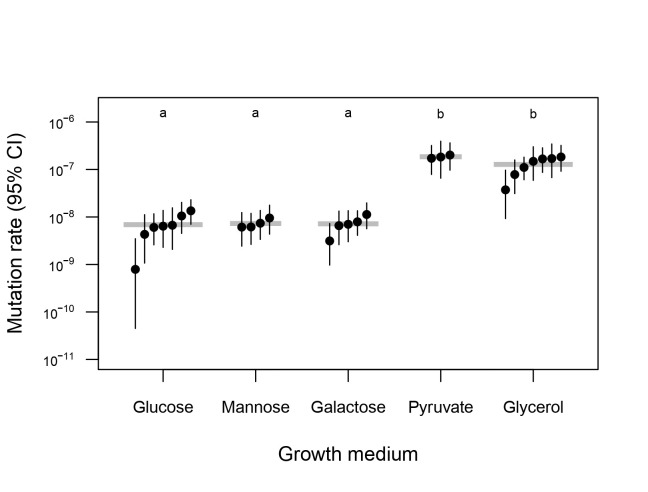 Figure 1
Peer Reviews
No public reviews on file for this paper yet. If you reviewed it on a platform where reviews are public (OpenReview, ICLR, NeurIPS, ICML), you can paste yours below so the community can read it here.
Videos
No videos yet. Explain this paper in a talk, walkthrough, or lecture? Add one.
Taxonomy
TopicsCarcinogens and Genotoxicity Assessment