The Complete Genome Sequences of Bacteriophages ASegato, DejaVu, Judebell, and RicoCaldo isolated using Microbacterium foliorum
Robert Logan, Mahlet Abebe Biratu, Maria Andreea Busila, Ignacio Fernandez Busto, Nathan Caldwell, Peyton Chestnut, Hycell Colmenares Duno, Ricardo Cuello, Dhazyah Johnson, Jeniush Kark, Curvan Lawrnece, Jhemerial Arnique Lewis, Wod-Dardely Maglorie, Andrea Mendoza, Wesely Mills

TL;DR
This paper describes four new bacteriophages isolated from grass in Quincy, Massachusetts, and their classification into known phage clusters.
Contribution
The novel contribution is the isolation and genome sequencing of four new bacteriophages using Microbacterium foliorum as a host.
Findings
Four new bacteriophages were isolated from grass samples in Quincy, Massachusetts.
The phages were classified into actinobacteriophage clusters ED2, ED1, EG, and EK2 based on gene similarity.
Abstract
We report the discovery and characterization of bacteriophages ASegato, DejaVu, Judebell, and RicoCaldo, isolated from grass samples collected in Quincy, Massachusetts, using Microbacterium foliorum B-24224 as the isolation host. Based on gene content similarity, these phages are assigned to actinobacteriophage clusters ED2, ED1, EG, and EK2 respectively.
Genes, proteins, chemicals, diseases, species, mutations and cell lines named across the full text — each resolved to its canonical identifier and authoritative record.
Click any figure to enlarge with its caption.
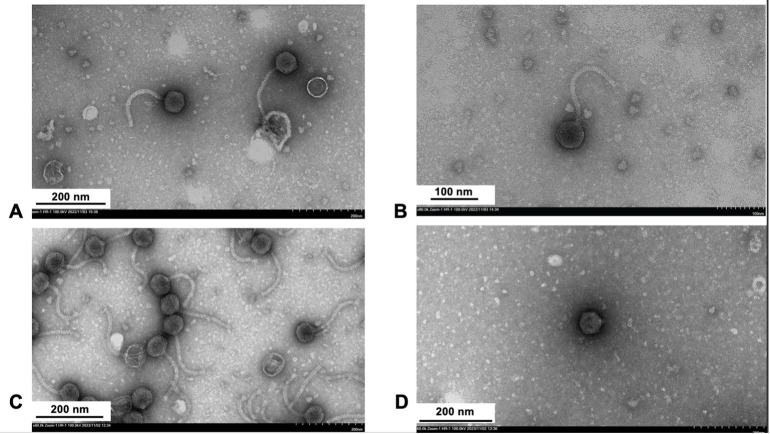 Figure 1
Peer Reviews
No public reviews on file for this paper yet. If you reviewed it on a platform where reviews are public (OpenReview, ICLR, NeurIPS, ICML), you can paste yours below so the community can read it here.
Videos
No videos yet. Explain this paper in a talk, walkthrough, or lecture? Add one.
Taxonomy
TopicsBacteriophages and microbial interactions · Genomics and Phylogenetic Studies · Genetics, Bioinformatics, and Biomedical Research