SMCT1 has a low affinity to PDZ domain containing 1 protein
Qingyang Zhang, Jacob Clinton, Kristina Westerlund, Carsten Mim

TL;DR
This study shows that SMCT1 binds to PDZ domains in PDZK1, but the interaction is weak and likely not important in the body.
Contribution
The study experimentally confirms SMCT1-PDZ domain interaction but challenges its physiological relevance.
Findings
SMCT1 binds to two PDZ domains in PDZK1.
The binding affinity is low, with dissociation constants higher than typical PDZ interactions.
Abstract
Sodium-coupled monocarboxylate transporter 1 (SMCT1) is a membrane transporter abundantly expressed in colon, kidney, thyroid, brain; and silenced in cancer cells. It transports monocarboxylic acids with little specificity into cells. Based on pulldown experiments, it was proposed that the scaffolding protein PDZ Domain Containing 1 (PDZK1) regulates its surface expression and increases SMCT1’s transportation efficiency. Here, we performed pull-down assays, Surface Plasmon Resonance (SPR), and Micro Scale Thermophoresis (MST) to evaluate the affinity between SMCT1 and two PDZ domains in PDZK1. Our results show that SMCT1 binds to these PDZ domains. However, the estimated equilibrium dissociation constants are higher than in canonical PDZ domains and likely physiological not relevant.
Genes, proteins, chemicals, diseases, species, mutations and cell lines named across the full text — each resolved to its canonical identifier and authoritative record.
Click any figure to enlarge with its caption.
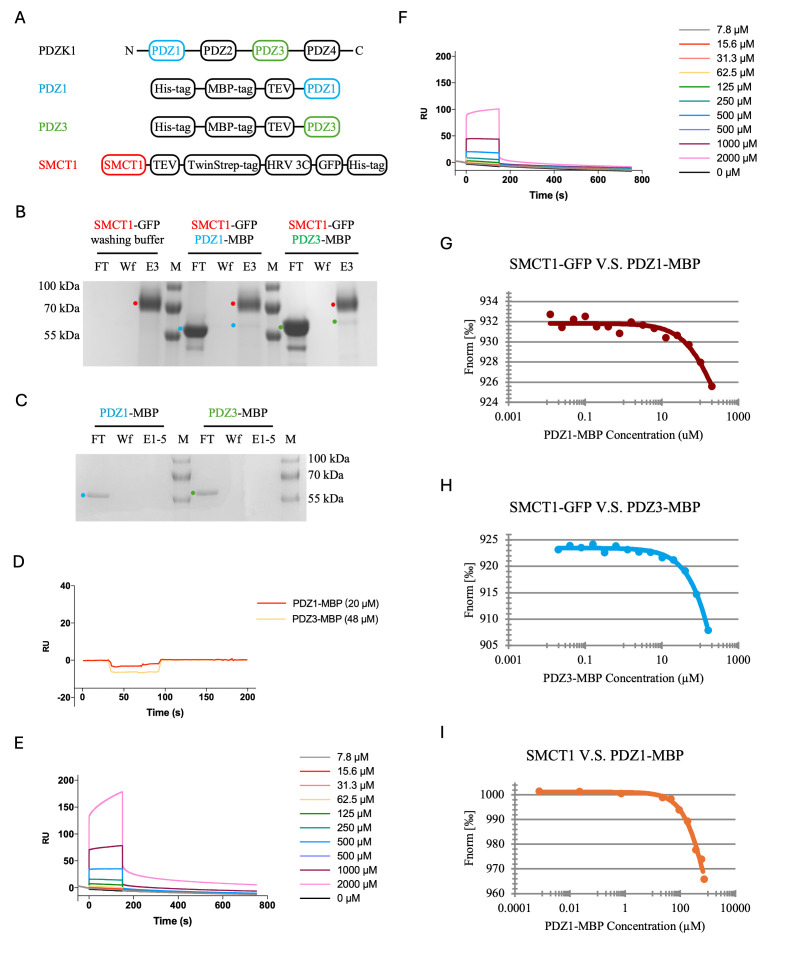 Figure 1
Peer Reviews
No public reviews on file for this paper yet. If you reviewed it on a platform where reviews are public (OpenReview, ICLR, NeurIPS, ICML), you can paste yours below so the community can read it here.
Videos
No videos yet. Explain this paper in a talk, walkthrough, or lecture? Add one.
Taxonomy
TopicsHippo pathway signaling and YAP/TAZ