Safety of a short-term infusion of fosnetupitant in patients with gastrointestinal and breast cancer: a prospective study
Akinobu Nakata, Naoya Hashimoto, Yukiya Narita, Munehiro Wakabayashi, Hiroyuki Kodama, Takatsugu Ogata, Kazunori Honda, Toshiki Masuishi, Hiroya Taniguchi, Shigenori Kadowaki, Masashi Ando, Yuka Endo, Haruru Kotani, Ayumi Kataoka, Masaya Hattori, Akiyo Yoshimura, Masataka Sawaki

TL;DR
A 15-minute infusion of fosnetupitant is safe and effective for preventing chemotherapy-induced nausea in patients with gastrointestinal and breast cancer.
Contribution
Demonstrates the safety of a shortened 15-minute fosnetupitant infusion compared to the standard 30-minute infusion.
Findings
No allergic reactions occurred during the 15-minute infusion of fosnetupitant.
The complete response rate was 87.0% among patients receiving the shortened infusion.
No grade 3 or higher treatment-related adverse events were reported.
Abstract
Fosnetupitant, a neurokinin-1 receptor antagonist, is used to prevent chemotherapy-induced nausea and vomiting (CINV) in patients undergoing highly emetogenic chemotherapy (HEC) or moderately emetogenic chemotherapy (MEC). Previous phase III trials demonstrated the non-inferiority of its 30-minute infusion to fosaprepitant in efficacy and a favorable safety profile. This was a single-arm, phase II study to investigate the safety of a 15-minute infusion of fosnetupitant in patients with gastrointestinal and breast cancer. Patients who had received their dose of fosnetupitant in a 30-minute infusion without developing an allergic reaction were eligible and received their next fosnetupitant dose for 15 minutes. The primary endpoint was the incidence of an allergic reaction during the first 15-minutes infusion, and the secondary endpoints were the incidence of injection site reaction…
Genes, proteins, chemicals, diseases, species, mutations and cell lines named across the full text — each resolved to its canonical identifier and authoritative record.
Click any figure to enlarge with its caption.
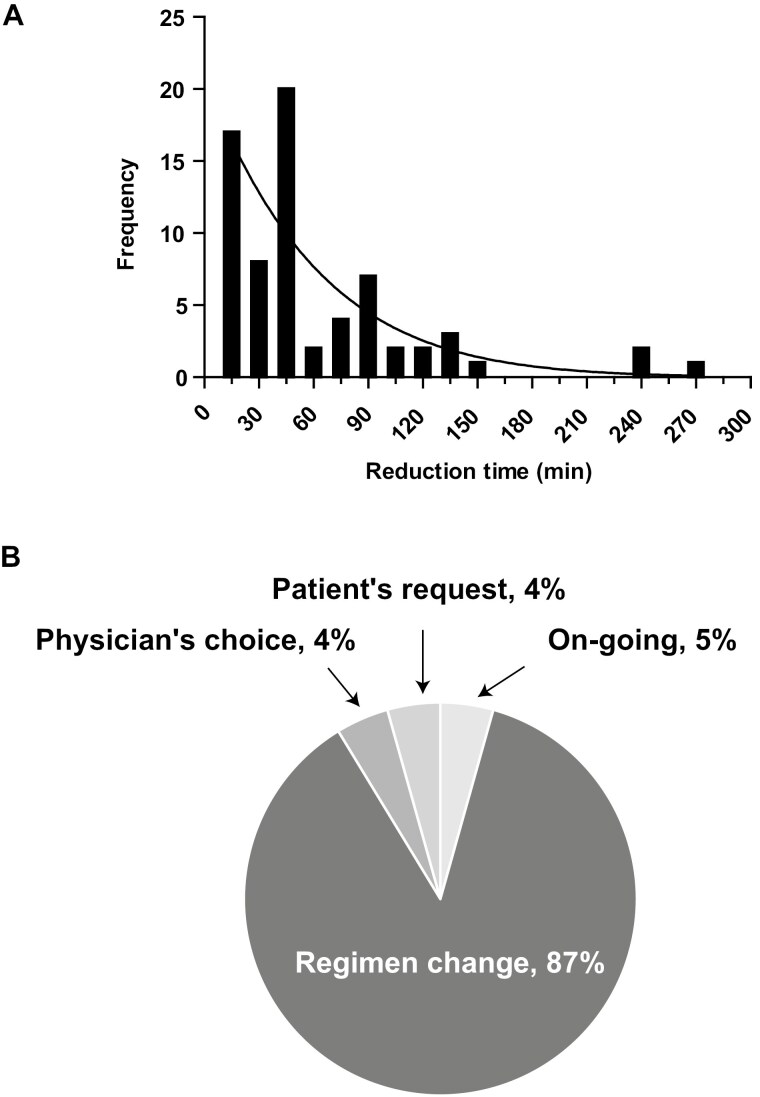 Figure 1
Peer Reviews
No public reviews on file for this paper yet. If you reviewed it on a platform where reviews are public (OpenReview, ICLR, NeurIPS, ICML), you can paste yours below so the community can read it here.
Videos
No videos yet. Explain this paper in a talk, walkthrough, or lecture? Add one.
Taxonomy
TopicsNausea and vomiting management · Anesthesia and Pain Management · Pathogenesis and Treatment of Hiccups