DEFinitely multitasking: Orchestration of petunia floral scent and petal formation
Linhan Sun

Abstract
Genes, proteins, chemicals, diseases, species, mutations and cell lines named across the full text — each resolved to its canonical identifier and authoritative record.
Click any figure to enlarge with its caption.
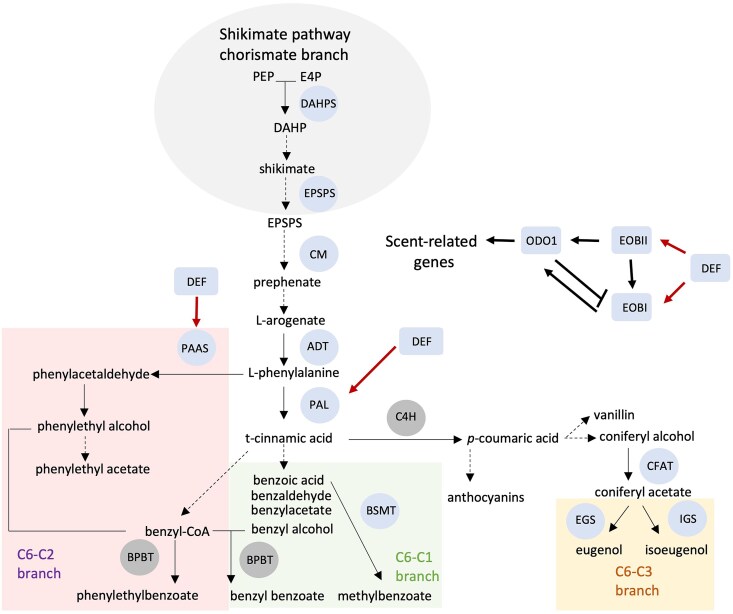 Figure 1
Peer Reviews
No public reviews on file for this paper yet. If you reviewed it on a platform where reviews are public (OpenReview, ICLR, NeurIPS, ICML), you can paste yours below so the community can read it here.
Videos
No videos yet. Explain this paper in a talk, walkthrough, or lecture? Add one.
Taxonomy
TopicsPlant and animal studies · Plant Reproductive Biology · Plant Physiology and Cultivation Studies
The garden petunia (Petunia hybrida) is prized for producing large, showy flowers of many different colors. Some cultivars, as well as wild Petunia species, also produce an array of volatile organic compounds that make them highly fragrant, a trait that may be underappreciated by humans but is highly favored by hawkmoths and other pollinators. Plant biologists have long been intrigued by the regulation of floral volatile production. Three key transcription factors involved in this process, ODORANT 1 (ODO1), EMISSION OF BENZENOIDS I (EOBI), and EOBII, have been widely studied (Spitzer-Rimon et al. 2012). However, little is known about what initiates the activation of these regulators when the flowers are mature enough for pollination.
In new work, Dominika Bednarczyk and colleagues (Bednarczyk et al. 2025) revealed a new regulator of scent production in mature flowers of Petunia hybrida, namely DEFICIENS (PhDEF). Surprisingly, PhDEF is a MADS-BOX homeotic gene known to determine petal identity in the textbook ABC model of flower development at early stages (Vandenbussche et al. 2004; Rijpkema et al. 2006). However, Bednarczyk et al. found that PhDEF expression can also be detected during later stages of flower development, reaching its peak transcript level 1 day post anthesis. More importantly, PhDEF exhibited significantly higher transcript levels in the evening compared with the daytime, concurrent with the higher scent emission of petunia flowers in the evening.
The authors used a reverse genetics approach to further examine whether PhDEF is involved in volatile production in petunia flowers. As a complete knockout of PhDEF resulted in flowers without petals (Rijpkema et al. 2006), the authors chose a virus-induced gene silencing approach to transiently knock down this gene in petunia flowers (Shor et al. 2023). In flowers with suppressed PhDEF expression, they observed significantly decreased levels of total volatiles emitted compared with the wild-type controls. Intriguingly, only volatiles derived from the phenylpropanoid pathway were affected by the transient suppression of PhDEF expression (Figure). In line with these findings, the transcript levels of major transcription factor genes regulating scent production, including ODO1, EOBI, and EOBII, showed a drastic reduction in PhDEF-suppressed petals (Figure). Knockdown of PhDEF also resulted in reduced transcript levels of genes encoding biosynthetic enzymes in the phenylpropanoid pathway (Figure) and proteins involved in scent emission. These results pointed to the role of PhDEF in regulating both biosynthesis of phenylpropanoid volatiles and volatile emission at the transcriptional level.
Furthermore, the authors used an agroinfiltration system to examine whether PhDEF can activate the promoters of genes encoding scent-regulating transcription factors and enzymes in the phenylpropanoid pathway. Indeed, in both infiltrated petals and leaves, expression of PhDEF resulted in upregulation of the transcriptional activity of the promoters examined (Figure). These results further support the role of PhDEF as a transcriptional regulator of volatile production in petunia flowers.
PhDEF belongs to the B-class MADS-BOX family, which also includes 2 GLOBOSA (GLO) genes, PhGLO1 and PhGLO2 (Vandenbussche et al. 2004). Expression patterns of PhGLO1 and PhGLO2 resembled that of PhDEF, but transient knockdown of either gene separately, or both genes together, did not affect volatile production in flowers or the expression levels of scent-regulating genes like ODO1 and EOBII. Therefore, although PhDEF works in concert with PhGLO1/2 in the establishment of flower organ identity at early stages (Vandenbussche et al. 2004; Rijpkema et al. 2006), the role of PhDEF in regulating scent production in mature flowers appears to be independent of PhGLO1/2.
In this elegant work, Bednarczyk et al. (2025) revealed an unexplored link between the classical ABC model of early floral organ identity establishment and later-stage scent production and emission in petunia. As the MADS-BOX homeotic genes are conserved across angiosperms (Rijpkema et al. 2006), it would be interesting to examine whether PhDEF homologs in other plant species are also involved in regulating pollinator-related phenotypes, especially in species with flower-producing volatile profiles distinct from that of petunia for attracting different pollinators.
The reference list from the paper itself. Each links out to its DOI / PubMed record.
- 1Bednarczyk D, Skaliter O, Kerzner S, Masci T, Shklarman E, Shor E, Vainstein A. Homeotic gene DEF, specifying petal identity, regulates volatile production in petunia flowers by activating scent-related transcription factors EOBI and EOBII. Plant Cell. 2025; 10.1093/plcell/koaf 027PMC 1185030439913239 · doi ↗ · pubmed ↗
- 2Rijpkema AS, Royaert S, Zethof J, van der Weerden G, Gerats T, Vandenbussche M. Analysis of the petunia TM 6 MADS Box gene reveals functional divergence within the DEF/AP 3 lineage. Plant Cell. 2006:18(8):1819–1832. 10.1105/tpc.106.04293716844905 PMC 1533978 · doi ↗ · pubmed ↗
- 3Shor E, Ravid J, Sharon E, Skaliter O, Masci T, Vainstein A. SCARECROW-like GRAS protein PES positively regulates petunia floral scent production. Plant Physiol. 2023:192(1):409–425. 10.1093/plphys/kiad 08136760164 PMC 10152688 · doi ↗ · pubmed ↗
- 4Spitzer-Rimon B, Farhi M, Albo B, Cna’ani A, Ben Zvi MM, Masci T, Edelbaum O, Yu Y, Shklarman E, Ovadis M, et al The R 2R 3-MYB–like regulatory factor EOBI, acting downstream of EOBII, regulates scent production by activating ODO 1 and structural scent-related genes in petunia. Plant Cell. 2012:24(12):5089–5105. 10.1105/tpc.112.10524723275577 PMC 3556977 · doi ↗ · pubmed ↗
- 5Vandenbussche M, Zethof J, Royaert S, Weterings K, Gerats T. The duplicated B-class heterodimer model: whorl-specific effects and complex genetic interactions in Petunia hybrida flower development. Plant Cell. 2004:16(3):741–754. 10.1105/tpc.01916614973163 PMC 385285 · doi ↗ · pubmed ↗