Persicariazhenaiguoi (Polygonaceae, Persicarieae), an overlooked new species from Dabie Mountains, central China

Abstract
Genes, proteins, chemicals, diseases, species, mutations and cell lines named across the full text — each resolved to its canonical identifier and authoritative record.
Click any figure to enlarge with its caption.
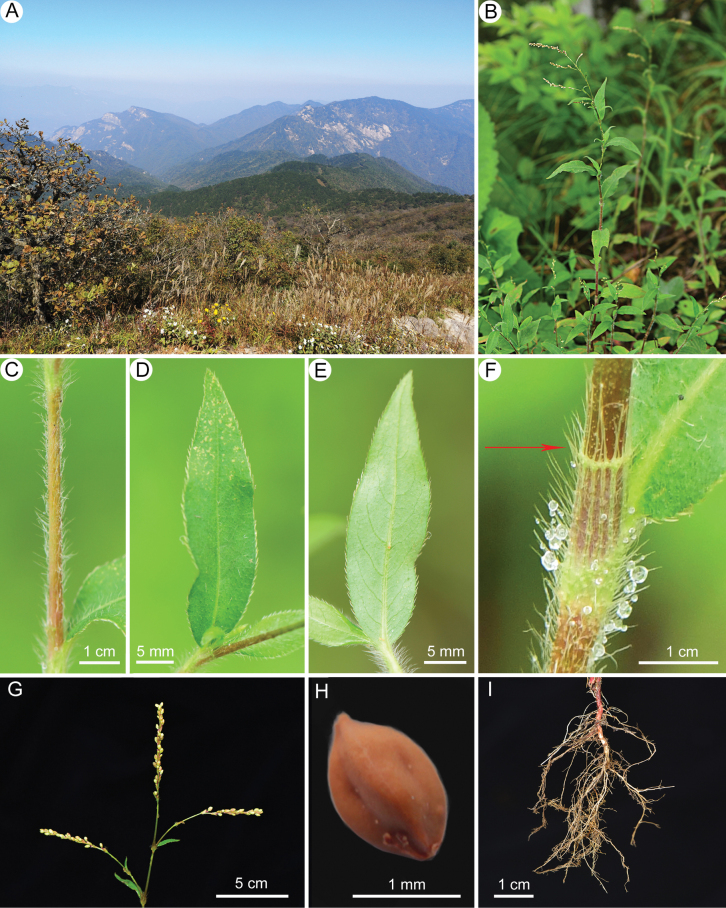 Figure 1
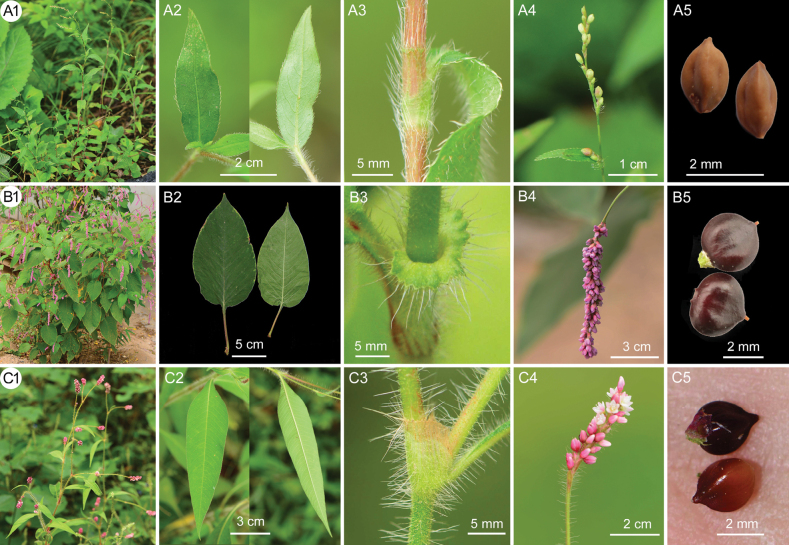 Figure 2
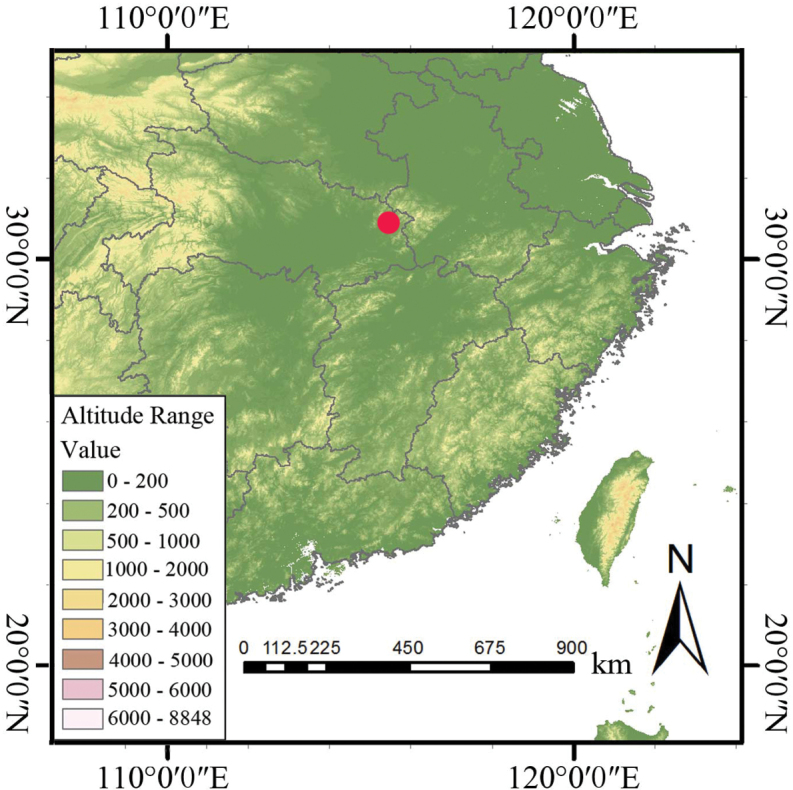 Figure 3
|
|
|
| |
|---|---|---|---|
| Plant height | 0.2–0.5 m | 0.8–2.2 m | 0.4–0.9 m |
| Stems | slender, erect, densely spreading villous | robust, erect, densely spreading villous | ascending to erect, densely spreading villous and glandular hairy, odoriferous |
| Petioles | connate with lower parts of ocrea, nearly absent | 1.7–11.5 cm | 3.3–1.2 cm, leaf base long decurrent along petioles |
| Leaf blades | lanceolate, 2.8–5.3 × 0.6–1.1 cm | broadly ovate, 10.5–22.8 × 5.1–12.3 cm | lanceolate, 4.4–7.8 × 1.2–2.1 cm |
| Ocreae | apex with a small circle of green leaf-like wing | apex usually with large green leaf-like wing | apex truncate |
| Inflorescences | erect, slender, interrupted below | pendulous, densely flowered | erect, densely flowered |
| Peduncles | glabrous | densely hirsute | densely spreading villous and glandular hairy |
| Perianth | greenish | pink or white | pinkish |
| Achenes | long ovoid, trigonous, surfaces grooved | nearly orbicular, biconcave, surfaces grooved | broadly ovoid, trigonous, surfaces flat |
- —National Natural Science Foundation of China 501100001809 https://ror.org/01h0zpd94 http://doi.org/10.13039/501100001809
Peer Reviews
No public reviews on file for this paper yet. If you reviewed it on a platform where reviews are public (OpenReview, ICLR, NeurIPS, ICML), you can paste yours below so the community can read it here.
Videos
No videos yet. Explain this paper in a talk, walkthrough, or lecture? Add one.
Taxonomy
TopicsPlant and Fungal Species Descriptions · Phytochemistry and Biological Activities · Plant Diversity and Evolution
Introduction
Persicaria Mill. is one of the largest genera in the buckwheat family (Polygonaceae) and belongs to the tribe Persicarieae, which also includes Bistorta Mill. and Koenigia L. (Galasso et al. 2009; Sanchez et al. 2011; Schuster et al. 2015). The genus includes approximately 100 species, primarily annual or perennial herbaceous plants, and is widely distributed around the world (Brandbyge 1993; Freeman 2005; Galasso et al. 2009). Within the genus, six sections have been proposed: sect. Persicaria, sect. Amphibia Tzvelev, sect. Cephalophilon (Meisn.) H.Gross, sect. Echinocaulon (Meisn.) H.Gross, and sect. Tovara (Adans.) H.Gross, and sect. Truelloides Tzvelev (Galasso et al. 2009). However, the sole species of sect. Truelloides Tzvelev, P.bungeana (Turcz.) Nakai ex Mori, has been tested to be a member of the sect. Persicaria in previous molecular phylogenetic analyses (Min et al. 2013; Zhai 2021) and the monophyly of the other five sections were always supported in molecular phylogenetic analyses (Kim and Donoghue 2008; Schuster et al. 2015; Cao et al. 2022, 2023).
Among these sections, species of sect. Persicaria can be distinguished from other Persicaria taxa by having a combination of characteristic features, including: usually glabrous stems without prickles, lanceolate simple leaves, tubular ocreae typically with truncate and ciliate apex, spicate inflorescences with few to many flowers, styles that are not deflexed and have a hooked apex, and Persicaria-type pollen grains with 20 circular pores and a reticulum (Hedberg 1946; Haraldson 1978; Brandbyge 1993; Li 1998; Li et al. 2003; Kim and Donoghue 2008). In China, 23 species were originally recorded in Polygonumsect.Persicaria (Mill.) Meisn. (≡ Persicariasect.Persicaria) (Li 1998; Li et al. 2003). However, following the exclusion of P.amphibia (L.) Gray (which belongs to sect. Amphibia), the inclusion of P.bungeana (which should be transferred from sect. Truelloides), and the addition of two recently described species, i.e., P.wugongshanensis Bo Li (Li 2014) and P.lankeshanensis T.J.Liang & Bo Li (Liang and Li 2014), there are now 25 species of sect. Persicaria recognized in China.
During field surveys in the Dabie Mountains of central China from 2022 to 2023, we encountered several populations of an unknown Persicaria plant at the summit of Tiantangzhai Peak (Fig. 1A) in Yingshan County of Hubei Province, which is morphologically remarkable in having dense spreading hairs throughout and a small ring of green, leaf-like wing at the apex of the ocrea (Fig. 1B–E). Based on its lanceolate leaves with broadly cuneate to rounded bases, spicate inflorescences, ciliate ocreae, and the absence of prickles, we confirmed that it is a member of the sect. Persicaria. After thorough morphological comparisons with congeneric taxa, a review of relevant literature, and examination of herbarium specimens, we found that the plant is most similar to P.orientalis (L.) Spach and P.viscosa (Buch.-Ham. ex D.Don) H.Gross ex Nakai but different in many aspects (Fig. 2). Thus, we have concluded that this plant represents a new, previously undescribed species of Persicaria, namely P.zhenaiguoi Bo Li, which is formally reported here.
Habitat and morphology of Persicariazhenaiguoi Bo Li, sp. nov. A habitat B habit C stem D adaxial view of leaf blade E abaxial view of leaf blade F ocrea (the red arrow shows the green leaf-like wing) G inflorescence H achene I roots (photographed by Dr. Xin-Xin Zhu).
Morphological comparisons among P.zhenaiguoi (A1–A5), P.orientalis (B1–B5), and P.viscosa (C1–C5) A1, B1, C1 habit A2, B2, C2 leaves A3, B3, C3 ocrea A4, B4, C4 inflorescences A5, B5, C5 achenes.
Materials and methods
Field surveys were carried out in the Dabie Mountains, located at the border between Hubei and Anhui provinces, central China, from June to September in 2022 and 2023, respectively. Morphological observations and descriptions of the putative new species were based on living plants in Yingshan County and herbarium specimens collected from the type locality. Its morphological variation was measured using a ruler and a micrometer. High-resolution images of type materials for all Persicaria taxa, including their synonyms, were consulted via JSTOR Plant Science (http://plants.jstor.org), and digital images of all Persicaria species recorded in China were examined through the Chinese Virtual Herbarium (https://www.cvh.ac.cn/). Morphological comparisons with P.orientalis and P.viscosa were critically evaluated using specimens deposited in CSH, GZTM, HBNU, HENU, HIB, IBK, IBSC, IMC, JJF, JMSM, JXCM, KUN, PE, QFNU, and SZ [acronyms according to (Thiers 2020)], as well as living plants that we have observed.
Taxonomic treatment
Persicaria
zhenaiguoi
Taxon classificationPlantaeCaryophyllalesPolygonaceae
Bo Li sp. nov.
4735CE23-4EAD-546A-B938-C135E09CFAC3
urn:lsid:ipni.org:names:77357225-1
Diagnosis.
Morphologically, P.zhenaiguoi is superficially most similar to P.orientalis and P.viscosa in the indumentum characteristic, but can be clearly distinguished from the latter two taxa by its nearly sessile leaves, which are lanceolate in shape with broadly cuneate to rounded bases, membranous ocrea with a small circle of green leaf-like wing, sparse and interrupted inflorescences, glabrous peduncles, greenish tepals, and ovoid achenes with grooved surfaces (Fig. 2, Table 1).
Type.
China • Hubei Province, Huanggang City, Yingshan County, Tiantangzhai Town, Dabie Mountains, in the grassland at the summit of Tiantangzhai Peak, 31°06'21.44"N, 115°46'22.60"E, alt. 1712 m, 10 July 2023, X.X. Zhu et al. ZXX23818 (holotype: HITBC0122106, isotype: IBSC0923376).
Description.
Herbs annual. Stems erect, slender, angulate, 20–50 cm tall, densely spreading villous. Petiole connate with lower parts of ocrea, nearly absent; Leaf blade lanceolate, 2.8–5.3 × 0.6–1.1 cm wide, apex acuminate, base broadly cuneate to rounded, margin densely ciliate, both surfaces densely villous, midvein slightly hollow on the adaxial surface and rise on the abaxial surface, lateral veins 8–10 pairs. Ocrea tubular, membranous, 0.6–1.1 mm long, densely villous, margin truncate with long ciliate and a small circle of green leaf-like wing. Inflorescence terminal or axillary, spicate, 2.8–5.1 cm long, slender, interrupted below, usually several spikes aggregated and panicle-like; peduncle glabrous. Bracts green, funnel-shaped, 2.8–4.6 mm long, sparsely villous, margin long ciliate, each 2–4 flowered. Pedicels slightly longer than bracts. Perianth greenish, 5-parted; tepals elliptic, 2.3–3.4 mm. Stamens 8, included. Styles 3, connate to below middle; stigma capitate. Achenes included in persistent perianth, 1.6–2.1 × 0.8–1.2 mm, brown, shiny, long ovoid, trigonous, surfaces grooved.
Phenology.
Flowering and fruiting was observed synchronously from July to October.
Etymology.
The specific epithet “zhenaiguoi” is dedicated to Professor Ai-Guo Zhen, in recognition of his significant contributions to the study of the local flora and biodiversity in Yingshan County.
Vernacular name.
The Chinese name of the new species is “甄氏蓼”, and the pronunciation of the Chinese Pinyin is zhēn shì liǎo.
Distribution and habitat.
Persicariazhenaiguoi can be found above an altitude of 1.600 m, in the moist grassland at the summit of Tiantangzhai Peak, one of the main peaks of the Dabie Mountains, which are located on the border between Hubei and Anhui provinces (Fig. 3). This plant is typically found growing alongside species of Dryopteris Adanson and Carex L.
Distribution of P.zhenaiguoi (marked by the red circle).
Preliminary conservation status.
As currently known, this species has only been discovered from its type locality in the Tiantangzhai Peak of the Dabie Mountains, where it is distributed in a small area within the mountaintop region. Moreover, its habitat is increasingly threatened by the growing development of local tourism (author’s personal observation). Therefore, it should be categorised as critically endangered under criteria B and D following IUCN Red List Categories (IUCN 2012).
Taxonomic notes.
Morphologically, the ocrea of all species within P.sect.Persicaria is tubular and membranous, with a truncate, mostly ciliate apex (Meisner 1856; Gross 1913; Steward 1930; Haraldson 1978; Tutin et al. 1991; Li et al. 2003; Freeman 2005). Before this, P.orientalis was the only species in this section known to typically have a circle of green, leaf-like wing at the apex of the ocrea (Fig. 2B3). P.zhenaiguoi is the second species to exhibit a similar structure, caused by the enlargement of the longitudinal veins at the apex of the ocrea (Fig. 2A3), although not as prominent as observed in P.orientalis. They also share the similar indumentum that are long spreading white hairs densely covering on stems, leaves as well as ocreae, but are clearly different from each other in plant size (Fig. 2A1, B1), leaf shape and size (Fig. 2A2, B2), inflorescence structure (Fig. 2A4, B4), as well as the fruit shape (Fig. 2A5, B5). Persicariaviscosa is another species having the same indumentum and much more similar to P.zhenaiguoi in gross morphology, but it differs from the latter in several aspects: its leaf bases are long decurrent along petioles (Fig. 2C2), the peduncles cover dense hirsute and glandular hairs (Fig. 2C1, C4), and the inflorescences are dense and pinkish (Fig. 2C4). Detailed morphological comparisons among these three taxa are listed in the Table 1.
It is worthy to mention that the habitat and distribution of P.zhenaiguoi are somewhat unusual, at least when comparing with other species in sect. Persicaria found in central and southern China. Based on our years of observation, species from sect. Cephalophilon and sect. Echinocaulon, such as P.nepalensis (Meisn.) H.Gross, P.runcinatavar.sinensis (Hemsl.) Bo Li, and P.thunbergii (Siebold & Zucc.) H.Gross, are easily found in habitats like the summit of Tiantangzhai Peak (Fig. 1A). However, species from sect. Persicaria are rarely occurring at such high altitudes. At the same time, there has been a lack of comprehensive and in-depth surveys of the plant flora in the Dabie Mountains, especially in the mountaintop areas. This may explain why P.zhenaiguoi has likely been overlooked and not collected in the Dabie Mountains until now.
Additional specimens examined.
Persicariaorientalis: China • Anhui Province, Shucheng County, Xiaotian Town, 1 October 1951, East China Workstation 4162 (PE00497378!); • Chongqing Municipality, Nanchuan County, Sanquan Village, alt. 640 m, 14 October 1985, Z.Y. Liu 7429 (IMC0038461!); • Guangdong Province, Yangjiang City, Jiangcheng District, Hailing Town, 21°37'36.42"N, 111°58'8.87"E, alt. 27 m, 6 April 2021, G.W. Tang et al. TangGW1343 (KUN1556765!); • Guizhou Province, Congjiang County, Doli Town, Panli Village, 25°35'14.35"N, 108°59'11.11"E, alt. 672 m, 21 September 2019, K.T. Liu 522633190921914LY (GZTM0096269!); • Hainan Province, Haikou City, Longhua District, Xue Village, 19°57'39.19"N, 110°20'57.89"E, alt. 15 m, 2 May 2018, Y.T. Hou et al. 20180426580-1 (QFNU0048156!); • Hebei Province, Longhua County, Bugugou Town, alt. 993 m, 20 August 2013, Group Six Z0272 (HBNU20001289!); • Heilongjiang Province, Qiqihar City, Longjiang County, 47°19'23"N, 123°11'41"E, alt. 131 m, 25 August 2019, L.Y. Lin 2019082501 (JMSMC0000049!); • Henan Province, Xinxiang City, Huilong Village, 35°35'02"N, 113°35'57"E, alt. 369 m, 12 July 2018, J.R. Li 368 (HENU1900368!); • Hunan Province, Nanyue District, Hengshan Nature Reserve, alt. 300 m, 1 September 2002, Z.H. Hu 533 (PE00497445!); • Jiangsu Province, Suqian City, Siyang County, Longji Town, 33°20'40.36"N, 118°38'19.97"E, alt. 18 m, 3 August 2019, Y.T. Hou et al. 20190803230-1 (QFNU0052420!); • Jiangxi Province, Fengchen City, Xiushi Town, grassland, 27°51'38.81"N, 115°53'15.04"E, alt. 423 m, 3 October 2019, L. Cao 360981191003305LY (JXCM0010118!); • Shandong Province, Zouping City, Xiyu Village, 36°47'17"N, 117°40'49"E, alt. 342 m, 4 August 2018, J.L. Lan 201808037-1 (QFNU0047293!); • Shanxi Province, Wanrong County, Jiachun Town, 32°21'0"N, 110°37'0"E, alt. 566 m, 28 July 2020, Y.J. Feng 201941325966 (QFNU0059553!); • Zhejiang Province, Jinyun County, Huzhen Town, Xiaxiang Village, 28°47'23"N, 120°12'58"E, alt. 194 m, 2 July 2013, H.Y. Shou & Z.H. Wang SHY00909 (CSH0012891!).
Persicariaviscosa: China • Chongqing Municipality, Zhong County, Baishi Town, Huangjia Village, 30°20'17.78"N, 107°56'28.29"E, alt. 624 m, 30 May 2013, Zhong County Team 500233-130530-519-03 (IMC0045792!); • Guangxi Province, Liuzhou City, Liujiang County, Jinde Town, Siliang Village, 24°15'44.59"N, 109°20'25.69"E, alt. 114 m, 14 August 2018, Liujiang Team 450221180814022LY (IBK00425346!); • Heilongjiang Province, Jiamusi City, Huachuan County, Shenjiadian Village, 46°34'39.68"N, 130°37'48.81"E, alt. 189 m, 8 September 2018, C. Wang & Y.G. Peng WangCh532 (KUN1554918!); • Henan Province, Xinyang City, Shihe District, 32°6'52.15"N, 114°0'33.63"E, alt. 87 m, 8 June 2020, X.X. Zhu et al. ZXX20942 (HIB0187735!); • Hubei Province, Hongan County, Xinhua Town, Zhangshan Village, alt. 80 m, 14 June 2019, C.M. Tan et al. 19061418 (JJF00044259!); • Hunan Province, Shaoyang City, Dongkou County, alt. 350 m, 12 August 2004, L.D. Duan 5337 (PE00640285!); • Jiangxi Province, Jiujiang County, alt. 250 m, 17 September 2005, A.M. Dong 930 (SZG00002585!); • Jilin Province, Baishan City, Badaojiang District, 41°34'12.01"N, 126°34'33.24"E, alt. 311 m, 22 August 2019, C.Q. Cao CaoChQ495 (KUN1487264!); • Yunnan Province, Baoshan City, Tengchong County, Qushi Town, 25°23'58"N, 98°50'54"E, 1820 m, 3 October 2009, Y.F. Chen et al. 09209-3 (QFNU0056773!); • Shandong Province, Yantai City, Rizhao Village, 36°48'5"N, 121°18'55"E, alt. 18 m, 28 September 2015, X.W. Xin Lilan859 (KUN1438272!).
Supplementary Material
XML Treatment for Persicaria zhenaiguoi
The reference list from the paper itself. Each links out to its DOI / PubMed record.
- 1Brandbyge J (1993) Polygonaceae. In: Kubitzki K Bittich V (Eds) The Families and Genera of Vascular Plants.Springer Verlag, Berlin, 531–544. 10.1007/978-3-662-02899-5_63 · doi ↗
- 2Cao DL Zhang XJ Qu XJ Fan SJ (2022) Plastid phylogenomics sheds light on divergence time and ecological adaptations of the tribe Persicarieae (Polygonaceae). Frontiers in Plant Science 13: 1046253. 10.3389/fpls.2022.1046253 PMC 978003036570890 · doi ↗ · pubmed ↗
- 3Cao DL Zhang XJ Qu XJ Fan SJ (2023) Phylogenomics, divergence time estimation, and adaptive evolution in the Polygonoideae (Polygonaceae).Journal of Systematics and Evolution 61(6): 1004–1019. 10.1111/jse.12946 · doi ↗
- 4Freeman CC (2005) Polygonaceae. In: Flora of North America Editorial Committee (Eds) Flora of North America.Oxford University Press, New York, 574–594.
- 5Galasso G Banfi E Mattia FD Grassi F Sgorbati S Labra M (2009) Molecular phylogeny of Polygonum L. s.l. (Polygonoideae, Polygonaceae), focusing on European taxa: Preliminary results and systematic considerations based on rbc L plastidial sequence data.Atti della Società Italiana di Scienze Naturali e del Museo Civico di Storia Naturale di Milano 150(1): 113–148.
- 6Gross H (1913) Beiträge zur Kenntnis der Polygonaceae.Botanische Jahrbücher für Systematik, Pflanzengeschichte und Pflanzengeographie 49: 234–339.
- 7Haraldson K (1978) Anatomy and taxonomy in Polygonaceae subfam. Polygonoideae Meissn. [sic.] emend. Jaretzky.Symbolae Botanicae Upsalienses 22: 1–95.
- 8Hedberg O (1946) Pollen morphology in the genus Polygonum L. s.l. and its taxonomic significance.Svensk Botanisk Tidskrift 40: 371–404.