Patient and caregiver involvement in implementing health research in chronic kidney disease: a workshop report
Dale Coghlan, Allison Jaure, Anastasia Hughes, Rebecca Wu, Andrea K Viecelli, Noa Amir, Hayley Candler, Brydee Cashmore, Yeoungjee Cho, Jonathan C Craig, Rosanna Cazzolli, Chandana Guha, Carmel M Hawley, Amandi Hiyare-Hewage, Martin Howell, Shilpanjali Jesudason, David W Johnson

Abstract
Genes, proteins, chemicals, diseases, species, mutations and cell lines named across the full text — each resolved to its canonical identifier and authoritative record.
Click any figure to enlarge with its caption.
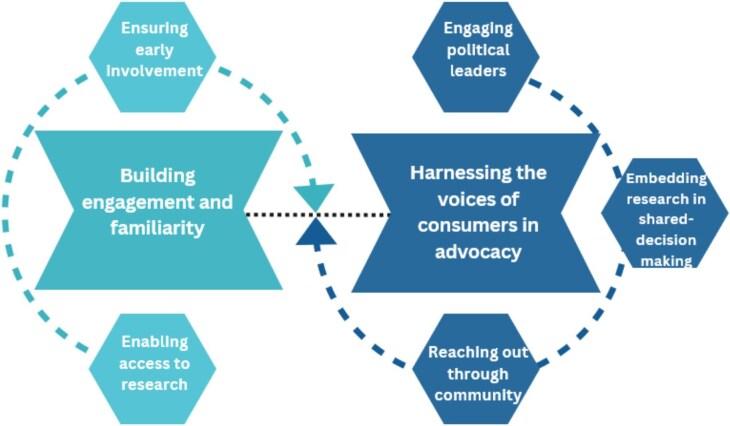 Figure 1
| First name | Last name | Primary Affiliation | City | State |
| Adela | Yip | The University of Sydney | Sydney | NSW |
| Alice | Kennard | Canberra Health Services | Canberra | ACT |
| Allan | Blackley | Consumer—patient | Invercargill, New Zealand | |
| Allison | Jaure | The University of Sydney | Sydney | NSW |
| Amanda | Dominello | Consumer—The University of Sydney | Sydney | NSW |
| Amanda | Sluiter | Consumer—The University of Sydney | Sydney | NSW |
| Amandi | Hiyare | Flinders University | Adelaide | SA |
| Amber | Williamson | Consumer—patient | Brisbane | QLD |
| Amy | Luchterhand | Consumer—caregiver | Brisbane | QLD |
| Anastasia | Hughes | The University of Sydney | Sydney | NSW |
| Andrea | Viecelli | The University of Queensland | Brisbane | QLD |
| Andrew | Currey | Consumer—patient | Blue Mountains | NSW |
| Angela | Rejuso | The University of Sydney | Sydney | NSW |
| Anh | Kieu | The University of Sydney | Sydney | NSW |
| Anh Tho | Tien | Consumer—patient | Brisbane | QLD |
| Anita | van Zwieten | The University of Sydney | Sydney | NSW |
| Annie | Conway | Australian and New Zealand Dialysis and Transplant Registry | Adelaide | SA |
| Armando | Teixeira-Pinto | The University of Sydney | Sydney | NSW |
| Bill | HP | Adelaide | SA | |
| Breonny | Robson | Kidney Health Australia | Adelaide | SA |
| Brydee | Johnson | The University of Sydney | Sydney | NSW |
| Carmel | Hawley | The University of Queensland | Brisbane | QLD |
| Chandana | Guha | Consumer—caregiver—The University of Sydney | Sydney | NSW |
| Clarissa | Hompas | Australian and New Zealand Dialysis and Transplant Registry | Adelaide | SA |
| Dale | Coghlan | Flinders University | Adelaide | SA |
| Darling | Rojas-Canales | Flinders University | Adelaide | SA |
| David J. | Tunnicliffe | The University of Sydney | Sydney | NSW |
| Dominic | Keuskamp | Australian and New Zealand Dialysis and Transplant Registry | Adelaide | SA |
| Effie | Johns | Consumer—patient | Adelaide | SA |
| Erandi | Hewawasam | Australian and New Zealand Dialysis and Transplant Registry | Adelaide | SA |
| Felicity | Lord | Consumer—patient | Adelaide | SA |
| Fiona | Carlisle | Consumer—patient | NSW | |
| Fleur | Tuthill | SA Health | Adelaide | SA |
| Germaine | Wong | The University of Sydney | Sydney | NSW |
| Gorjana | Radisic | Royal Adelaide Hospital | Adelaide | SA |
| Hayley | Candler | The University of Queensland | Brisbane | QLD |
| Heather | Shepherd | The University of Sydney | Sydney | NSW |
| Helen | Coolican | Consumer—PKD Foundation Australia | Sydney | NSW |
| Henry | Pleass | The University of Sydney | Sydney | NSW |
| Ieyesha | Roberts | Consumer—patient—The University of Sydney | Kempsey | NSW |
| Irene | Mewburn | Consumer—patient | Brisbane | QLD |
| Isabelle | Haklar | South Australian Health and Medical Research Institute | Adelaide | SA |
| Janelle | Colquhoun | Consumer—patient | QLD | |
| Janet | Kelly | University of Adelaide | Adelaide | SA |
| Jasmin | Mazis | Australian and New Zealand Dialysis and Transplant Registry | Adelaide | SA |
| Javier | Recabarren | The University of Sydney | Sydney | NSW |
| Jill | Brown | Consumer—patient | Sydney | NSW |
| Joy | Roberts | Consumer—patient | Adelaide | SA |
| Karine | Manera | The University of Sydney | Sydney | NSW |
| Kathy | Strudwick | Consumer—patient | Adelaide | SA |
| Kim | Nguyen | HP | SA | |
| Luca | Torrisi | Consumer—patient | Sydney | NSW |
| Madeleine | Parker | Consumer—patient | Sydney | NSW |
| Madeleine | Rapisardi | Consumer—patient | Sydney | NSW |
| Martin | Howell | The University of Sydney | Sydney | NSW |
| Michael | Collins | Royal Adelaide Hospital | Adelaide | SA |
| Natalie | Brown | Consumer—patient | New Zealand | |
| Nicky | Boulter | The University of Sydney | Sydney | NSW |
| Nicole | Scholes-Robertson | Consumer—The University of Sydney | Alice Springs | NT |
| Noa | Amir | The University of Sydney | Sydney | NSW |
| Pushparaj | Velayudham | The University of Queensland | Brisbane | QLD |
| Rachel | Li | The Royal Flying Doctor | Adelaide | SA |
| Richard | Le Leu | Central and Northern Adelaide Renal and Transplantation Services | Adelaide | SA |
| Rick | Rapana | Consumer—patient | New Zealand | |
| Robert | Dale | Consumer—patient | Adelaide | SA |
| Rosanna | Cazzolli | The University of Sydney | Sydney | NSW |
| Sadia | Jahn | University Health Network | Adelaide | SA |
| Sally | Spence | Consumer—patient | New Zealand | |
| Seethalakshmi | Viswanathan | ICPMR Westmead/University of Sydney | Sydney | NSW |
| Shyamsundar | Muthuramalingam | Consumer—patient | Adelaide | SA |
| Yeoungjee | Cho | The University of Queensland | Brisbane | QLD |
| Verlencia | En ying chu | OSCAR Care Group | Adelaide | SA |
| Victoria | Sinka | The University of Sydney | Sydney | NSW |
| Vishal | Diwan | The University of Queensland | Brisbane | QLD |
| Wendy | Hoy | Metro North Health | Brisbane | QLD |
- —National Health and Medical Research Council10.13039/501100000925
- —NHMRC Investigator Award
- —NHMRC Investigator Grant
- —NHMRC Postgraduate Scholarship
Peer Reviews
No public reviews on file for this paper yet. If you reviewed it on a platform where reviews are public (OpenReview, ICLR, NeurIPS, ICML), you can paste yours below so the community can read it here.
Videos
No videos yet. Explain this paper in a talk, walkthrough, or lecture? Add one.
Taxonomy
TopicsMental Health and Patient Involvement · Health Policy Implementation Science · Primary Care and Health Outcomes
To the Editor,
Patient and caregiver (consumer) involvement in research can strengthen the relevance and uptake of evidence [1, 2]. However, there is little guidance on how to involve consumers in the implementation of research in practice and policy [3, 4]. Existing frameworks suggest that consumers can contribute to implementation of research by providing input on the design and delivery of interventions to ensure acceptability in practice [1]. Consumers can also contribute to strategies for implementing research, for example by identifying potential barriers and facilitators to adopting new treatments or providing feedback on implementing interventions through surveys or interviews [3, 5—7]. In the context of chronic kidney disease (CKD), there is little documented on consumer involvement in the implementation of research. The aim of this workshop was to identify ways to involve patients and caregivers in the implementation of research in CKD.
We convened a workshop involving patients with CKD and their caregivers (n = 27), and health professionals (n = 54) with simultaneous workshops in Adelaide, Brisbane, Sydney (in person), and online. Across 10 facilitated breakout groups using set questions, participants discussed approaches to involve consumers in the implementation of research. Further details are available in the Supplementary File.
We identified two themes that reflected strategies for patient and caregiver involvement in the implementation of research in CKD: building engagement and familiarity, and harnessing the voices of consumers in advocacy. The themes and subthemes are described in the following sections, and illustrative quotations are provided in Supplementary Item S1. Fig. 1 depicts the relationship among the themes.
ENSURING EARLY INVOLVEMENT
Participants emphasized that the involvement of consumers at the earliest stages of the research (e.g. setting research priorities and developing the research questions) would empower consumers with a ‘greater voice’ to meaningfully contribute to the research output and direction. Consumers stated that a ‘true partnership’ formed ‘from the very get-go’ of the study would motivate them to help implement research, as such studies are more likely to be relevant and meaningful to them. This approach fosters trust and reciprocity with researchers and the product of their work, ensuring research implementation aligns with consumer priorities.
ENABLING ACCESS TO RESEARCH
Consumers needed convenient access to research to support its implementation. Consumers often conveyed that they were unaware of what research was being undertaken and without their meaningful involvement they could not implement the findings into practice, for example, in their own health decision making.
EMBEDDING RESEARCH IN SHARED DECISION MAKING
Consumers suggested that they could have a direct role in implementing research in their own individual health decision making, or more broadly, in translating research evidence into decision-making tools. Consumers wanted to ‘actively participate’ and be ‘confident to voice’ their treatment preferences based on research findings, highlighting the need for research outputs to be ‘consumer friendly’ (i.e. plain language, ease of access) so they could understand the evidence to advocate for their needs in clinical care.
REACHING OUT THROUGH COMMUNITY
Consumers emphasized the value of ‘peer sharing’ and ‘leveraging community networks’ to amplify advocacy efforts to support the implementation of research in CKD. They emphasized that receiving information from other patients who had been involved in research experience was valuable, as they could gain practical insights and advice to help understand research and to work together to develop a plan of action to drive research implementation. They felt that there was power in their collective voice, ultimately strengthening advocacy efforts for the implementation of research that they believed was valuable and important.
ENGAGING POLITICAL LEADERS
Advocating at the political level through collective lobbying was emphasized as a way to implement research findings in practice and policy decisions. Consumers suggested that they could engage local politicians by ‘writing letters’ and ‘making appointments’, and advocate for implementing research findings that could improve patient-centred care and effectively change policy.
The two key strategies highlighted by consumers in this workshop included engaging consumers early in the research process to motivate and build confidence to be involved in implementing the findings, and involving consumers in advocacy efforts. Consumers expressed they are often unaware of research opportunities available, and their potential role and power to influence research implementation. Consumers felt they could be involved in the direct implementation of research in the context of their personal shared decision making in clinical care and influencing clinical care more broadly.
Frameworks for the implementation of research [5, 6, 8] similarly suggest that consumers should be involved in the initial stage of a research study to maximize implementation [7, 9]. The Medical Research Council framework also provides valuable guidance on integrating consumer input throughout the research process, including as early as formulating the research question.^S1^ Early and meaningful involvement of consumers not only clarifies objectives and ensures research relevance but also plays a critical role in identifying potential barriers to implementation through supporting designs of interventions and programmes likely to have greater acceptability and feasibility. Adopting this strategy can clarify objectives, ensure the research is meaningful and relevant to consumers, and foster their motivation and inclusion in the execution of implementation strategies.
There is a small amount of evidence on patient and caregiver involvement in the implementation of research in CKD. For example, patients with CKD were involved in an eHealth service intervention for self-management to help ensure that the online tools and resources addressed their needs, leading to greater engagement, higher satisfaction, and more successful self-management outcomes.^S2^ In another study, patients with CKD were involved in the development and implementation of individualized care plans, which enhanced their motivation to actively participate in the treatment.^S3^ Ongoing feedback mechanisms were established during the implementation of their care plans, which ensured the continuous integration of their preferences and challenges in the plan, and ultimately fostered a greater sense of ownership and active adoption of their treatment plans.^S4^
Our workshop highlights that consumers desire to actively support the implementation of research. In the context of shared decision making, consumers may be able to implement research findings directly in their own care or contribute to the development of decision-making tools based on the evidence.
Moreover, consumers can individually or collectively advocate for the implementation of research findings by engaging policymakers, healthcare providers, and other key stakeholders to ensure that research is translated into practice. Consumer representatives lobbying for government support could influence and change policy and political agendas, demonstrating the power of advocacy in translating research into actionable outcomes.^S4^ Advocacy organizations, local community groups, and peer navigators possess trusted voices and relationships. They can serve as conduits and provide input to ensure research is translated into practice, such as in the development of patient tools and outreach programmes.^S5^
Further efforts are needed to involve consumers in the implementation of research in CKD. By building early engagement and familiarity, and harnessing consumers’ voices in advocacy, research can be more effectively translated into practice and policy, ultimately improving patient outcomes and healthcare.
**: **
Supplementary Material
sfaf021_Supplemental_File
The reference list from the paper itself. Each links out to its DOI / PubMed record.
- 1Gray-Burrows KA, Willis TA, Foy R et al. Role of patient and public involvement in implementation research: a consensus study. BMJ Qual Saf 2018;27:858–64. 10.1136/bmjqs-2017-006954 PMC 616659329666310 · doi ↗ · pubmed ↗
- 2Gutman T, Kelly A, Scholes-Robertson N et al. Patient and caregiver experiences and attitudes about their involvement in research in chronic kidney disease. Clin J Am Soc Nephrol 2022;17:215–27. 10.2215/cjn.0596052135131928 PMC 8823931 · doi ↗ · pubmed ↗
- 3Kerkhoff AD, Farrand E, Marquez C et al. Addressing health disparities through implementation science—a need to integrate an equity lens from the outset. Implementation Sci 2022;17:13. 10.1186/s 13012-022-01189-5PMC 880246035101088 · doi ↗ · pubmed ↗
- 4Proctor E, Silmere H, Raghavan R et al. Outcomes for implementation research: conceptual distinctions, measurement challenges, and research agenda. Adm Policy Ment Health 2011;38:65–76. 10.1007/s 10488-010-0319-720957426 PMC 3068522 · doi ↗ · pubmed ↗
- 5Damschroder LJ, Reardon CM, Widerquist MAO et al. The updated Consolidated Framework for Implementation Research based on user feedback. Implementation Sci 2022;17:75. 10.1186/s 13012-022-01245-0PMC 961723436309746 · doi ↗ · pubmed ↗
- 6Glasgow RE, Harden SM, Gaglio B et al. RE-AIM planning and evaluation framework: adapting to new science and practice with a 20-year review. Mini review. Front Public Health 2019;7. 10.3389/fpubh.2019.00064.PMC 645006730984733 · doi ↗ · pubmed ↗
- 7King DK, Shoup JA, Raebel MA et al. Planning for implementation success using RE-AIM and cfir frameworks: a qualitative study. Original research. Front Public Health 2020;8. 10.3389/fpubh.2020.00059 PMC 706302932195217 · doi ↗ · pubmed ↗
- 8Feldstein AC, Glasgow RE. A practical, robust implementation and sustainability model (PRISM) for integrating research findings into practice. The Jt Comm J Qual Patient Saf 2008;34:228–43. 10.1016/S 1553-7250(08)34030-618468362 · doi ↗ · pubmed ↗