Tsukamurella tyrosinosolvens (tsū-kə-mə-rel′lə tī′-rǝ-sē-nō-sol′vins)
Clyde Partin

Abstract
Click any figure to enlarge with its caption.
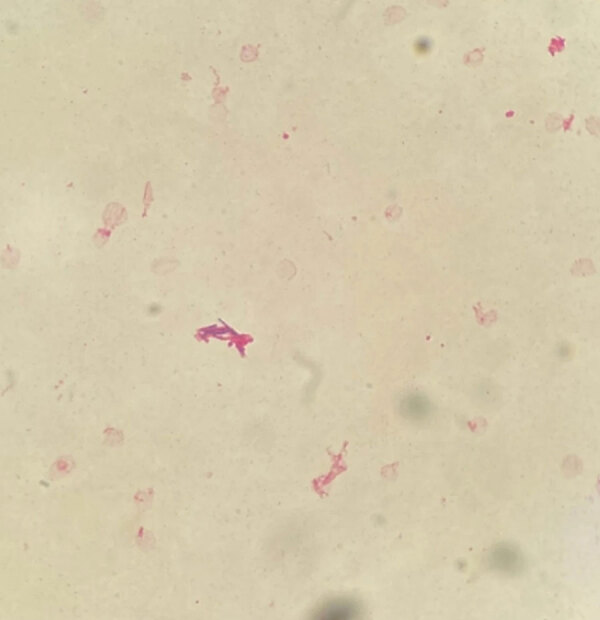 Figure 1
Peer Reviews
No public reviews on file for this paper yet. If you reviewed it on a platform where reviews are public (OpenReview, ICLR, NeurIPS, ICML), you can paste yours below so the community can read it here.
Videos
No videos yet. Explain this paper in a talk, walkthrough, or lecture? Add one.
Taxonomy
TopicsActinomycetales infections and treatment · Protist diversity and phylogeny · Genomics and Phylogenetic Studies
The species name for the bacterium Tsukamurella tyrosinosolvens was accepted in 1997 on the basis of biochemical attributes: tyrosina, from the amino acid tyrosine in cheese (tyros, Greek for cheese), which imparts a crystalline texture (Figure). The hydrolysis, or dissolving of tyrosine—thus, tyrosinosolvens—is a species characteristic.
The genus Tsukamurella consists of commensal bacteria with a propensity to cause opportunistic infections in immunocompromised patients, especially those with chronic lung disease. Tsukamurella bacteria are related to the genera Nocardia, Mycobacterium, Corynebacterium, and Gordonia. Gordonia aurantiaca was initially isolated in 1971 by renowned Japanese physician-microbiologist and Mycobacteria taxonomist Michio Tsukamura at Nagoya University in Nagoya, Japan. In 1988, he was honored with the genus name Tsukamurella.
Tsukamurella, retrospectively isolated by Edward A. Steinhaus in 1941 from the mycetoma and ovaries of the bedbug, was originally misidentified as Corynebacterium paurometabolum. Tsukamurella are weakly acid-fast; therefore, clinical manifestations can be confused with those of tuberculosis and create microbiological misidentification with Mycobacterium and Corynebacterium spp.
Tsukamurella infections are rare and usually associated with immune-suppressed patients, but severe infections have occurred in immunocompetent patients. Currently, of 17 known species, 12 cause human disease. Although Tsukamurella infections have been increasingly reported in Europe, Asia, America, and Africa, T. tyrosinosolvens has been the most common species observed.
The reference list from the paper itself. Each links out to its DOI / PubMed record.
- 1Genus Tsukamurella. LPSN—List of Prokaryotic names with Standing in Nomenclature [cited 2024 Dec 27]. https://lpsn.dsmz.de/genus/tsukamurella
- 2Mizuno S, Tsukamura Y, Nishio S, Ishida T, Hasegawa D, Kosaka Y, et al. Catheter-related bloodstream infection caused by Tsukamurella tyrosinosolvens identified by sec A 1sequencing in an immunocompromised child: a case report. Ann Clin Microbiol Antimicrob. 2023;22:97. 10.1186/s 12941-023-00651-637940983 PMC 10633952 · doi ↗ · pubmed ↗
- 3Species Tsukamurella tyrosinosolvens. LPSN—List of Prokaryotic names with Standing in Nomenclature [cited 2024 Dec 27]. https://lpsn.dsmz.de/species/tsukamurella-tyrosinosolvens
- 4Steinhaus EA. A study of the bacteria associated with thirty species of insects. J Bacteriol. 1941;42:757–90. 10.1128/jb.42.6.757-790.194116560484 PMC 374792 · doi ↗ · pubmed ↗
- 5Teng JLL, Tang Y, Wong SSY, Fong JYH, Zhao Z, Wong C-P, et al. MALDI-TOF MS for identification of Tsukamurella species: Tsukamurella tyrosinosolvens as the predominant species associated with ocular infections. Emerg Microbes Infect. 2018;7:80. 10.1038/s 41426-018-0083-429739926 PMC 5940693 · doi ↗ · pubmed ↗
- 6Usuda D, Tanaka R, Suzuki M, Shimozawa S, Takano H, Hotchi Y, et al. Obligate aerobic, gram-positive, weak acid-fast, nonmotile bacilli, Tsukamurella tyrosinosolvens: Minireview of a rare opportunistic pathogen. World J Clin Cases. 2022;10:8443–9. 10.12998/wjcc.v 10.i 24.844336157836 PMC 9453373 · doi ↗ · pubmed ↗
- 7Yu S, Ding X, Hua K, Zhu H, Zhang Q, Song X, et al. Systematic investigation of the emerging pathogen of Tsukamurella species in a Chinese tertiary teaching hospital. Microbiol Spectr. 2023;11:e 0164423. 10.1128/spectrum.01644-2337874148 PMC 10715089 · doi ↗ · pubmed ↗