Genomic evidence of Oropouche virus autochthonous circulation in a small district in the state of Rio de Janeiro, Brazil
Filipe Romero Rebello Moreira, Fábio Luís Lima Monteiro, Mariane Talon de Menezes, Pedro Junior Pinheiro Mourão, Camila de Almeida Velozo, Matheus Villanueva Andrade, Andréa Cony Cavalcanti, Mário Sérgio Ribeiro, Sílvia Cristina de Carvalho, Claudia Maria Braga de Mello

Abstract
Genes, proteins, chemicals, diseases, species, mutations and cell lines named across the full text — each resolved to its canonical identifier and authoritative record.
Click any figure to enlarge with its caption.
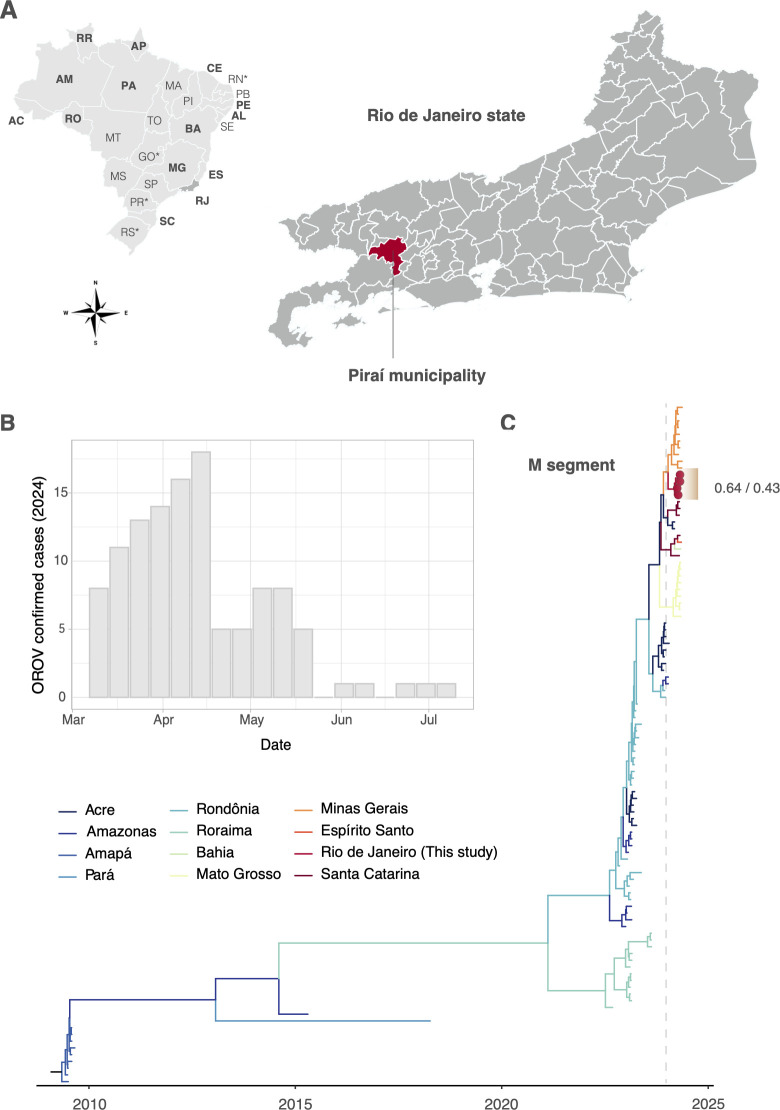 Fig 1
Fig 1- —Instituto Todos pela Saúde
- —Fundação Carlos Chagas Filho de Amparo à Pesquisa do Estado do Rio de Janeiro (FAPERJ)
- —Coordenação de Aperfeiçoamento de Pessoal de Nível Superior (CAPES)
- —Conselho Nacional de Desenvolvimento Científico e Tecnológico (CNPq)
Peer Reviews
No public reviews on file for this paper yet. If you reviewed it on a platform where reviews are public (OpenReview, ICLR, NeurIPS, ICML), you can paste yours below so the community can read it here.
Videos
No videos yet. Explain this paper in a talk, walkthrough, or lecture? Add one.
Taxonomy
TopicsMosquito-borne diseases and control · Viral Infections and Vectors · Plant Virus Research Studies
LETTER
Oropouche virus (OROV; Peribunyaviridae), is an emerging arbovirus endemic to the Amazon Basin region of South America, which causes a febrile disease named Oropouche fever (1). This disease is usually mild and presents symptoms similar to other arboviral diseases, but more severe infections have been recently reported, including the first cases of abortion and fetal malformation due to vertical transmission and deaths in 2024 (2–7). This year marked the first OROV outbreak in Brazil outside the Amazon region, following successive resurgences in the endemic area (8). Genomic surveillance indicates that these outbreaks were caused by a reassortant OROV lineage, which presents the S, M, and L segments more closely related to distinct viral strains, including the OROV prototype, Iquitos, and Perdões viruses (9, 10). Preliminary experimental evidence suggests that this lineage replicates faster in mammalian cells and is less effectively neutralized by antibodies from prior infections compared to the prototype OROV strain (11).
Prompted by the identification of several cases of OROV throughout Brazil (12), an effort to monitor the initial OROV cases in the state of Rio de Janeiro (RJ) was employed. The State Health Department of RJ initiated a screening effort employing a standardized molecular diagnostic assay (13), revealing 116 RT-qPCR positive samples scattered across the state, with a considerable cluster of cases (n = 42, 36.21%) in the small district of Cacaria (Piraí municipality), which has a population of approximately 800 people (Fig. 1A; Fig. S1). Local surveillance detected the first OROV cases in mid-March 2024, with a subsequent increase in cases over the next five epidemiological weeks, followed by a steady decline through early July (Fig. 1B).
Epidemiological and phylogenetic contextualization of the Oropouche virus outbreak in Rio de Janeiro state, Brazil. (A) Map of Brazil and Rio de Janeiro state. Two letter codes for Brazilian states were provided, according to Instituto Brasileiro de Geografia e Estatística (https://www.ibge.gov.br/cidades-e-estados, last accessed 25 October 2024). States with more than 100 OROV cases in 2024 were highlighted with bold fonts. Asterisks denote states where no case was confirmed. The Piraí municipality, marked in dark red, comprises one-third of OROV laboratory-confirmed cases in RJ. (B) Number of confirmed OROV infections per epidemiological week in RJ. (C) Time-scaled phylogenetic tree of the M segment data set. The model indicates that the sequences cluster in an RJ monophyletic clade, supporting local viral transmission. This clade was dated to the first trimester of 2024 and was most likely introduced from Minas Gerais state. Colors indicate ancestral locations as inferred on a discrete phylogeographic model. Sequences presenting tip shapes (circles) were characterized in this study. Numbers near novel sequences indicate the statistical support for the phylogenetic and trait models, respectively. The dashed gray line marks the beginning of the year 2024.
To further investigate this outbreak, we performed virus isolation, whole-genome sequencing, and phylogenetic analysis of four clinical samples (see Text S1). Our analyses confirm that the viruses circulating in RJ belong to the reassortant lineage that spread throughout Brazil in 2024 (Fig. S2). The Bayesian phylogenetic reconstruction from the M data set shows that the sequenced isolates form a monophyletic cluster with strong statistical support (posterior probability = 1), dated to February 2024 (95% highest posterior density: 20 January–2 March 2024), indicating a local transmission chain in RJ (Fig. 1C). A discrete phylogeographic reconstruction suggests that the virus was likely introduced from Minas Gerais in early 2024, though with modest statistical support (posterior probability = 0.64; geographic model posterior probability = 0.43). All four isolates obtained from specimens circulating in Cacaria displayed similar plaque morphology and cytopathic effects (CPE) to the prototypic OROV BeAn strain in culture, even though they belong to the reassortant lineage (Fig. S3). As the prototype OROV strain is likely adapted to in vitro growth compared to recent isolates, these findings should be interpreted with caution.
This study provides molecular evidence of OROV autochthonous transmission in a non-endemic area. Although the cases were concentrated in Cacaria, this area is linked to larger urban centers, which are well-integrated by road networks to densely populated regions, such as the Rio de Janeiro metropolitan area and the state of São Paulo. Given the local patterns of arbovirus transmission (14), the population’s susceptibility to OROV, and climatic conditions favorable to vectors (15, 16), we hypothesize that the virus could spread further across the state, potentially leading to larger epidemics in future transmission seasons. Continuous epidemiological monitoring through molecular, genomic, and serological methods will be critical to assessing the public health impact of OROV circulation in Rio de Janeiro.
Supplementary Material
Reviewer comments
The reference list from the paper itself. Each links out to its DOI / PubMed record.
- 1Wesselmann KM, Postigo-Hidalgo I, Pezzi L, de Oliveira-Filho EF, Fischer C, de Lamballerie X, Drexler JF. 2024. Emergence of Oropouche fever in Latin America: a narrative review. Lancet Infect Dis 24:e 439–e 452. doi:10.1016/S 1473-3099(23)00740-538281494 · doi ↗ · pubmed ↗
- 2das Neves Martins FE, Chiang JO, Nunes BTD, Ribeiro B de FR, Martins LC, Casseb LMN, Henriques DF, de Oliveira CS, Maciel ELN, Azevedo R da S, Cravo L de CC, Barreto ARF, Pessoa ALS, Filho AJM, de Sousa JR, Schuler-Faccini L, Quaresma JAS, da Costa Vasconcelos PF, da Silva Azevedo R do S. 2024. Newborns with microcephaly in Brazil and potential vertical transmission of Oropouche virus: a case series. Lancet Infect Dis:S 1473-3099(24)00617-0. doi:10.1016/S 1473-3099(24)00617-039423837 · doi ↗ · pubmed ↗
- 3Samara A, Coutinho CM, Veal P, Osborne J, Duarte G, Ladhani S, Khalil A. 2024. Potential vertical transmission of Oropouche virus during the current outbreak. Lancet Infect Dis 24:e 668–e 669. doi:10.1016/S 1473-3099(24)00571-139265591 · doi ↗ · pubmed ↗
- 4Garcia Filho C, Lima Neto AS, Maia AMPC, da Silva LOR, Cavalcante R da C, Monteiro H da S, Marques KCA, Oliveira R de S, Gadelha S de AC, Nunes de Melo D, Mota AG de M, de Lima STS, Cavalcante KF, Duarte LMF, Cavalcante ÍJM, Mello LMS, Alencar CH, Rodrigues CDDS, de Oliveira CS, de Bruycker-Nogueira F, Naveca FG, Ribas Freitas AR, Cavalcanti LP de G. 2024. A case of vertical transmission of Oropouche virus in Brazil. N Engl J Med 391:2055–2057. doi:10.1056/NEJ Mc 241281239476360 · doi ↗ · pubmed ↗
- 5Pan American Health Organization. 2024. Epidemiological alert Oropouche in the region of the Americas: vertical transmission event under investigation in Brazil - 17 July 2024. Available from: https://www.paho.org/en/documents/epidemiological-alert-oropouche-region-americas-vertical-transmission-event-under. Retrieved 17 Dec 2024.
- 6Martins-Filho PR, Carvalho TA, Dos Santos CA. 2024. Oropouche fever: reports of vertical transmission and deaths in Brazil. Lancet Infect Dis 24:e 662–e 663. doi:10.1016/S 1473-3099(24)00557-739182500 · doi ↗ · pubmed ↗
- 7Bandeira AC, Barbosa A da S, Souza M, Saavedra R da C, Pereira FM, Santos S de O, Mello A e S de, Purificação S da, Souza D de, Lessa A de A, Guimarães NR, Fonseca V, Giovanetti M, Alcantara LCJ, Tome LMR, Iani F de M, Barros RM, Fonseca RR, Jesus J de, Araújo MLV. 2024. Clinical profile of Oropouche fever in Bahia, Brazil: unexpected fatal cases. Sci ELO preprints. doi:10.1590/Sci ELO Preprints.9342 · doi ↗
- 8Ministério da Saúde do Brasil. Boletim Epidemiológico - Volume 55 - no 11. Monitoramento das arboviroses e balanço de encerramento do Comitê de Operações de Emergência (COE) Dengue e outras Arboviroses 2024. Available from: https://www.gov.br/saude/pt-br/centrais-de-conteudo/publicacoes/boletins/epidemiologicos/edicoes/2024/boletim-epidemiologico-volume-55-no-11.pdf/view. Retrieved 7 Oct 2024.