Genome Sequence of Mycobacterium Phage Guppsters
Emma K Alley, Lexi C Hill, Mya E Houglum, Maggie R Lamppa, Khailee K Pack, Hailey D Pageau, Cale J Prosen, Kylie R Richards, Kendra S Royer, Emily A Slettedahl, Ian L Strusz, Lydia A Wiita, Jillian C Zeidler, Daniel E Westholm

TL;DR
This paper describes the genome of a new bacteriophage, Guppsters, which infects Mycobacterium and belongs to a specific group of phages.
Contribution
The paper reports the genome sequence of Guppsters, a Mycobacterium phage lacking mobile elements typical of its cluster.
Findings
Guppsters has a 54,835 base pair genome and siphovirus morphology.
It is classified in cluster F1 based on gene content similarity.
Unlike most F1 phages, Guppsters lacks mycobacteriophage mobile elements.
Abstract
Mycobacterium Phage Guppsters was isolated on Mycobacterium smegmatis mc 2 155, displays a siphovirus morphology, and possesses a 54,835 base pair genome. Based on gene content similarity, Guppsters is assigned to cluster F1. Unlike a majority of F1 phages, Guppsters does not encode mycobacteriophage mobile elements.
Genes, proteins, chemicals, diseases, species, mutations and cell lines named across the full text — each resolved to its canonical identifier and authoritative record.
Click any figure to enlarge with its caption.
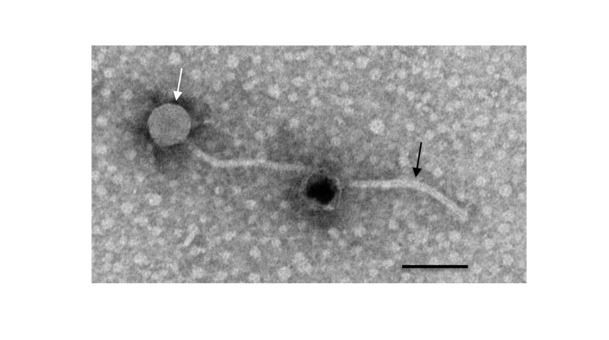 Figure 1
Peer Reviews
No public reviews on file for this paper yet. If you reviewed it on a platform where reviews are public (OpenReview, ICLR, NeurIPS, ICML), you can paste yours below so the community can read it here.
Videos
No videos yet. Explain this paper in a talk, walkthrough, or lecture? Add one.
Taxonomy
TopicsBacteriophages and microbial interactions · Mycobacterium research and diagnosis · Genomics and Phylogenetic Studies
Description
The genus *Mycobacterium * contains many disease-causing pathogens, with some establishing antibiotic-resistant infections. Mycobacterium smegmatis is a non-pathogenic and genetically tractable member of the genus, and bacteriophages isolated on M. smegmatis have been used to treat antibiotic-resistant mycobacterial infections (Barka et al., 2016; Dedrick et al., 2019) . Here, we report the discovery and characteristics of a novel mycobacteriophage, Guppsters, isolated using *Mycobacterium smegmatis * mc ^2^ 155.
Guppsters was isolated from potted plant soil from the green roof of The College of St. Scholastica Science Building in Duluth, Minnesota (GPS coordinates: 46.816111 N, 92.104444 W). The soil sample was suspended in Middlebrook 7H9 liquid media, inoculated with M. smegmatis mc ^2^ 155 and incubated at 37 ^o^ C with 250 rpm shaking for 24 hours to enrich for mycobacteriophages. Following enrichment, the sample was vacuum-filtered (0.22 µM pore size), the filtrate was spotted on top agar supplemented with *M. smegmatis, * and the plates incubated at 37˚C for 48 hours, yielding a clearing on the bacterial lawn by bacteriophage Guppsters. Guppsters was purified through three rounds of plating for plaques. After purification, a liquid lysate was prepared and used for negative staining transmission electron microscopy using 1% phosphoric tungsten acid, revealing a siphovirus morphology with a 70 nm isometric capsid and 200 nm tail (n=1) (Russell and Hatfull, 2017) .
DNA was isolated from the liquid lysate using the Promega Wizard DNA cleanup kit. Sequencing of Guppsters DNA was completed with an Illumina MiSeq (v3 reagents) using a library prepared with NEB Ultra II Library Kit, producing 392,678 single-end 150-base reads, representing ~1,000-fold coverage. Newbler v2.9 (Silva et al., 2013) and Consed v29 (Gordon and Green, 2013) were used to assemble the raw reads and verify completeness, using default parameters. The 54,835 base pair Guppsters genome contains 3’ single stranded overhang (5’CGGTAGGCGC). Its GC content of 62.47% GC is similar to its isolation host *M. smegmatis * ( https://www.ncbi.nlm.nih.gov/nuccore/CP000480.1 ).
Guppster’s genome was auto-annotated using Glimmer (Delcher et al., 2007) and GeneMark (Besemer and Borodovsky, 2005) , then refined through manual annotation with DNA Master ( http://cobamide2.bio.pitt.edu ), PECAAN ( http://discover.kbrinsgd.org ), Phamerator (Cresawn et al., 2011) , Starterator ( http://phages.wustl.edu/starterator/ ), BLAST (Altshul et al., 1990), and HHPRED (Soding et al., 2005) . Aragorn v1.2.41 (Laslett and Canback, 2004) and tRNAscan-SE v2.0 (Lowe and Eddy, 1997) detected no tRNA genes. Databases accessed include the following: BLAST-Actinobacteriophage and NCBI non-redundant database; HHPRED- PDB_mmCIF70, Pfam v36, NCBI Conserved Domain Database v3.20; and Phamerator- Actino_draft database v578. Guppsters is assigned to cluster FI based on gene content similarity of at least 35% to phages in the Actinobacteriophage database, phagesdb ( https://phagesDB.org ) (Russell and Hatfull, 2017) . All software were used with default parameters.
As with other cluster F1 phages, Guppsters encodes an immunity repressor and a tyrosine integrase, suggesting it is able to establish lysogeny. Guppster also encodes Cro (control of repressor’s operator) adjacent to its immunity repressor gene. A majority of cluster F1 phages (154/240 phages, to date), encode mycobacteriophage mobile elements (MPMEs) (Sampson et al., 2009) . Interestingly, annotation failed to identify MPMEs in Guppster’s genome, despite the presence of a putative MPME 2 in LittleShirley (Russell and Hatfull, 2017) , another F1 phage isolated from the same green roof potted plant as Guppsters. Guppsters and LittleShirley share 58% gene content similarity (Russell and Hatfull, 2017) .
Nucleotide sequence accession numbers
Guppsters is available at GenBank with Accession No. PP978892 and Sequence Read Archive (SRA) No. SRX25734229.
The reference list from the paper itself. Each links out to its DOI / PubMed record.
- 1Altschul Stephen F. Gish Warren Miller Webb Myers Eugene W. Lipman David J. 1990101 Basic local alignment search tool Journal of Molecular Biology 21530022-283640341010.1016/s 0022-2836(05)80360-22231712 · doi ↗ · pubmed ↗
- 2Barka Essaid Ait Vatsa Parul Sanchez Lisa Gaveau-Vaillant Nathalie Jacquard Cedric Klenk Hans-Peter Clément Christophe Ouhdouch Yder van Wezel Gilles P. 201631 Taxonomy, Physiology, and Natural Products of Actinobacteria Microbiology and Molecular Biology Reviews 8011092-217214310.1128/mmbr.00019-1526609051 PMC 4711186 · doi ↗ · pubmed ↗
- 3Besemer J. Borodovsky M. 200571 Gene Mark: web software for gene finding in prokaryotes, eukaryotes and viruses Nucleic Acids Research 33Web Server 0305-1048 W 451W 45410.1093/nar/gki 48715980510 PMC 1160247 · doi ↗ · pubmed ↗
- 4Cresawn Steven G Bogel Matt Day Nathan Jacobs-Sera Deborah Hendrix Roger W Hatfull Graham F 20111012 Phamerator: a bioinformatic tool for comparative bacteriophage genomics BMC Bioinformatics 1211471-210510.1186/1471-2105-12-395PMC 323361221991981 · doi ↗ · pubmed ↗
- 5Dedrick Rebekah M. Guerrero-Bustamante Carlos A. Garlena Rebecca A. Russell Daniel A. Ford Katrina Harris Kathryn Gilmour Kimberly C. Soothill James Jacobs-Sera Deborah Schooley Robert T. Hatfull Graham F. Spencer Helen 201951 Engineered bacteriophages for treatment of a patient with a disseminated drug-resistant Mycobacterium abscessus Nature Medicine 2551078-895673073310.1038/s 41591-019-0437-z PMC 655743931068712 · doi ↗ · pubmed ↗
- 6Delcher Arthur L. Bratke Kirsten A. Powers Edwin C. Salzberg Steven L. 2007119 Identifying bacterial genes and endosymbiont DNA with Glimmer Bioinformatics 2361367-481167367910.1093/bioinformatics/btm 00917237039 PMC 2387122 · doi ↗ · pubmed ↗
- 7Gordon David Green Phil 2013831 Consed: a graphical editor for next-generation sequencing Bioinformatics 29221367-48112936293710.1093/bioinformatics/btt 51523995391 PMC 3810858 · doi ↗ · pubmed ↗
- 8Laslett D. 200412 ARAGORN, a program to detect t RNA genes and tm RNA genes in nucleotide sequences Nucleic Acids Research 3211362-4962111610.1093/nar/gkh 15214704338 PMC 373265 · doi ↗ · pubmed ↗