Discrete Repetition Effects for Visual Words Compared to Faces and Animals, but No Modulation by Expectation: An Event‐Related Potential Study
Bingbing Song, Werner Sommer, Urs Maurer

TL;DR
The study found that repetition effects in the brain differ for words, faces, and animals, but these effects were not influenced by expectations.
Contribution
The study provides new insights into how repetition effects vary across stimulus categories and challenges the predictive coding account of repetition suppression.
Findings
Repetition effects in the N250 component were present in all stimulus categories.
Repetition effects for words occurred earlier and showed distinct topographic patterns compared to faces and animals.
No evidence was found for repetition effects modulated by repetition probability across any category.
Abstract
Repetition suppression (RS) refers to the reduction of neuronal responses to repeated stimuli as compared to nonrepeated stimuli. The predictive coding account of RS proposes that its magnitude is modulated by repetition probability (P(rep)) and that this modulation increases with prior experience with the stimulus category. To test these proposals, we examined RS and its modulation by P(rep) for three stimulus categories for which participants had different expertise (Asian faces, written Chinese words and animals) using EEG. Cantonese speakers watched paired stimuli (S1–S2) of a given category with S2 being the same or a different stimulus as S1. Attributes of S1 (e.g., the sex of the first face) served as a cue for the repetition probability of S2. There were significant repetition effects and distinct topographic distributions across stimulus categories. Repetition effects in the…
Genes, proteins, chemicals, diseases, species, mutations and cell lines named across the full text — each resolved to its canonical identifier and authoritative record.
Click any figure to enlarge with its caption.
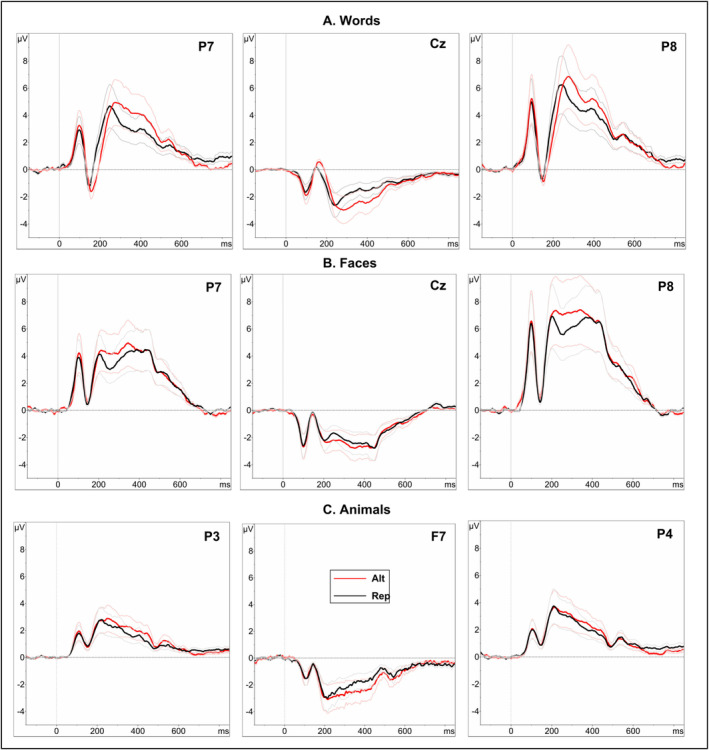 Figure 1
 Figure 2
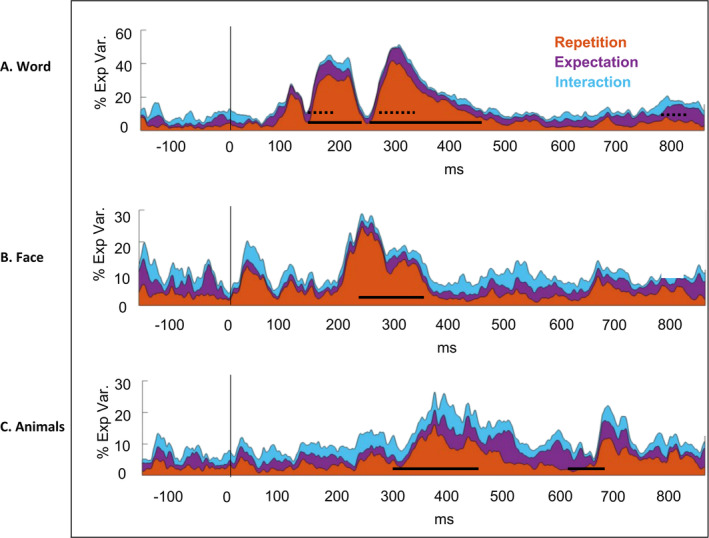 Figure 3
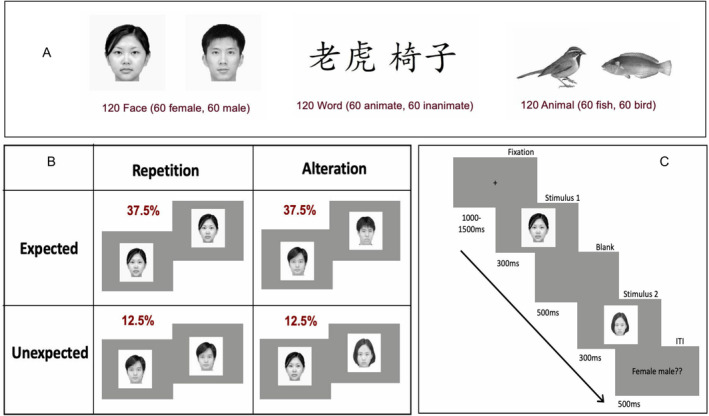 Figure 4
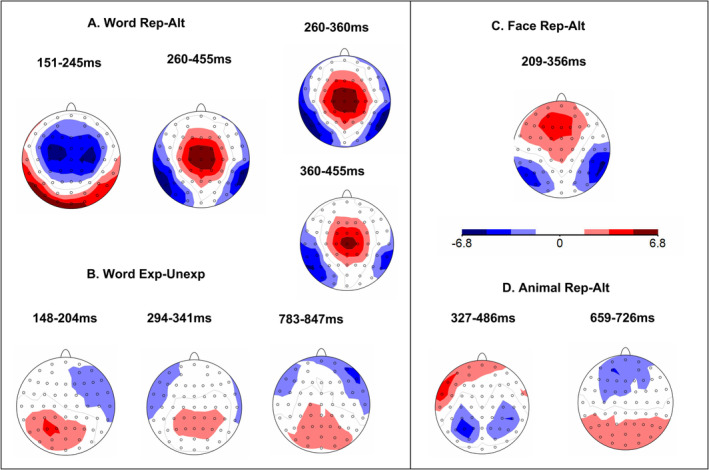 Figure 5
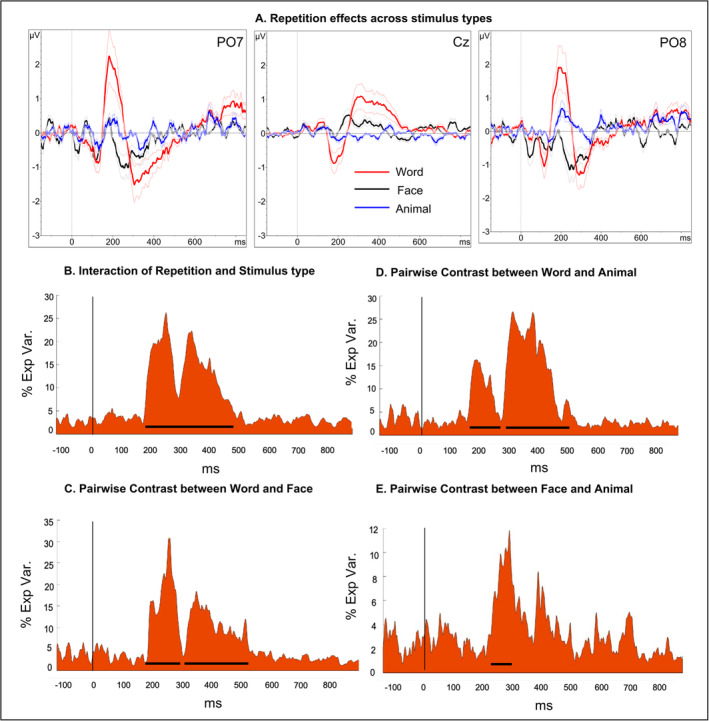 Figure 6
Peer Reviews
No public reviews on file for this paper yet. If you reviewed it on a platform where reviews are public (OpenReview, ICLR, NeurIPS, ICML), you can paste yours below so the community can read it here.
Videos
No videos yet. Explain this paper in a talk, walkthrough, or lecture? Add one.
Taxonomy
TopicsFace Recognition and Perception · Multisensory perception and integration · Visual perception and processing mechanisms