Field evaluation of the Bioline Malaria Ag P.f/Pan Rapid Diagnostic Test: Causes of Microscopy Discordance and Performance in Uganda
Kisakye Diana Kabbale, Bienvenu Nsengimaana, Francis D. Semakuba, Brian A. Kagurusi, Caroline Mwubaha, Innocent Wiringilimaana, Thomas Katairo, Shahiid Kiyaga, Monica Mbabazi, Samuel Gonahasa, Moses R. Kamya, Stephen Tukwasibwe, Sam L. Nsobya, Victor Asua, Daudi Jjingo

TL;DR
This study evaluates a malaria rapid diagnostic test in Uganda, finding it highly sensitive but with issues of false positives due to persistent antigens.
Contribution
The study quantifies the performance and causes of discordance for a combination malaria RDT in a real-world setting.
Findings
The Bioline Malaria Ag P.f/Pan RDT had high sensitivity (>91%) for detecting malaria.
False negatives were mainly due to low-density P. falciparum or non-falciparum infections.
False positives were common due to persistent antigenemia, leading to overuse of antimalarials.
Abstract
Histidine Rich Protein 2 (HRP2)/pan-Lactate Dehydrogenase (pLDH) combination Rapid Diagnostic Tests (RDTs) may address the shortcomings of RDTs that detect HRP2 alone. However, the relative contribution of the possible causes of discordant results (RDT-negative and microscopy-positive) and performance in field settings are poorly quantified. This study utilized samples from two cross-sectional surveys conducted in 32 districts at 64 sites across Uganda between November 2021 and March 2023 that enrolled 6354 febrile participants ≥ two years of age. Discordant samples (negative by HRP2/pLDH RDT and positive by microscopy) underwent quantitative PCR (qPCR) to detect and quantify parasitemia. Those confirmed to be positive for P. falciparum at > 1 parasites/microliter (p/μL) were tested for pfhrp2 and pfhrp3 deletions using digital PCR. Those that were negative or had P. falciparum…
Genes, proteins, chemicals, diseases, species, mutations and cell lines named across the full text — each resolved to its canonical identifier and authoritative record.
Click any figure to enlarge with its caption.
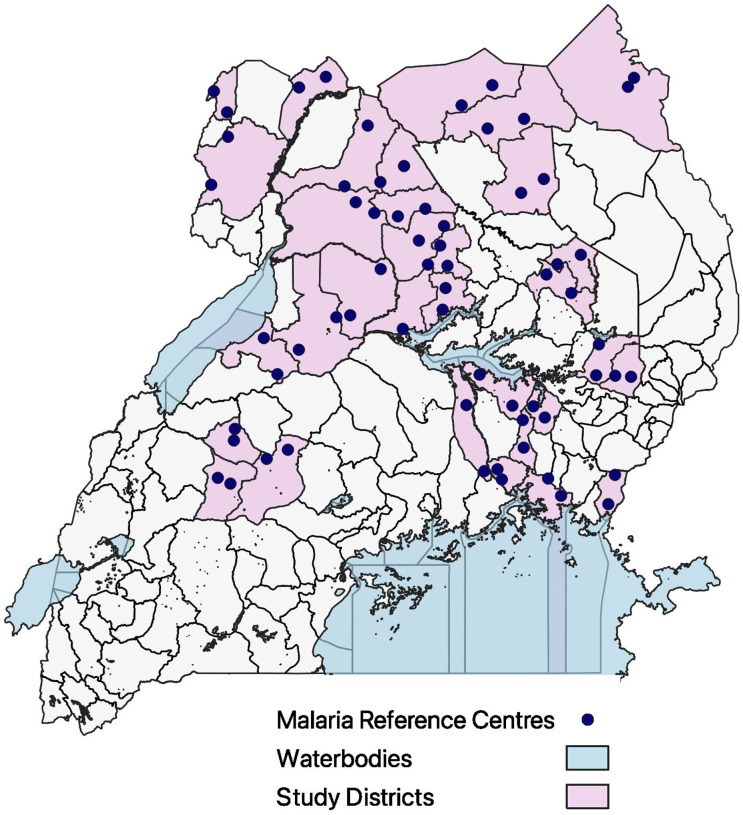 Figure 1
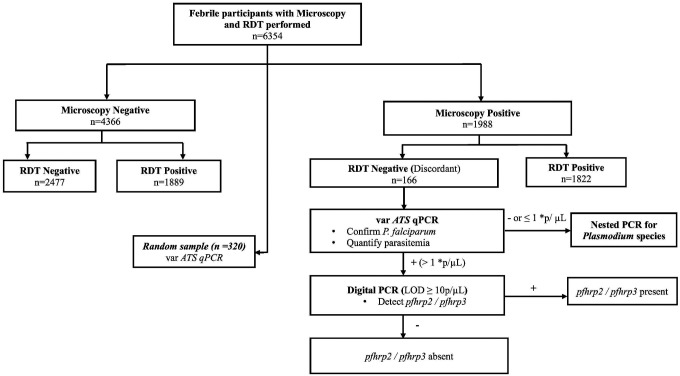 Figure 2
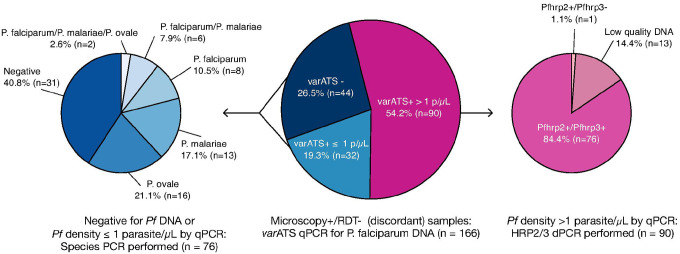 Figure 3
Peer Reviews
No public reviews on file for this paper yet. If you reviewed it on a platform where reviews are public (OpenReview, ICLR, NeurIPS, ICML), you can paste yours below so the community can read it here.
Videos
No videos yet. Explain this paper in a talk, walkthrough, or lecture? Add one.
Taxonomy
TopicsMalaria Research and Control · Mosquito-borne diseases and control · Viral Infections and Vectors