Standard v mini percutaneous nephrolithotomy in the supine modified lithotomy position: a randomized pilot study on 10–25 mm stones
Philip McCahy, Anthony Dat, Daniel Gilbourd, Eldho Paul, Shekib Shahbaz

TL;DR
This study compares standard and mini versions of a kidney stone removal procedure and finds the standard method to be more effective.
Contribution
The study introduces a randomized pilot comparison of mini versus standard PCNL in a supine position for medium-sized kidney stones.
Findings
Standard PCNL achieved 77.75% stone-free outcomes compared to 44.4% for mini PCNL.
Both procedures were tubeless and complication-free with no differences in operative time or recovery.
The study suggests standard 24F PCNL is safer and more effective than mini PCNL for stone clearance.
Abstract
Percutaneous nephrolithotomy (PCNL) is the recommended treatment for stones >2 cm in size. The majority of PCNL are still conducted with larger telescopes using tracts up to 30F in size. We have conducted a randomized pilot study comparing mini PCNL with our standard 22F PCNL for renal stones between 10 and 25 mm in diameter. Patients were randomized to either PCNL (24F Amplatz sheath/22F nephrosocope) or mini PCNL (18F Amplatz sheath/11F nephroscope). All operations were performed in the modified supine position. Patients were reviewed with imaging to assess stone clearance and complications. Eighteen well matched patients were randomized. All procedures were completed as planned and all were tubeless with no complications. There were no differences in operative time, analgesia requirements or length of stay. Seven of nine (77.75%) standard PCNL were completely stone free at CT…
Genes, proteins, chemicals, diseases, species, mutations and cell lines named across the full text — each resolved to its canonical identifier and authoritative record.
Click any figure to enlarge with its caption.
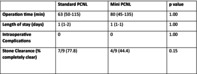 Figure 1
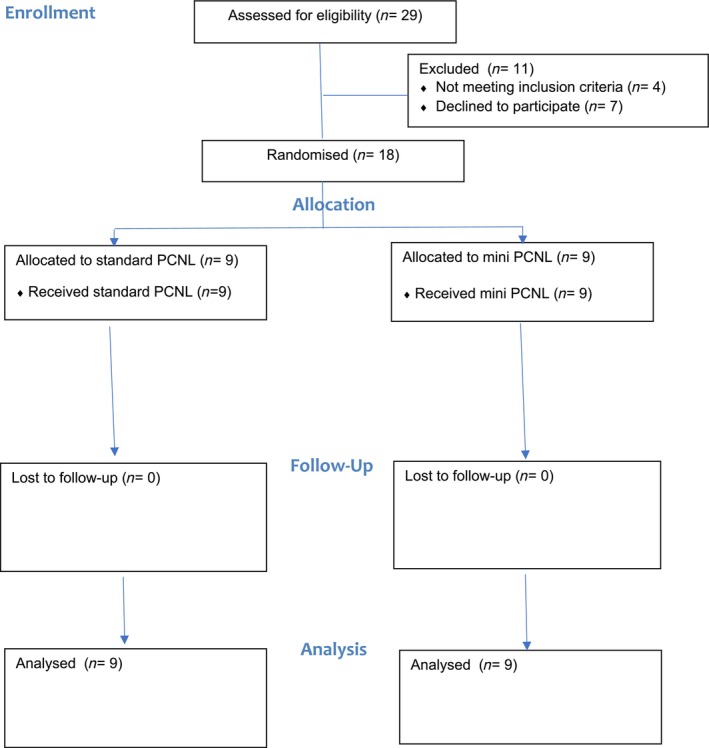 Figure 2
Peer Reviews
No public reviews on file for this paper yet. If you reviewed it on a platform where reviews are public (OpenReview, ICLR, NeurIPS, ICML), you can paste yours below so the community can read it here.
Videos
No videos yet. Explain this paper in a talk, walkthrough, or lecture? Add one.
Taxonomy
TopicsKidney Stones and Urolithiasis Treatments · Pediatric Urology and Nephrology Studies · Urinary Bladder and Prostate Research