Specialized mental healthcare use for common mental disorders and prescription of antidepressants before and during the COVID-19 pandemic among working-age refugees and Swedish-born individuals – a nationwide register-based study
Vera Atarodi, Ellenor Mittendorfer-Rutz, Daniel Morillo-Cuadrado, Roberto Mediavilla, Mireia Felez-Nobrega, Anna Monistrol-Mula, Pierre Smith, Vincent Lorant, Papoula Petri-Romão, Marit Sijbrandij, Anke B. Witteveen, Irene Pinucci, Matteo Monzio Compagnoni, Claudia Conflitti

TL;DR
The study found that working-age refugees in Sweden had increased mental healthcare use for conditions like depression and anxiety during the pandemic, especially those in marginalized positions.
Contribution
This is the first nationwide study to compare mental healthcare trends for common mental disorders in refugees versus Swedish-born individuals during the pandemic.
Findings
Refugees showed a 3% quarterly increase in CMD-related healthcare use during the pandemic.
Marginalized refugees and those with low education had higher incidence rate ratios (IRR) for CMD healthcare use.
Antidepressant prescriptions did not change significantly during the pandemic for either group.
Abstract
It is known that refugees have an elevated risk of common mental disorders (CMDs, including depression, anxiety, and stress-related disorders). The effect of the coronavirus disease pandemic on healthcare use due to CMDs in refugees is yet unknown, especially in socioeconomically deprived groups. We conducted a population-wide study comparing specialized healthcare use for CMDs and antidepressant prescriptions before and during the pandemic in refugees and Swedish-born, and investigated differences by labor market marginalization and education. An interrupted time series analysis of quarterly cohorts (2018.01.01–2021.12.31) of all refugees and Swedish-born, aged 19 to 65 was applied. Information on outcome measures and covariates were linked individually from administrative registers. We applied interrupted time series and estimated incidence rate ratios (IRR) of the incidence rates…
Genes, proteins, chemicals, diseases, species, mutations and cell lines named across the full text — each resolved to its canonical identifier and authoritative record.
Click any figure to enlarge with its caption.
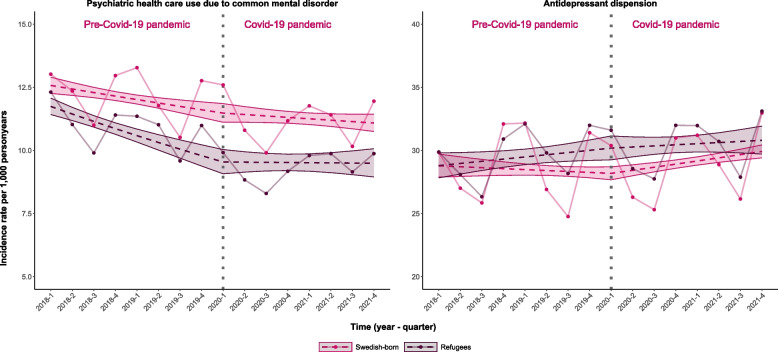 Figure 1
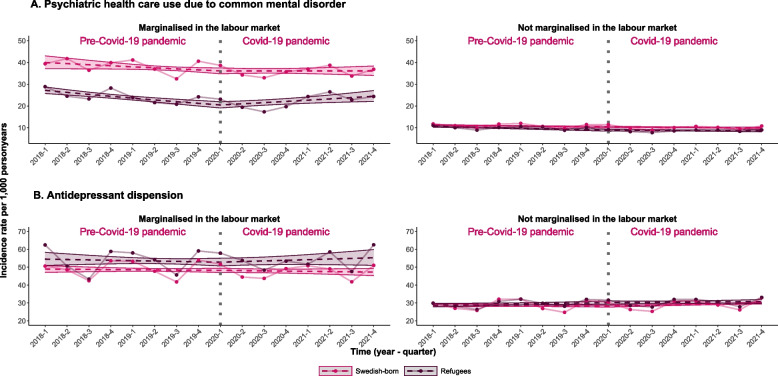 Figure 2
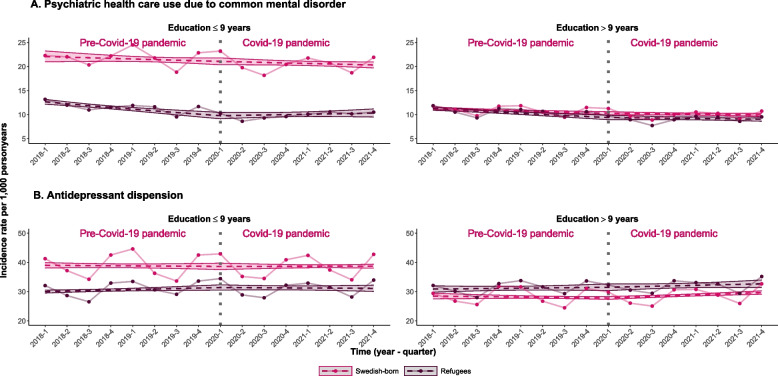 Figure 3
Peer Reviews
No public reviews on file for this paper yet. If you reviewed it on a platform where reviews are public (OpenReview, ICLR, NeurIPS, ICML), you can paste yours below so the community can read it here.
Videos
No videos yet. Explain this paper in a talk, walkthrough, or lecture? Add one.
Taxonomy
TopicsMigration, Health and Trauma · COVID-19 and Mental Health · Employment and Welfare Studies