Dysmegakaryopoiesis in myelodysplastic syndrome: Beyond cell dysplasia
Maria Mirele da Silva Ribeiro, Francisco Dário Rocha Filho, Howard Lopes Ribeiro Junior, Priscila da Silva Mendonça, Ronald Feitosa Pinheiro, Silvia Maria Meira Magalhães

Abstract
Genes, proteins, chemicals, diseases, species, mutations and cell lines named across the full text — each resolved to its canonical identifier and authoritative record.
Click any figure to enlarge with its caption.
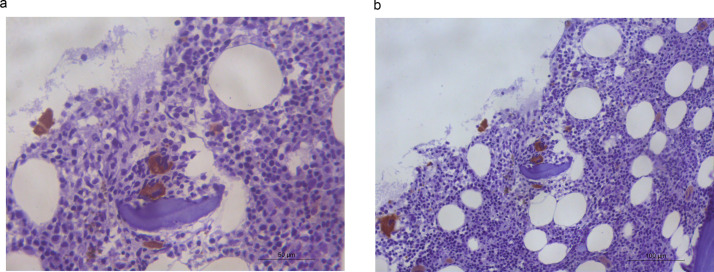 Figure 1
Peer Reviews
No public reviews on file for this paper yet. If you reviewed it on a platform where reviews are public (OpenReview, ICLR, NeurIPS, ICML), you can paste yours below so the community can read it here.
Videos
No videos yet. Explain this paper in a talk, walkthrough, or lecture? Add one.
Taxonomy
TopicsAcute Myeloid Leukemia Research · Myeloproliferative Neoplasms: Diagnosis and Treatment · Eosinophilic Disorders and Syndromes
A 57‑year-old female was admitted with persistent normocytic anemia (hemoglobin: 9.6 g/dL; mean corpuscular volume: 94 fL; neutrophil count: 2.0 × 10^3^/L; platelet count: 199 × 10^9^/L). Causes of non-clonal cytopenias were all excluded: nutritional deficiencies, hormonal disorders, autoimmune and infectious diseases.
A bone marrow aspirate showed dyserythropoiesis and dysmegakaryopoiesis with the presence of micro-megakaryocytes. <1 % of blasts were identified, and an increase of medullar iron was present with no ringed sideroblasts. Immunohistochemical analysis with CD61 made micro-megakaryocytes highlighted dysplastic megakaryocytes in an unusual peritrabecular area (Figure 1). CD34 and p53 showed no abnormalities. Bone marrow G-banding cytogenetic analysis revealed 46,XX,del(11)(q23)[8]/46,XX[12], according to the International System for Human Cytogenomic Nomenclature. The diagnosis of myelodysplastic syndrome (MDS) with multilineage dysplasia was established, according to the World Health Organization (WHO) classification and risk-stratification. The Revised International Prognostic Scoring System (IPSS-R) score was very low. After seven years of follow-up, the patient is still alive and no disease progression has been observed.Figure 1. Immunohistochemical analysis of CD61 antibody in bone marrow aspirate smear showed a dysplastic megakaryocyte in an unusual peritrabecular area (a. ×20 and b. ×40).Figure 1:
In healthy adult subjects, megakaryocytes are usually found, individually, adjacent to the bone marrow sinusoid and away from bone trabeculae. Peritrabecular dysplastic megakaryocytes are extremely rare and this abnormal architectural finding, beyond cell dysplasia, corroborates the diagnosis of MDS.1
Morphological dysplasia is still of paramount importance in the diagnosis of MDS, even in the molecular genetic era. The presence of at least one cytopenia is required for diagnosis. Bone marrow aspiration examination with iron stain, biopsy and cytogenetics testing standard karyotypes are all considered mandatory. Genetic testing for somatic mutations in genes associated with MDS is highly recommended, although not universally available. Therefore, conventional diagnostic tools and risk prognostic models will continue to have a role in the clinical practice.1^,^2
The case we present emphasizes an unusual morphologic abnormality. Accurate diagnoses have implications for both decision-making and prognosis.
Author contributions
MMSR, FDRF, RFP and SMMM: Conceptualization, Visualization, Laboratorial analysis, Writing—original draft, and writing—review and editing. HLRJ and PSM: Visualization, Writing—original draft, and Writing—review and editing.
Conflicts of interest
The authors have no conflicts of interest to declare.
The reference list from the paper itself. Each links out to its DOI / PubMed record.
- 1Feng G.Gale R.P.Cui W.Cai W.Huang G.Xu Z.A systematic classification of megakaryocytic dysplasia and its impact on prognosis for patients with myelodysplastic syndromes Experiment Hematol Oncol 51220161810.1186/s 40164-016-0041-6PMC 484880827127725 · doi ↗ · pubmed ↗
- 2Della Porta M.G.Malcovati L.Boveri E.Travaglino E.Pietra D.Pascutto C.Clinical relevance of bone marrow fibrosis and CD 34-positive cell clusters in primary myelodysplastic syndromes J Clin Oncol 2720097547621910373010.1200/JCO.2008.18.2246 · doi ↗ · pubmed ↗