Characterization and comparison of temperature-sensitive Schizosaccharomyces pombe mutants of the septation initiation network scaffolds, Cdc11 and Sid4
Lesley A. Turner, Anna Bowman Fletcher, Alaina H. Willet, Kathleen L. Gould

TL;DR
This paper studies temperature-sensitive mutants of two proteins in a yeast cell division network to better understand how they function.
Contribution
The study characterizes new temperature-sensitive mutants of Cdc11 and Sid4 in S. pombe, expanding tools for SIN research.
Findings
Temperature-sensitive cdc11 and sid4 mutants were identified and characterized.
Mutant alleles showed distinct phenotypes and growth patterns compared to previously known mutants.
The findings enhance understanding of SIN scaffold assembly at spindle pole bodies.
Abstract
The Schizosaccharomyces pombe septation initiation network (SIN) is required for cytokinesis and septation. The SIN includes a protein kinase cascade that is assembled at spindle pole bodies (SPBs) in a cell cycle specific manner on a scaffold consisting of Cdc11 , related to human centriolin, and the a-helical protein Sid4 . Here, we characterized temperature-sensitive cdc11 and sid4 mutants isolated in the 1990s. We determined the mutations within each allele, examined their phenotypes, and analyzed their growth compared with previously characterized mutant alleles. The new mutants described here expand the toolkit for studying how the SIN assembles at SPBs.
Genes, proteins, chemicals, diseases, species, mutations and cell lines named across the full text — each resolved to its canonical identifier and authoritative record.
Click any figure to enlarge with its caption.
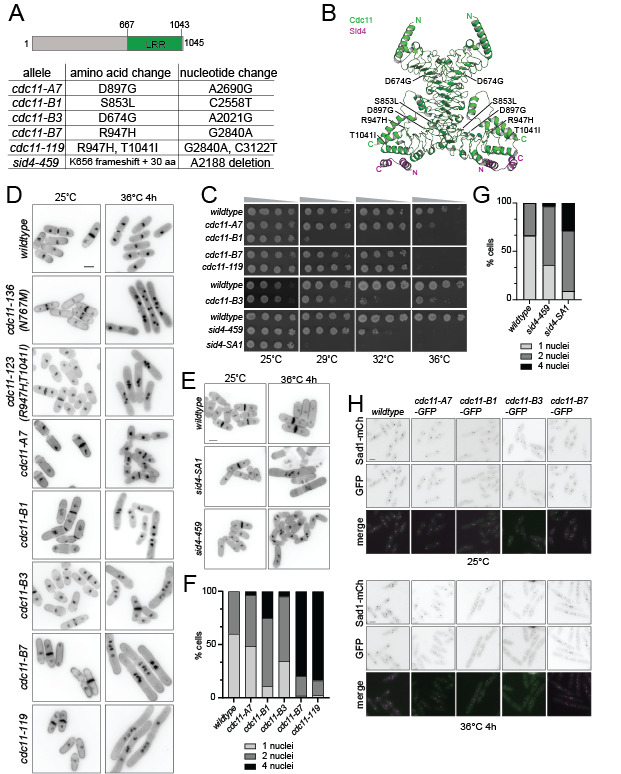 Figure 1
Peer Reviews
No public reviews on file for this paper yet. If you reviewed it on a platform where reviews are public (OpenReview, ICLR, NeurIPS, ICML), you can paste yours below so the community can read it here.
Videos
No videos yet. Explain this paper in a talk, walkthrough, or lecture? Add one.
Taxonomy
TopicsRNA Research and Splicing · Viral Infectious Diseases and Gene Expression in Insects · Ubiquitin and proteasome pathways