Management of patients with mesh perforation into viscus following pelvic mesh surgery
Yu Hwee Tan, Krishanthy Thayalan, Hannah Krause, Vivien Wong, Judith Goh

TL;DR
This study examines the outcomes of surgically managing mesh perforation into organs after pelvic mesh surgery, finding that it effectively reduces infections and pain.
Contribution
The paper provides clinical evidence on the effectiveness of surgical management for mesh perforation into viscus, an uncommon but significant complication.
Findings
Surgical excision and viscus repair were successful in all 51 patients who underwent the procedure.
There was a significant reduction in recurrent urinary tract infections and pain after surgery.
No patients experienced complications like mesh erosion or fistulae after the procedure.
Abstract
Pelvic mesh has been used for the treatment of pelvic organ prolapse (POP) and stress urinary incontinence (SUI). Between 3 and 20% suffer complications with debilitating long-term outcomes. Uncommon complications include mesh perforation into viscus however there is minimal published data regarding outcomes following surgical management. A retrospective observational study of patients with diagnosis of mesh in viscus at three tertiary urogynaecology units was performed to report on clinical outcomes following surgical management. Fifty-eight patients were diagnosed with mesh in viscus following cystourethroscopy and thorough examination of vagina/rectum. Mesh involved included mid-urethral slings—retropubic (36.9%), transobturator (18.5%), single incision slings (10.8%); transvaginal POP mesh (15.4%); sacrocolpopexy (13.8%); uncertain type (4.6%). Viscus involved included bladder…
Genes, proteins, chemicals, diseases, species, mutations and cell lines named across the full text — each resolved to its canonical identifier and authoritative record.
Click any figure to enlarge with its caption.
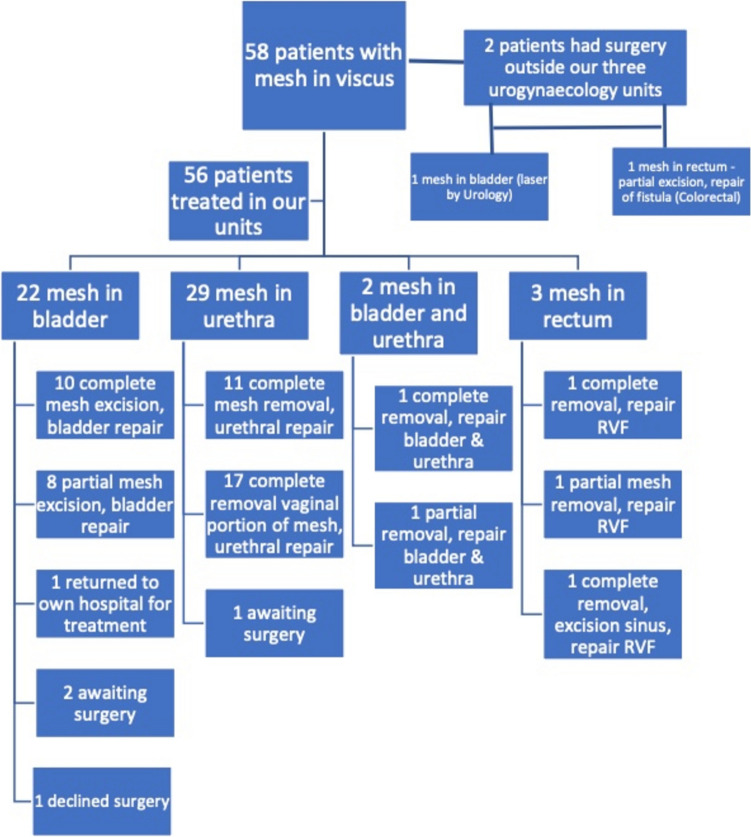 Figure 1
Peer Reviews
No public reviews on file for this paper yet. If you reviewed it on a platform where reviews are public (OpenReview, ICLR, NeurIPS, ICML), you can paste yours below so the community can read it here.
Videos
No videos yet. Explain this paper in a talk, walkthrough, or lecture? Add one.
Taxonomy
TopicsPelvic floor disorders treatments · Urinary Tract Infections Management · Urinary Bladder and Prostate Research