On the correlation gap of matroids
Edin Husić, Zhuan Khye Koh, Georg Loho, László A. Végh

TL;DR
This paper studies the correlation gap of matroid rank functions and provides improved lower bounds based on matroid properties.
Contribution
The paper introduces a fine-grained analysis of matroid rank functions' correlation gaps with improved lower bounds.
Findings
An improved lower bound on the correlation gap is presented based on matroid rank and girth.
The correlation gap of a matroid's weighted rank function is minimized under uniform weights.
The results have implications for submodular maximization and mechanism design.
Abstract
A set function can be extended to the unit cube in various ways; the correlation gap measures the ratio between two natural extensions. This quantity has been identified as the performance guarantee in a range of approximation algorithms and mechanism design settings. It is known that the correlation gap of a monotone submodular function is at least \documentclass[12pt]{minimal} \usepackage{amsmath} \usepackage{wasysym} \usepackage{amsfonts} \usepackage{amssymb} \usepackage{amsbsy} \usepackage{mathrsfs} \usepackage{upgreek} \setlength{\oddsidemargin}{-69pt} \begin{document}\end{document}1-1/e, and this is tight for simple matroid rank functions. We initiate a fine-grained study of the correlation gap of matroid rank functions. In particular, we present an improved lower bound on the correlation gap as parametrized by the rank and girth of…
Genes, proteins, chemicals, diseases, species, mutations and cell lines named across the full text — each resolved to its canonical identifier and authoritative record.
Click any figure to enlarge with its caption.
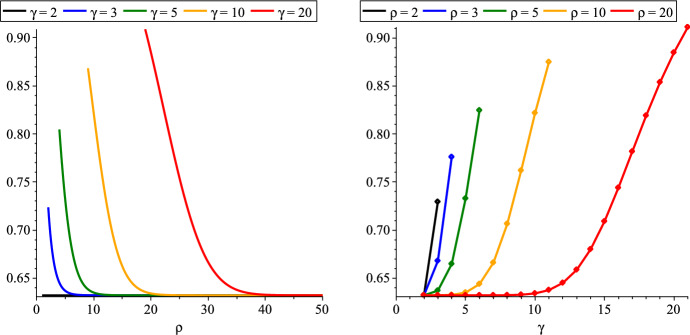 Figure 1
 Figure 2
 Figure 3
 Figure 4
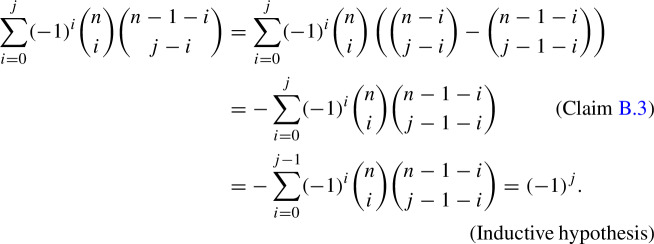 Figure 5
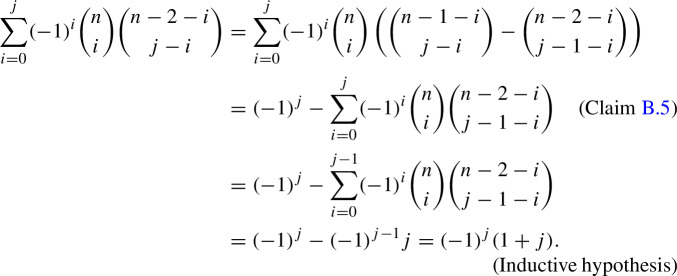 Figure 6
Peer Reviews
No public reviews on file for this paper yet. If you reviewed it on a platform where reviews are public (OpenReview, ICLR, NeurIPS, ICML), you can paste yours below so the community can read it here.
Videos
No videos yet. Explain this paper in a talk, walkthrough, or lecture? Add one.
Taxonomy
TopicsAuction Theory and Applications · Optimization and Search Problems · Complexity and Algorithms in Graphs