A nearly optimal randomized algorithm for explorable heap selection
Sander Borst, Daniel Dadush, Sophie Huiberts, Danish Kashaev

TL;DR
A new randomized algorithm is presented for selecting the nth smallest value in a binary heap, improving efficiency while using more space.
Contribution
A nearly optimal randomized algorithm for heap selection with improved runtime and a matching lower bound.
Findings
The new algorithm runs in O(n log(n)^3) time with O(log n) space.
A lower bound of Ω(log(n)n / log(log(n))) is established for the problem.
The algorithm improves upon previous randomized methods at the cost of slightly increased space.
Abstract
Explorable heap selection is the problem of selecting the nth smallest value in a binary heap. The key values can only be accessed by traversing through the underlying infinite binary tree, and the complexity of the algorithm is measured by the total distance traveled in the tree (each edge has unit cost). This problem was originally proposed as a model to study search strategies for the branch-and-bound algorithm with storage restrictions by Karp, Saks and Widgerson (FOCS ’86), who gave deterministic and randomized \documentclass[12pt]{minimal} \usepackage{amsmath} \usepackage{wasysym} \usepackage{amsfonts} \usepackage{amssymb} \usepackage{amsbsy} \usepackage{mathrsfs} \usepackage{upgreek} \setlength{\oddsidemargin}{-69pt} \begin{document}\end{document}n·exp(O(logn)) time algorithms using…
Genes, proteins, chemicals, diseases, species, mutations and cell lines named across the full text — each resolved to its canonical identifier and authoritative record.
Click any figure to enlarge with its caption.
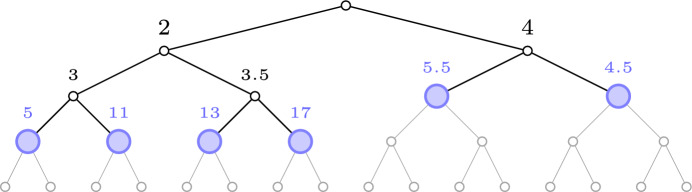 Figure 1
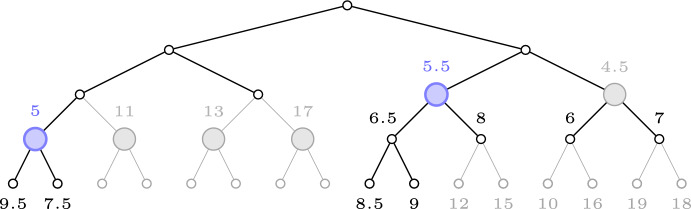 Figure 2
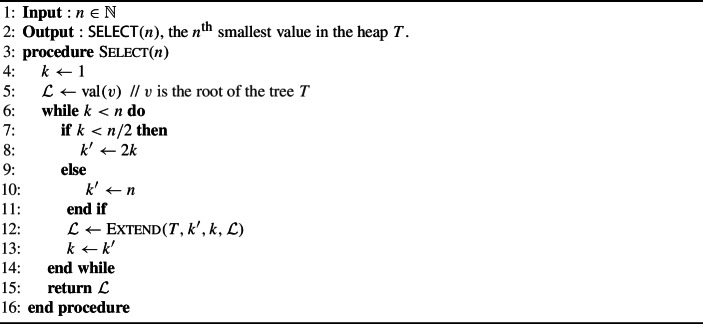 Figure 3
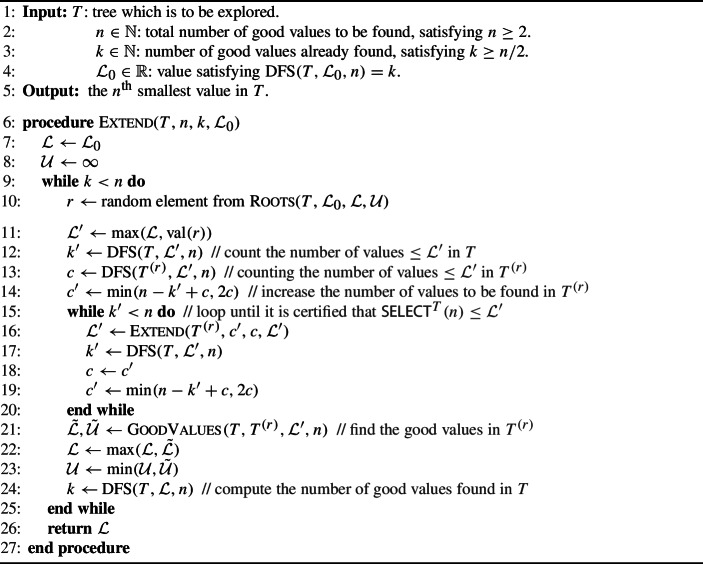 Figure 4
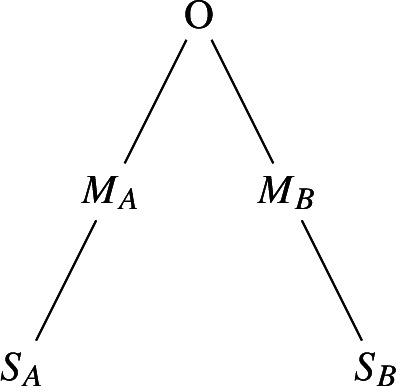 Figure 5
Peer Reviews
No public reviews on file for this paper yet. If you reviewed it on a platform where reviews are public (OpenReview, ICLR, NeurIPS, ICML), you can paste yours below so the community can read it here.
Videos
No videos yet. Explain this paper in a talk, walkthrough, or lecture? Add one.
Taxonomy
TopicsOptimization and Search Problems · Algorithms and Data Compression · Machine Learning and Algorithms