Histological prediction and choice of the best resection strategy in front of a colorectal lesion > 2 cm: prospective comparison of endoscopic characterization, non-targeted and targeted biopsies
Pierre Lafeuille, Emilien Daire, Jérôme Rivory, Florian Rostain, Jean-Christophe Saurin, Thomas Lambin, Frédéric Moll, Fabien Subtil, Tanguy Fenouil, Jérémie Jacques, Mathieu Pioche

TL;DR
This study compares endoscopic characterization and biopsies for predicting the best treatment for large colorectal lesions, finding that characterization is more effective.
Contribution
The study provides a prospective comparison of endoscopic characterization versus biopsy methods for treatment strategy selection in large colorectal lesions.
Findings
Endoscopic characterization proposed adequate treatment in 52.3 to 70.5% of cases, while biopsies had higher under treatment rates.
Biopsies failed to accurately assess cancer invasion depth and risked under treatment in nearly a third of cases.
Endoscopic characterization using CONECCT classification reduced under treatment and unnecessary surgeries for non-malignant lesions.
Abstract
Accurate endoscopic characterization of colorectal lesions is essential to predict histology and select the best treatment strategy but remains very difficult. Instead of the recommended endoscopic characterization, many gastroenterologists routinely perform biopsies of the lesion to propose endoscopic resection with or without R0 intent. The aim of this study was to determine which of endoscopic characterization or biopsies, either targeted (TB) or non-targeted (NTB), is the most effective to determine the best treatment strategy for colorectal neoplasia > 2 cm. We prospectively assessed the best strategy between endoscopic characterization and targeted or non-targeted biopsies, so that the proposed resection technique offered a level of quality of tumor resection adapted to the definitive histology of the lesion on R0-resected specimen. 84 patients with 88 lesions were included.…
Genes, proteins, chemicals, diseases, species, mutations and cell lines named across the full text — each resolved to its canonical identifier and authoritative record.
Click any figure to enlarge with its caption.
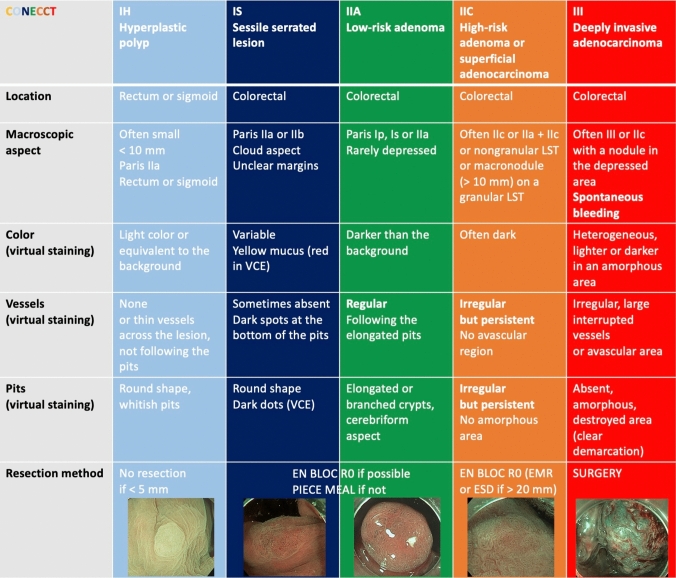 Figure 1
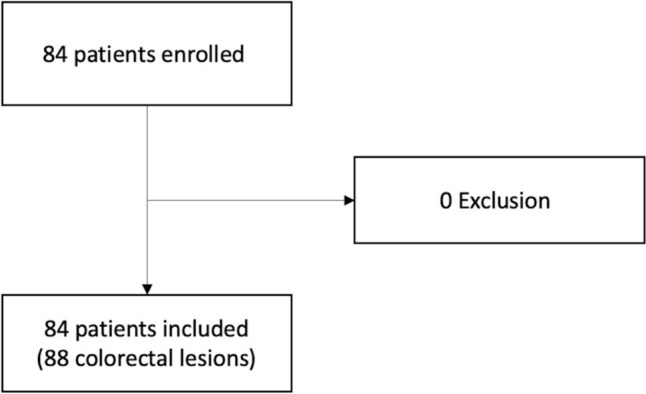 Figure 2
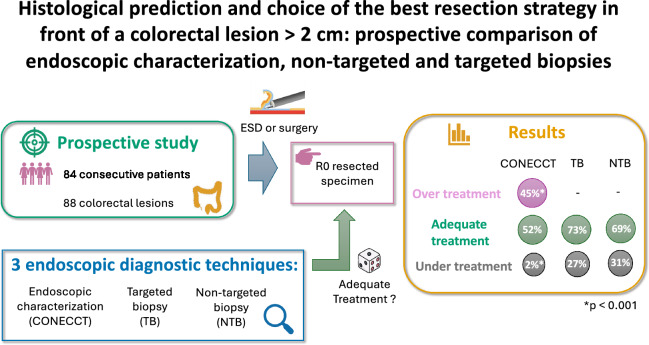 Figure 3
Peer Reviews
No public reviews on file for this paper yet. If you reviewed it on a platform where reviews are public (OpenReview, ICLR, NeurIPS, ICML), you can paste yours below so the community can read it here.
Videos
No videos yet. Explain this paper in a talk, walkthrough, or lecture? Add one.
Taxonomy
TopicsGastric Cancer Management and Outcomes · Colorectal Cancer Screening and Detection · Esophageal Cancer Research and Treatment