Avian tuberculosis identified as the potential disease in an outbreak in wild migratory birds in China
Chunge Zhang, Liang Wang, Cheng Zhang, Ning Zhang, Heting Sun, Dong Chu, Siyuan Qin, Zhenghai Ma, Marina Gulyaeva, Alexander Shestopalov, Wenjun Liu, George F. Gao, Yuhai Bi

TL;DR
This study finds avian tuberculosis as a cause of bird deaths in China, highlighting the need for wildlife disease monitoring to prevent public health risks.
Contribution
The study presents a rare case of tuberculosis in wild migratory birds using meta-transcriptomic and histopathological methods.
Findings
Avian tuberculosis is identified as a cause of mass mortality in migratory birds in Inner Mongolia.
The study highlights the risk of interspecies transmission of the disease.
It emphasizes the importance of wildlife disease surveillance for biodiversity and public health.
Abstract
This study identifies avian tuberculosis as a potential cause of mass mortality in wild migratory birds in Inner Mongolia, China. Combining meta‐transcriptomic sequencing and histopathological analysis, it reveals one of the rare instances of tuberculosis‐associated outbreaks in avian populations. These findings underscore the importance of surveillance on wildlife diseases to mitigate the risk of interspecies transmission of the disease associated pathogens and their broader implications for biodiversity and public health.
Genes, proteins, chemicals, diseases, species, mutations and cell lines named across the full text — each resolved to its canonical identifier and authoritative record.
Click any figure to enlarge with its caption.
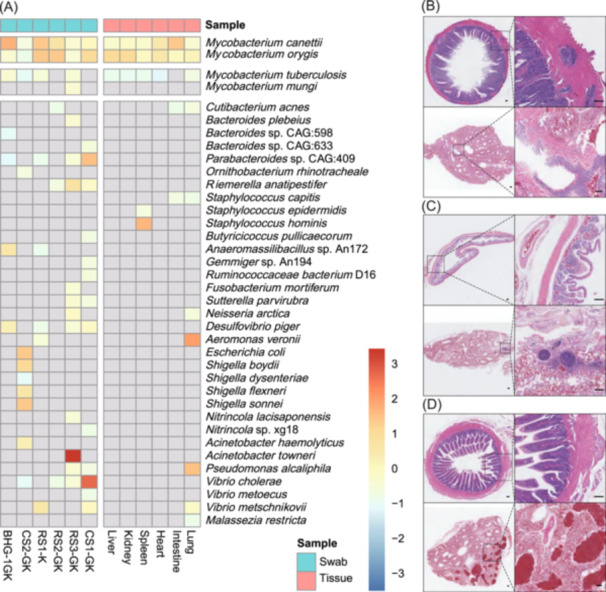 Figure 1
- —CAS Southeast Asia Biodiversity Research Institute
- —Russian Science Foundation 10.13039/501100006769
- —Innovation Team and Talents Cultivation Program of National Administration of Traditional Chinese Medicine
- —Youth Innovation Promotion Association of CAS
- —Major Project of Guangzhou National Laboratory
- —National Natural Science Foundation of China 10.13039/501100001809
- —National Science and Technology Infrastructure of China
Peer Reviews
No public reviews on file for this paper yet. If you reviewed it on a platform where reviews are public (OpenReview, ICLR, NeurIPS, ICML), you can paste yours below so the community can read it here.
Videos
No videos yet. Explain this paper in a talk, walkthrough, or lecture? Add one.
Taxonomy
TopicsMycobacterium research and diagnosis · Microbial infections and disease research · Tuberculosis Research and Epidemiology
Tuberculosis (TB) is a class of diseases caused by pathogens from the genus Mycobacterium and is also the leading cause of human deaths due to infectious diseases globally1. In 2022, tuberculosis diseases caused 1.4 million human deaths worldwide2. Typical symptoms of tuberculosis include a bad cough lasting 3 weeks or longer, chest pain, and coughing up blood or sputum (phlegm from deep inside the lungs)3. The host range of pathogens in Mycobacterium is widely distributed from terrestrial mammals4 to birds5, 6. Previous studies have documented infections caused by various species of Mycobacterium in wild bird populations. For instance, Mycobacterium avium has been frequently reported as a cause of avian tuberculosis in wild birds, leading to significant health impacts such as weight loss, respiratory issues, and eventual death, particularly in immunocompromised or stressed birds7, 8, 9, 10, 11. However, these reports are often limited to sporadic cases or small outbreaks. Large‐scale mortality events linked to Mycobacterium infections in wild bird populations are rarely documented. In addition, tuberculosis‐inducing pathogens can cross the host barrier and be transmitted between humans and animals12, posing a potential threat to public health. This study aims to elucidate the etiological agent behind an unprecedented event of mass mortality among migratory birds in Inner Mongolia, China, potentially broadening our understanding of Mycobacterium's host range and environmental resilience.
On August 15, 2018, wild bird deaths began in Dalinor Lake, Inner Mongolia, China. By September 19, 2861 wild birds representing 22 different species had died, with an average of 80 deaths per day. Clinical symptoms of diseased wild birds include physical weakness, lying prone, and tiredness of movement. Moreover, some wild birds discharged blue‐green and loose feces. In the present case, three bird species with the highest number of deaths were the common shelduck (CS, Tadorna tadorna), ruddy shelduck (RS, Tadorna ferruginea), and black‐headed gull (BHG, Larus ridibundus). However, the cause of death was unclear.
Organ specimens were collected from six dead wild birds. After mixing samples from the same organ, 12 samples (lung, intestine, heart, spleen, kidney, liver, and six throat and cloacal swabs from six dead birds) were labelled as Lung, Intestine, Heart, Spleen, Kidney, Liver, CS1‐GK, CS2‐GK, RS1‐K, RS2‐GK, RS3‐GK, and BHG‐1GK (K, throat swab; GK, throat and cloacal mixed swab); the samples were used for meta‐transcriptomic sequencing to determine the cause of death. To ensure the accuracy of our findings, Fastp13 was employed for quality control and adapter trimming of the raw sequencing data. Utilizing Fastp, we applied default parameters to remove low‐quality reads and adapter sequences, focusing on maintaining reads with a quality score above Q20. Subsequently, MetaPhlAn214 (version 2.2) was used to quantify the microbiome components in these samples. Sequences from viruses contained in each sample were limited, and no virus was shared by all samples; therefore, the studies focused only on detecting bacteria within the samples. Four species belonging to Mycobacterium were detected in each sample. Both Mycobacterium canettii and Mycobacterium orygis were detected in all 12 samples, and Mycobacterium tuberculosis was detected in all samples, except for the intestine, CS1‐GK, and RS2‐GK. Mycobacterium mungi was detected in only one sample from RS3‐GK. Some other bacteria were also identified among different samples (Figure 1A). As only RNA was used to perform next‐generation sequencing (NGS) and because of the short length of reads generated from NGS, it was difficult to precisely distinguish the taxonomy at the species level. However, the conclusion that wild birds died of Mycobacterium infection was strongly supported by the above evidence.
To further confirm whether the dead birds exhibited typical lesions caused by tuberculosis, we performed histopathological analysis of the tissues. As shown in Figure 1, typical lesions caused by tuberculosis were found in the tissues of CS, including lymphocyte infiltration of the small intestine, cellulose envelope of nodules, and serious congestion of the lungs (Figure 1B). The RS also showed typical lesions such as lymphocyte infiltration, cellulose exudation, intestinal mucosa shedding, and severe congestion of the lung tissue and trachea (Figure 1C). Additionally, we observed a significant influx of inflammatory cells surrounding the bronchioles, accompanied by cellular necrosis and disintegration at the focal center (Figure 1C,D). The histopathological results are consistent with those of the meta‐transcriptomic study. Based on the evidence, we conclude that wild birds in Dalinor Lake, Inner Mongolia, China, likely died of Mycobacterium bacterial infection. However, the pathogen of Mycobacterium was not successfully isolated so that the animal regression experiment was not performed, which warrants further study.
This study highlights the need for heightened surveillance of Mycobacterium in wildlife, particularly in migratory birds, to prevent interspecies transmission and potential public health risks.
AUTHOR CONTRIBUTIONS
Chunge Zhang: Data curation (lead); formal analysis (lead); investigation (lead); methodology (lead); validation (lead); visualization (lead); writing—original draft (lead); writing—review and editing (lead). Liang Wang: Data curation (lead); formal analysis (lead); visualization (lead); writing—review and editing (lead). Cheng Zhang: Formal analysis (supporting); investigation (supporting). Ning Zhang: Methodology (supporting); writing—review and editing (supporting). Heting Sun: Data curation (supporting); resource (supporting). Dong Chu: Resources (supporting). Siyuan Qin: Methodology (supporting); resources (supporting). Zhenghai Ma: Resources (supporting). Marina Gulyaeva: Methodology (supporting); writing—review and editing (supporting). Alexander Shestopalov: Methodology (supporting); writing—review and editing (supporting). Wenjun Liu: Resources (supporting). George F. Gao: Resources (equal); supervision (equal); writing—review and editing (supporting). Yuhai Bi: Conceptualization (lead); funding acquisition (lead); investigation (lead); project administration (lead); resources (lead); supervision (lead); writing—review and editing (lead).
ETHICS STATEMENT
This study was approved by the Animal Ethics Committee of the Institute of Microbiology, Chinese Academy of Sciences (Approval Number: APIMCAS2018034 and APIMCAS2021112).
CONFLICT OF INTERESTS
The authors declare no conflict of interests.
The reference list from the paper itself. Each links out to its DOI / PubMed record.
- 1Furin J , Cox H , Pai M . Tuberculosis. Lancet. 2019;393:1642–1656.30904262 10.1016/S 0140-6736(19)30308-3 · doi ↗ · pubmed ↗
- 2World Health Organization . Global tuberculosis report. 2022 [cited 2024 Jun 27]. Available from: https://www.who.int/teams/global-tuberculosis-programme/tb-reports/global-tuberculosis-report-2022
- 3Tuberculosis (TB). Signs and symptoms of Tuberculosis. 2025 [cited 2025 Jan 17]. Available from: https://www.cdc.gov/tb/signs-symptoms/
- 4Pereira AC , Reis AC , Ramos B , Cunha MV . Animal tuberculosis: impact of disease heterogeneity in transmission, diagnosis and control. Transbound Emerg Dis. 2020;67:tbed.13539.10.1111/tbed.1353932155685 · doi ↗ · pubmed ↗
- 5Dhama K , Mahendran M , Tiwari R , Dayal Singh S , Kumar D , Singh S , et al. Tuberculosis in birds: insights into the Mycobacterium avium infections. Vet Med Int. 2011;2011:712369.21776352 10.4061/2011/712369 PMC 3135220 · doi ↗ · pubmed ↗
- 6Rufai SB , Mc Intosh F , Poojary I , Chothe S , Sebastian A , Albert I , et al. Complete genome sequence of Mycobacterium orygis strain 51145. Microbiol Resour Announc. 2021;10:e 01279‐20.33414309 10.1128/MRA.01279-20PMC 8407732 · doi ↗ · pubmed ↗
- 7Hoop RK . Public health implications of exotic pet mycobacteriosis. Semin Avian Exotic Pet Med. 1997;6:3–8.
- 8Montali RJ , Mikota SK , Cheng LI . Mycobacterium tuberculosis in zoo and wildlife species. Rev Sci Tech Off Int Epiz. 2001;20:291–303.10.20506/rst.20.1.126811288517 · doi ↗ · pubmed ↗