Orobancheandryalae (Orobanchaceae): a new species from the Canary Islands

Abstract
Genes, proteins, chemicals, diseases, species, mutations and cell lines named across the full text — each resolved to its canonical identifier and authoritative record.
Click any figure to enlarge with its caption.
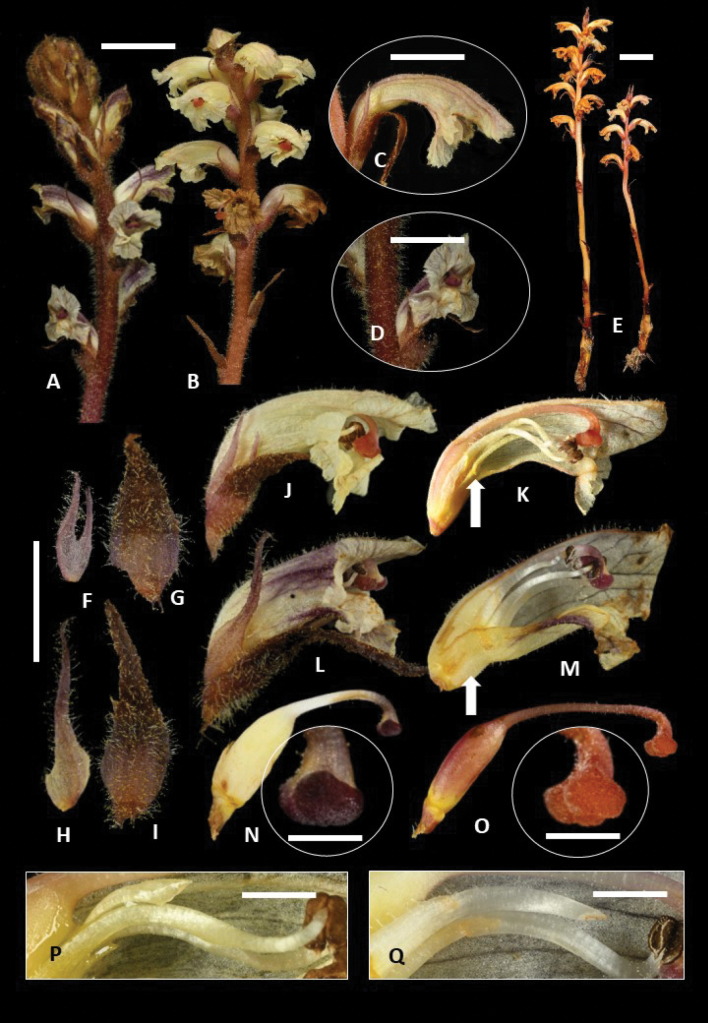 Figure 1
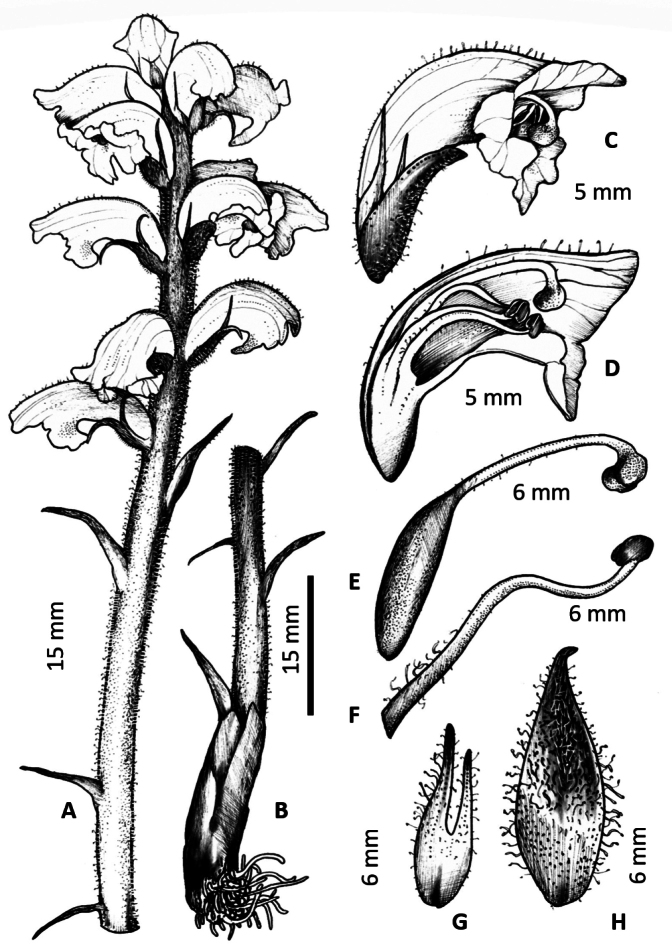 Figure 2
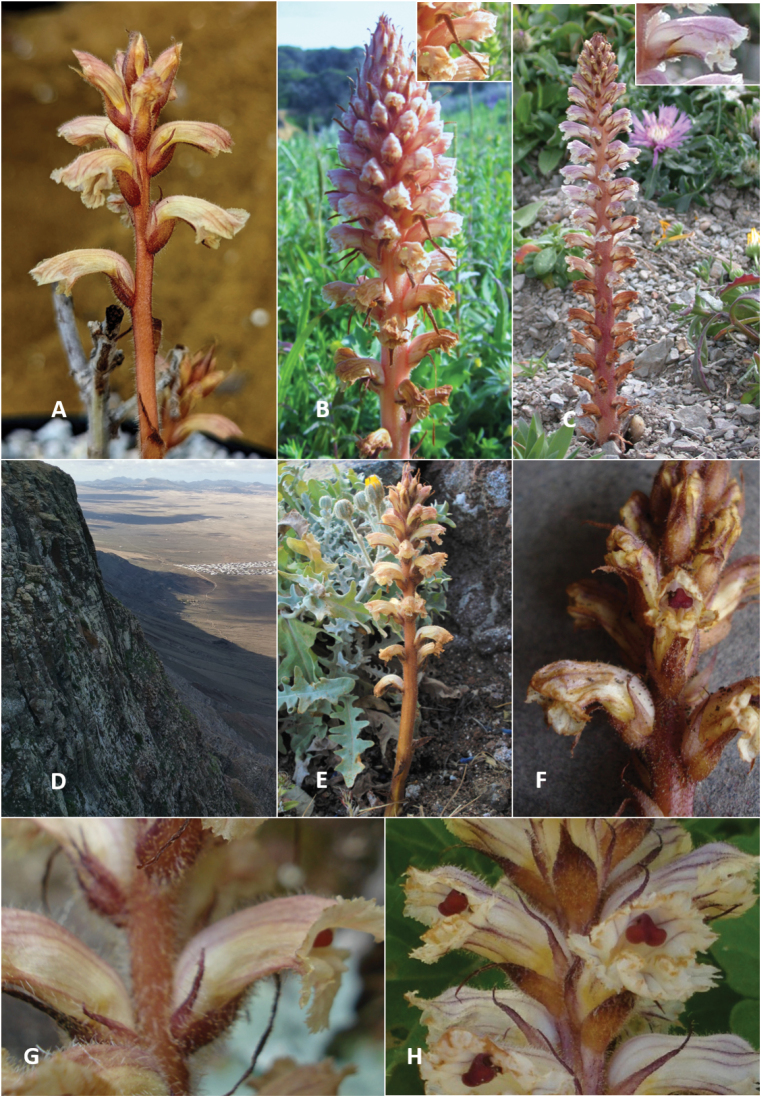 Figure 3
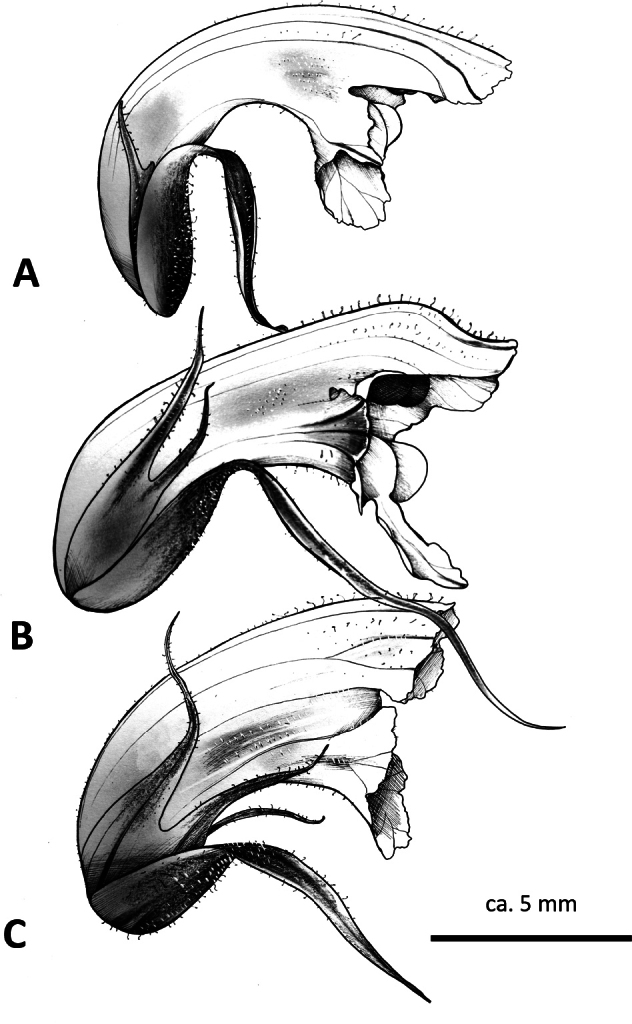 Figure 4
|
|
|
|
|
| |
|---|---|---|---|---|---|
| Host |
|
|
| Numerous hosts, especially | |
| Stem | Slender, pale reddish-orange; flowers ± lax, over the upper part of the stem | Slender to robust, brownish red or violet; flowers ± lax, over most of stem | Slender, purple; flowers ± lax, over the upper part of the stem | Slender to robust, purple or pinkish-brown; flowers ± dense, over the upper part of the stem | Slender, purplish to reddish; flowers lax, over most of stem |
| Floral bracts | 10–12 mm, markedly shorter than the corolla | 10–15 mm, slightly shorter than the corolla | 13–16 mm, ± Equalling the corolla | 14–17 mm, markedly exceeding the corolla | 6–22 mm ± equalling to exceeding the corolla |
| Calyx | 5–7 mm, segments fused, unequal (rarely entire) | 10–15 mm, segments free | 9–12 mm, segments fused, unequal | 10–13 mm, segments free, unequal | 6–14 mm, entire or segments fused, unequal to subequal |
| Corolla | 10–15 mm, pale yellow with faint reddish veins | 15–18 mm, cream with pink to violet veins | 17–20 mm, cream with purple veins | 16–25 mm, cream with purple veins | 10–18(20) mm, cream with purple veins |
| Corolla dorsal line | Strongly cernuous to geniculate | Smoothly-curved | ± erect, straight | ± erect, straight | Smoothly-curved |
| Corolla indumentum | Sparsely glandular hairy throughout or basally glabrescent | Glandular hairy, basally glabrescent | Densely glandular hairy, basally glabrescent | Glandular hairy, basally glabrescent or glabrous | Glandular hairy, basally glabrescent |
| Filaments | Sparsely hairy below, glabrous above; inserted 5 mm above the corolla base | Hairy below, glabrescent above; inserted 2–4 mm above the corolla base | Hairy below, glabrescent above; inserted 2–3 mm above the corolla base | Hairy below, glabrous above; inserted 3–4 mm above the corolla base | Glabrescent or sparsely hairy below; inserted 2–3 mm above the corolla base |
| Stigma (typically) | Red-orange | Reddish-purple | Violet | Pink to violet | Pink to violet |
| 1 | Corolla whitish, distally blue-purple |
|
| – | Corolla whitish to cream with reddish or violet veins (not distally blue-purple) |
|
| 2 | Flowers fragrant, corolla whitish, tubular-campanulate, lobes with crenate margins |
|
| – | Flowers not fragrant, corolla cream to pale yellow, narrowly-tubular, lobes not crenate |
|
| 3 | Stigma typically yellow, parasitic mainly on ivy in woods |
|
| – | Stigma pink or red-orange, not in woods |
|
| 4 | Corolla with an evenly-curved to almost straight dorsal line, filaments inserted 2–3 mm; various hosts, disturbed habitats |
|
| – | Corolla markedly cernuous (to geniculate), filaments inserted c. 5 mm; on |
|
Peer Reviews
No public reviews on file for this paper yet. If you reviewed it on a platform where reviews are public (OpenReview, ICLR, NeurIPS, ICML), you can paste yours below so the community can read it here.
Videos
No videos yet. Explain this paper in a talk, walkthrough, or lecture? Add one.
Taxonomy
TopicsPlant Parasitism and Resistance · Plant and animal studies · Plant Diversity and Evolution
Introduction
Broomrapes (genus Orobanche L., family Orobanchaceae Vent.) are taxonomically challenging. They are holoparasitic so devoid of functional leaves and other diagnostic characteristics, and many of the characters useful for identification such as stigma and corolla colour, are lost when dry. Herbarium specimens are often determined incorrectly and have inadequate field notes. Particularly challenging are closely related species in the Subsection Minores Teryokhin: a group of similar, small-flowered species (corollas typically < 20 mm) (see e.g. El Mokni et al. 2015). Beck-Mannagetta (1930) in his comprehensive monograph of the genus, listed over 345 binomials belonging to this group (to which he referred as the Grex Minores) and recognised 20 species, 20 varieties, and a total of 69 forms. Existing phylogenies have not successfully resolved taxa in the Subsection Minores. Moreover, genetically distinct host races can be obscured by cryptic morphology (Thorogood et al. 2009). In the absence of a comprehensively sampled and well-resolved phylogeny, a combined approach that considers ecology, host range, and stable morphological features (such as filament insertion and corolla dorsal line) is needed to tease apart taxa in this complicated group.
There are at least seven species of Orobanche, and a further seven species of the related genus Phelipanche Pomel, recorded to occur in the Canary Islands (BIOTA 2024), but a detailed taxonomic assessment for the area is absent and necessary. Within the Subsection Minores, five species have been recorded to occur in the region: O.minor Sm., O.calendulae Pomel, O.artemisiae-campestris Vaucher ex Gaudin (as cf. O.loricata – doubtfully, probably in error for the species under consideration) and O.amethystea Thuill., together with O hederae Duby (also considered, based on molecular evidence, to belong to the similar Subsection Hederae Teryokhin). The most widespread of these is O.minor which occurs across Europe and the Mediterranean Basin, and is widely naturalised in temperate regions across the globe. This species tends to occur in urban and ruderal sites on all the Canary Islands and may be introduced to the region. Orobancheminor is lax, small-flowered (corolla 10–18 mm), and purplish in colour; it grows on a wide variety of hosts from 16 orders (Thorogood et al. 2009). Orobanchehederae occurs in damp woods on Hedera – but once also reported to grow on Geraniumreuteri Aedo & Muñoz Garm. (Gilli 1980) - on the western islands (Tenerife, La Gomera, La Palma) and is easily distinguished by its yellow stigma (in other species the stigma is variable but typically pinkish, reddish, purplish), corollas with a distinct constriction behind the corolla mouth, and acute and lacerate corolla lower lip lobes. Orobancheamethystea is widespread across Europe and is usually parasitic on Eryngiumcampestre L., but has been recorded on other hosts including various other Apiaceae Lindl., and even Digitalis Tourn. ex L. (Plantaginaceae) (Chater and Webb 1972). It is superficially similar to O.minor but more robust, with a larger corolla (15–25 mm) that is rather sharply inflected near the base, rather flat along the dorsal line, and geniculate near the tip (rather than with a smoothly-curved dorsal line), with a somewhat 2-lobed upper lip, and high filament insertion. Orobancheamethystea has long been recorded to occur on Lanzarote and Tenerife (Reyes-Betancort et al. 2000; Padrón-Mederos et al. 2009); the subspecies reported there is subsp. castellana (Reut.) Rouy which differs from the type subspecies in lacking filiform calyx teeth, pinkish-brown (rather than violet) flowers, and the upper corolla lip being less conspicuously divided. However, these plants identified as O.amethystea in the Canary Islands lack nearly all the features associated with that species. They also differ markedly from O.minor with which it co-occurs, but in a different niche (ruderal sites). The plant in question has only been recorded to parasitize Andryalaperezii M.Z.Ferreira, R.Jardim, Alv.Fern. & M.Seq. (Ferreira et al. 2014), endemic to Lanzarote and Fuerteventura, and to a lesser extent, on Andryalapinnatifida Aiton on Tenerife (a species that occurs on all the Canary Islands) - an unusual but not unquestionable host range for O.amethystea; the genus Andryala is also the host range of O.almeriensis A.Pujadas (González and Pujadas Salvà 1995), which also belongs to the Subsection Minores; however this too, is morphologically dissimilar to the material in question (Table 1). The latter author (JARB) has also observed the taxonomic entity in question apparently growing on Asteriscussericeus (L.f.) DC. once, on Pico de la Zarza, the highest peak of Fuerteventura. This population needs revisiting.
The closest morphological match to the plants thus far identified as O.amethysteasubsp.castellana in the Canary Islands is in our view, O.calendulae: a rather confused taxon that tends to grow on coastal cliffs, primarily parasitizing Calendulasuffruticosa Vahl aggregate, and related species (and possibly other Asteraceae). It is generally described as having a curved, pale-yellow corolla (although see taxonomic remarks, below). Indeed the plant under consideration in the Canary Islands has also been identified as O.calendulae (Marrero et al. 1995), notwithstanding the atypical host (Andryala). However the plant in Lanzarote has a markedly cernuous (more rarely geniculate) corolla not seen in any other known species in the Subsection Minores, as well as distinct colouration and a high filament insertion. On account of this unusual combination of morphological features, and marked distribution and ecology, we examined material from the Canary Islands to resolve this long-standing taxonomic confusion.
Materials and methods
Plant material
Plants were observed in the field in Lanzarote between 2020 and 2023, and then cultivated in 2023–2024 to ensure morphological characteristics were stable (i.e. not a product of environment). Seeds were collected by the second author (MHG) from a population near Haría (29°08'07.4"N, 13°30'18.2"W) and sent to the first author (CJT) who cultivated the plant at the University of Oxford Botanic Garden on 10 potted specimens of Andryalaperezii grown under glass (ambient light, 15–20 °C). Seventeen spikes of Orobancheandryalae emerged in April, 4 months after planting, and each was measured and examined to inform the type description. Specimens were then compared with O.minor (growing spontaneously at the University of Oxford Botanic Garden) because this is the most widespread and common species in the Subsection Minores and co-occurs (at least on Lanzarote) with O.andryalae.
Results
Orobanche
andryalae
Taxon classificationPlantaeLamialesOrobanchaceae
C.J.Thorogood, M. Hernández González, Rumsey & Reyes-Bet. sp. nov.
9D4999B2-BB8A-5274-9E99-14F6898766F1
urn:lsid:ipni.org:names:77356942-1
Description.
Stems 6–16(25) cm, glandular-hairy, pale orange to light reddish-brown. Stem scarcely swollen below; subterranean bracts broadly triangular, yellow; those above (reduced leaves) rather sparse, brown, 8–15 mm. Flowers 5–15(20), arranged on the upper quarter or third of the stem, lax. Bracts 10–12 mm, rather shorter than the corolla, broadly triangular, brown, glandular-hairy. Calyx 5–7 mm with segments fused, strongly unequal (rarely entire), not exceeding the corolla tube. Corolla 10–15 mm, pale yellow with faint reddish veins and scattered glandular hairs, strongly cernuous when mature, remaining so in fruit, sometimes abruptly geniculate; upper lip bilobed; lower lip 3-lobed, the lateral lobes slightly exceeding the central; all lobes minutely-toothed. Filaments sparsely hairy below, glabrous above; inserted conspicuously (c.5 mm) above the corolla base; anthers ± glabrous. Stigma lobes touching, mid to dark red-orange.
Type.
Lanzarote, Canary Islands, Haría (29°08'07.4"N, 13°30'18.2"W); material grown from seed at the University of Oxford Botanic Garden, Oxford, United Kingdom; April 22, 2024. (holotype ORT 48576!), (isotype OXF! Barcode 00227715O).
Distribution, ecology and IUCN Red List status.
We examined O.andryalae in two locations on the island of Lanzarote, with five specimens at a population near Yé (29°11'46.1"N, 13°29'34.1"W), and about 40 in the other near Haría (29°08'07.4"N, 13°30'18.2"W) in 2020, 2021 and 2022. The plant was also observed in the Valle de Guerra and Teno regions of north Tenerife. Because O.andryalae is an annual, and based on observations of related species, we anticipate that numbers may fluctuate markedly from year to year (Rumsey and Thorogood 2023). Orobanche seed banks can, however, remain viable for decades (Rumsey and Thorogood 2023). Based on our current observations the species is likely to qualify for a threat status because of its restricted distribution, few locations and very low observed numbers and given that it co-occurs with its narrowly endemic host, Andryalaperezii on Lanzarote, and on A.pinnatifida on Tenerife (records on other endemic Asteraceae including Asteriscusintermedius (DC.) Pit. & Proust, A.sericeus, and Crepiscanariensis (Sch.Bip.) Babc. ex Jenkins require further investigation). Andryalaperezii – the predominant host, is locally common within its restricted range (Ferreira et al. 2014) and further parasite populations are to be expected on Lanzarote (the apparent stronghold for the parasite). Andryalaperezii also occurs on Fuerteventura, where we have observed O.andryalae (but here it was recorded on Asteriscussericeus; this too, requires further examination). Andryalapinnatifida, a recorded host in Tenerife, occurs across the western Canary Islands, again indicating O.andryalae may be under-recorded. We suggest that in the absence of long-term surveys, O.andryalae should, for now, be treated as DD (Data Deficient) (IUCN 2001).
Etymology.
Orobancheandryalae is named in accordance with its main host species, Andryalaperezii.
Taxonomic remarks.
Orobancheandryalae can readily distinguished by its strongly cernuous corolla (Figs 1C, 2C, 3A, 4A), coloration, filament insertion (Figs 1K, 2D), and distinct host and ecology. Importantly, these characteristics remain stable under cultivation (Fig. 3A). The plant is distinct from O.amethysteasubsp.castellana, which it is now clear does not occur in the Canary Islands, and we do not discuss further here. Rather, the closest taxon to O.andryalae appears to be O.calendulae, which is a somewhat confused taxon, originally documented from Algeria (Pomel 1874), and since recorded from Madeira, Morocco, Portugal and Spain (Chater and Webb 1972), and Tunisia (El Mokni et al. 2023). Orobanchecalendulae has marked host specificity and ecology, growing on relatives of the Calendulasuffruticosa aggregate on sea cliffs. Beck-Mannagetta (1930) also recognised a similar entity, Orobanchemauretanica Beck, mainly on the basis of distinct calyx characteristics: connate in O.mauretanica and entire, or bifid and free in O.calendulae. He described a variety of O.mauretanicathat he namedvar.calendulae, from the Algarve region of Portugal, which is parasitic on Calendulasuffruticosa. Greuter et al. (1989), however, synonymised O.mauretanica under Orobanchecalendulae, a decision that has been followed rather inconsistently; since that time, floras have also differed somewhat in their descriptions of Orobanchecalendulae. For example, both Flora Europaea (Chater and Webb 1972) and Flora Iberica (Foley 2001), describe equal calyx segments that are fused at the base; we note that the calyx segments in the holotype from Algeria are bifid but somewhat unequal; in the type description, they are reported to be entire or bifid (Pomel 1874).
AOrobancheminor habit BO.andryalae habit CO.andryalae corolla in profile DO.minor corolla in profile EO.andryalae whole plant F, G calyx and bract of O.andryalaeH, I calyx and bract of O.minorJ, KO.andryalae corolla in profile with cross section; arrow indicates filament insertion point L, MO.minor corolla in profile with cross section; arrow indicates filament insertion point N carpel and stigma of O.minorO carpel and stigma of O.andryalaeP stamen of O.andryalaeQ Stamen of O.minor. Scale bars: 15 mm (A, B); 7.5 mm (C, D); 15 mm (E); 15 mm (F, M); 5 mm (N–O); 4 mm (P, Q).
OrobancheandryalaeA habit B lower stem C corolla D corolla cross section E carpel F stamen G calyx lobe H bract.
AOrobancheandryalae in cultivation at the University of Oxford Botanic Garden BO.amethystea in the Algarve, Portugal CO.calendulae in the Algarve, Portugal D the habitat of O.andryalae in Lanzarote: volcanic cliffs (Famara area, northern Lanzarote) EO.andryalae in Lanzarote, with its host plant AndryalapereziiFO.andryalae collected from Fuerteventura (putatively parasitising Asteriscussericeus) G, HO.andryalae in northwest Tenerife growing on Andryalapinnatifida (the corolla dorsal line of the specimen in H is atypical in being less conspicuously cernuous).
Corollas in profile AO.andryalaeBO.amethysteaCO.calendulae. Note the scale is indicative only, as corolla length is variable.
The first author (CJT) has observed Orobanche populations on sea cliffs in the Algarve growing on C.suffruticosa (Fig. 3C, 4C) that may pertain to Beck’s O.mauretanicavar.calendulae (= O.calendulae). These plants possess pale orange stems, whitish corolla with violet pigmentation, reddish stigmas, apically filiform calyx lobes, and flowers arranged over most of the stem. These features appear to be consistent with the holotype of O.calendulae (Pomel 1874). But to complicate matters further, this plant (O.calendulae s.l.) co-occurs in the Algarve with O.minor (on various hosts), O.litorea Guss. (on Plantago), O.balsensis (J.A.Guim.) Carlón, M.Laínz, Moreno Mor. & Ó.Sánchez (on Carlina), and interestingly, O.amethystea (on Eryngiumcampestre) (Fig. 3B, 4B); Beck-Mannagetta also recognised a form of O.mauritanica on Eryngiumcampestre in the Algarve (‘forma dioristha’). Presumably this form in fact pertains to O.amethystea, but in the absence of material to examine, this remains a mystery. Again, this demonstrates the nontrivial historical confusion surrounding the taxa in this area, and the importance of examining a range of characters, as well as ecology and host identity when describing OrobancheSubsectionMinores.
Furthermore, we should note that populations of an unexamined entity in the Subsection Minores in Madeira also grow on Andryala, in this case A.glandulosa Lam. which is endemic to Madeira, Porto Santo and the Desertas. These plants have puberulent, yellowish stems, rather flat-backed corollas, long, apically filiform calyx lobes, and pinkish stigma lobes. Despite their Macaronesian distribution and host, they are clearly distinct from the Canary Island plant under consideration. They do, however, show a superficial similarity to O.litorea, and deserve further attention.
Notwithstanding the confusion surrounding the Subsection Minores, none of the taxonomic entities considered hitherto in this complex possess the stable combination of features we observe in Orobancheandryalae in the Canary Islands: a markedly cernuous corolla, high filament insertion and yellowish-orange colouration with a reddish stigma, and specificity for Andryala spp. on thermophilous volcanic substrates (Fig. 3D). In advance of a well-resolved phylogeny, it is important that taxonomic entities in the Subsection Minores are characterised morphologically and ecologically, to enable robust sampling and nomenclature.
Key to the Orobanche species known to occur in the Canary Islands
Note that O.amethystea is not included as we believe all records of the plant in the Canary Islands pertain to O.andryalae.
**: **
Supplementary Material
XML Treatment for Orobanche andryalae
The reference list from the paper itself. Each links out to its DOI / PubMed record.
- 1Beck-Mannagetta G (1930) Orobanchaceae. In: Engler A (Ed.) Das Pflanzenreich IV 261.Wilhelm Engelmann, Leipzig, 1–348.
- 2BIOTA (2024) Banco de Datos de Biodiversidad de Canarias. Gobierno de Canarias. https://www.biodiversidadcanarias.es/biota [accessed 31.10.2024]
- 3Chater AO Webb DA (1972) Orobanche L. In: Tutin TG (Ed.) Flora Europaea 3.Cambridge University Press, Cambridge, 286–293.
- 4El Mokni R Domina G Sebei H El Aouni MH (2015) Taxonomic notes and distribution of taxa of Orobanchegr.minor (Orobanchaceae) from Tunisia.Acta Botanica Gallica 162(1): 5–10. 10.1080/12538078.2014.993424 · doi ↗
- 5El Mokni R Domina G Barone G (2023) New records of the genus Orobanche L. (Orobanchaceae) to the Tunisian flora with lectotypification of the name O.rapum-genistae Thuill.Adansonia 45(5): 73–81. 10.5252/adansonia 2023 v 45a 5 · doi ↗
- 6Ferreira MZÁlvarez Fernández I Jardim R Menezes de Sequeira M (2014) Andryalaperezii (Asteraceae), a New Species from the Canary Islands.Novon: A Journal for Botanical Nomenclature 23(2): 147–156. 10.3417/2010119 · doi ↗
- 7Foley M (2001) Orobanchaceae. In: Castroviejo S (Ed.) Flora Iberica 14.Real Jardín Botánico, CSIC, Madrid, 28–72.
- 8Gilli A (1980) Neue Orobanche-Fundorte auf den Kanarischen Inseln. Feddes Repertorium 91(1–2): 115. 10.1002/fedr.19800910120 · doi ↗