Decoding an Uncommon Form of Inflammatory Polyposis Colitis
Nargiz Gasimova, Daria Yunina-Distefano

TL;DR
This paper presents a rare case of inflammatory polyposis colitis in an elderly man who improved with corticosteroid treatment.
Contribution
The case highlights the diagnostic and therapeutic challenges of a rare non-hereditary gastrointestinal disorder.
Findings
A 79-year-old male with inflammatory polyposis colitis showed response to corticosteroid therapy.
The condition presents with chronic diarrhea, polyposis, and systemic symptoms like hypoalbuminemia and weight loss.
Abstract
Inflammatory polyposis colitis is a rare, non-hereditary gastrointestinal disorder characterized by chronic diarrhea, diffuse gastrointestinal polyposis, and systemic features such as hypoalbuminemia, weight loss, and dermatological changes. The etiology remains unknown, with diagnosis reliant on clinical, endoscopic, and histopathological findings. This case describes a 79-year-old male with inflammatory polyposis colitis who responded to corticosteroid therapy. The report emphasizes the diagnostic and therapeutic challenges of this condition.
Genes, proteins, chemicals, diseases, species, mutations and cell lines named across the full text — each resolved to its canonical identifier and authoritative record.
Click any figure to enlarge with its caption.
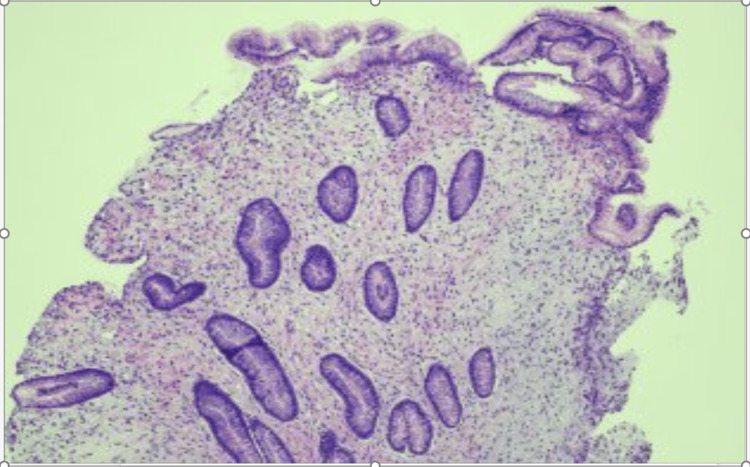 Figure 1
| Laboratory Test | Patient Value | Reference Value |
| Albumin | 3.4 g/dL | 3.5 - 5.0 g/dL |
| Erythrocyte Sedimentation Rate | 39 mm/hour | 0 - 20 mm/hour |
| C-reactive Protein | 22 mg/L | < 10 mg/L |
| Total Bilirubin | 1.76 mg/dL | 0.1 - 1.2 mg/dL |
| Stool Studies | "-" for infection | Negative |
Peer Reviews
No public reviews on file for this paper yet. If you reviewed it on a platform where reviews are public (OpenReview, ICLR, NeurIPS, ICML), you can paste yours below so the community can read it here.
Videos
No videos yet. Explain this paper in a talk, walkthrough, or lecture? Add one.
Taxonomy
TopicsMicroscopic Colitis · Celiac Disease Research and Management · Helicobacter pylori-related gastroenterology studies
Introduction
Inflammatory polyposis colitis is a rare disorder characterized by diffuse gastrointestinal polyposis, chronic diarrhea, weight loss, and systemic manifestations such as hypoalbuminemia, alopecia, and nail dystrophy [1,2]. With fewer than 500 documented cases worldwide, its pathophysiology remains poorly understood. Diagnosis is based on clinical presentation, endoscopic findings, and histological confirmation of inflammation with eosinophilic infiltration [3,4].
While treatment often involves corticosteroids and nutritional supplementation, the disease has a high mortality rate, estimated at 55% within five years of diagnosis [2,5]. We report a case of inflammatory polyposis colitis in a 79-year-old male who presented with typical symptoms and showed clinical improvement with corticosteroid therapy.
Case presentation
Clinical presentation and history
A 79-year-old male with a medical history of hypertension, hyperlipidemia, and coronary artery disease presented to the outpatient gastroenterology clinic with complaints of persistent diarrhea, weight loss, and systemic symptoms.
The patient reported up to 20 episodes of watery, non-bloody diarrhea daily over 6-8 weeks, accompanied by a 15-pound weight loss, nausea, and anorexia. He also noted nail cracking, hair thinning, and a sensation of a lump in his throat. He denied recent travel, antibiotic use, or dietary changes. His social history included past smoking but no alcohol consumption.
Physical examination
The patient appeared generally well but exhibited dry skin and nail dystrophy. Abdominal examination was unremarkable, revealing no tenderness, masses, or organomegaly. Table 1 lists the findings of laboratory tests.
Endoscopic findings
Upper endoscopy and colonoscopy revealed erythematous, granular mucosa in the stomach and diffuse polypoid changes throughout the colon. Biopsies showed acute and chronic inflammation with significant eosinophilic infiltration. Histopathological findings confirmed the diagnosis of inflammatory polyposis colitis (Figure 1).
Gastric antrum on 10 x magnification depicting striking lamina propria edema with mucosal thickening and hyperplasia
Treatment and outcome
The patient was started on oral budesonide (9 mg/day), resulting in the resolution of diarrhea within one week. He was also referred to a nutritionist to address vitamin and mineral deficiencies. Follow-up at three months showed no recurrence of symptoms.
Discussion
Inflammatory polyposis colitis is a rare and poorly understood condition, with pathophysiological mechanisms believed to involve immune dysregulation and chronic inflammation [1,3]. Its hallmark features include diffuse gastrointestinal polyposis and systemic manifestations such as hypoalbuminemia, alopecia, and nail dystrophy [2,4].
The average age of onset is 61 years, with no significant gender predilection [2]. Chronic diarrhea and weight loss are the most common presenting symptoms, as observed in our patient. Hypoalbuminemia, present in up to 88% of cases, contributes to systemic symptoms such as edema and dermatological changes [6].
Treatment typically involves corticosteroids to reduce inflammation and modulate immune responses, though their efficacy is not well-established in controlled studies [5,7]. In severe cases, immunosuppressants such as tacrolimus or surgical interventions may be considered.
Our case demonstrates the successful use of budesonide in alleviating symptoms and highlights the importance of early diagnosis and intervention to prevent complications.
Conclusions
Inflammatory polyposis colitis is an exceedingly rare condition requiring a high index of suspicion for diagnosis. This case underscores the importance of corticosteroid therapy and nutritional support in management while further research is needed to elucidate its pathophysiology and optimize treatment strategies.
The reference list from the paper itself. Each links out to its DOI / PubMed record.
- 1Generalized gastrointestinal polyposis; an unusual syndrome of polyposis, pigmentation, alopecia and onychotrophia N Engl J Med Cronkhite LW Jr Canada WJ 1011101525219551438395210.1056/NEJM 195506162522401 · doi ↗ · pubmed ↗
- 2Reversible normalisation of serum TSH levels in patients with autoimmune atrophic gastritis who received L-T 4 in tablet form after switching to an oral liquid formulation: a case series BMC Gastroenterol Fallahi P Ferrari SM Ruffilli I Antonelli A 221620162696551810.1186/s 12876-016-0439-y PMC 4787146 · doi ↗ · pubmed ↗
- 3Cronkhite-Canada syndrome: report of six cases and review of literature World J Gastroenterol Wen XH Wang L Wang YX Qian JM 75187522202014 https://pmc.ncbi.nlm.nih.gov/articles/PMC 4064099/2496662410.3748/wjg.v 20.i 23.7518 PMC 4064099 · doi ↗ · pubmed ↗
- 4Two cases of the rare Cronkhite-Canada syndrome Ugeskr Laeger Christensen T De Muckadell OBS 1792017 https://www.researchgate.net/publication/330513273_Two_cases_of_the_rare_Cronkhite-Canada_syndrome 28689546 · pubmed ↗
- 5Changes in fecal calprotectin after rifaximin treatment in patients with nonconstipated irritable bowel syndrome Am J Med Sci Lee SH Kim CR Kim KN 232835720193061131610.1016/j.amjms.2018.11.004 · doi ↗ · pubmed ↗
- 6Application of novel magnified single balloon enteroscopy for a patient with Cronkhite-Canada syndrome World J Gastroenterol Murata M Bamba S Takahashi K 412141262320172865266510.3748/wjg.v 23.i 22.4121 PMC 5473131 · doi ↗ · pubmed ↗
- 7Congenital analbuminemia in a Korean male diagnosed with single nucleotide polymorphism in the ALB gene: the first case reported in Korea Yonsei Med J Kim Y Yang YS Park SS Kim MJ Shin CM Choi SH 7007036020193125058510.3349/ymj.2019.60.7.700PMC 6597461 · doi ↗ · pubmed ↗