Investigation of the Positional Relationship Between the Tympanic Segment of the Chorda Tympani and the Incus in Patients With Otosclerosis or Middle Ear Anomalies Using Ultra-High Resolution Computed Tomography
Aya Katsura, Shinsuke Kaneshiro, Harukazu Hiraumi, Makiko Obara, Akio Tamura, Kiyoto Shiga, Kunihiro Yoshioka

TL;DR
This study shows that ultra-high-resolution CT scans can accurately predict the spatial relationship between two ear structures in patients with ear conditions.
Contribution
The study demonstrates the accuracy of U-HRCT in predicting the positional relationship of the chorda tympani and incus in otosclerosis or middle ear anomalies.
Findings
U-HRCT measurements were close to surgical measurements, with a mean distance of 0.7 mm versus 0.9 mm.
U-HRCT correctly predicted the attachment of the chorda tympani to the incus in all three cases observed.
Nine out of 13 patients had U-HRCT and surgical measurements in the same 0.5 mm group.
Abstract
Objective: This study evaluated the sensitivity and accuracy of ultra-high-resolution computed tomography (U-HRCT) in predicting the relationship between the chorda tympani and the long crus of the incus in patients with otosclerosis or middle ear anomalies. Methods: Thirteen patients with otosclerosis or middle ear anomalies were enrolled in this study (three males and ten females; mean age, 41.6 years; range, 7–67 years). The patients underwent U-HRCT (Aquilion Precision; Canon Medical Systems, Japan). Multiplanar reconstruction images were obtained, and the distance between the chorda tympani and the long crus of the incus was measured in a plane parallel to the superstructure of the stapes. In addition, the distance between the two structures was measured during surgery. Subsequently, distances of every 0.5 mm obtained using the two modalities were grouped and compared. Results:…
Genes, proteins, chemicals, diseases, species, mutations and cell lines named across the full text — each resolved to its canonical identifier and authoritative record.
Click any figure to enlarge with its caption.
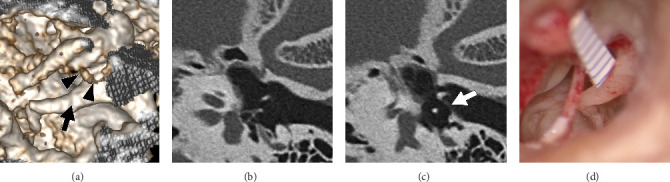 Figure 1
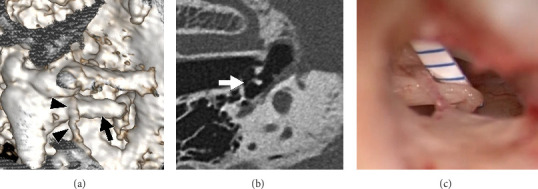 Figure 2
Peer Reviews
No public reviews on file for this paper yet. If you reviewed it on a platform where reviews are public (OpenReview, ICLR, NeurIPS, ICML), you can paste yours below so the community can read it here.
Videos
No videos yet. Explain this paper in a talk, walkthrough, or lecture? Add one.
Taxonomy
TopicsEar Surgery and Otitis Media · Vestibular and auditory disorders · Nasal Surgery and Airway Studies