“If everyone comes together, many things can be changed”: A qualitative study on men’s perspectives on menstrual health and equity in the Barcelona area (Spain)
Andrea García-Egea, Constanza Jacques-Aviñó, Anna Berenguera, Jordi Baroja-Benlliure, Diana Pinzón-Sanabria, Anna Sofie Holst, Tomàs López-Jiménez, Jordina Munrós-Feliu, María Mercedes Vicente-Hernández, Carme Valls-Llobet, Cristina Martínez-Bueno, Laura Medina-Perucha

TL;DR
This study explores how men and non-menstruating individuals in Barcelona understand and view menstruation, highlighting gaps in education and the need for inclusive policies.
Contribution
The study provides novel insights into men's perspectives on menstrual health and equity, emphasizing their role in advocacy and education.
Findings
Menstrual education is often inadequate and biomedical, with knowledge typically gained through personal relationships.
Menstruation is generally viewed negatively, with visible stigma and taboo.
Participants suggest men should help promote positive attitudes toward menstruation.
Abstract
There is a paucity of research exploring how men and individuals who do not menstruate comprehend menstrual health and equity. The objective of this study was to explore the conceptualization and attitudes towards menstruation and the menstrual cycle among men and people who do not menstruate aged between 18 and 55 in the Barcelona area. Furthermore, it examined their involvement in menstrual health and equity initiatives. This qualitative study employed a feminist critical perspective. Seventeen semi-structured photo-elicitation interviews were conducted. It was frequently observed that menstrual education was often inadequate and biomedical in nature. Participants often acquired knowledge about menstruation through interactions with menstruating sex-affective partners. Menstruation was generally perceived negatively, and menstrual taboo and stigma were apparent. Some participants…
Genes, proteins, chemicals, diseases, species, mutations and cell lines named across the full text — each resolved to its canonical identifier and authoritative record.
Click any figure to enlarge with its caption.
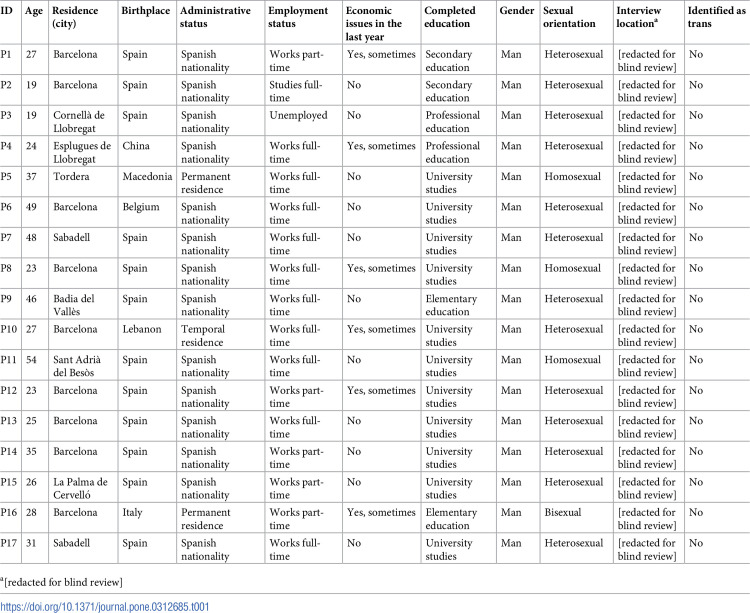 Figure 1
Peer Reviews
No public reviews on file for this paper yet. If you reviewed it on a platform where reviews are public (OpenReview, ICLR, NeurIPS, ICML), you can paste yours below so the community can read it here.
Videos
No videos yet. Explain this paper in a talk, walkthrough, or lecture? Add one.
Taxonomy
TopicsMenstrual Health and Disorders · Gender Roles and Identity Studies · Health and Wellbeing Research