Progesterone Primed Ovarian Stimulation (PPOS) vs. clomiphene Primed Ovarian Stimulation (CPOS) in high responder (HR) patients undergoing controlled ovarian stimulation. A Randomised Control trial
Krishna Mantravadi Chaitanya, Durga Gedela Rao, Isha Gambhir

TL;DR
A study compared two ovarian stimulation methods in high-responder patients undergoing IVF and found similar outcomes except for lower LH levels in one group.
Contribution
The study provides evidence that PPOS and CPOS yield comparable results in high-responder IVF patients, with PPOS showing lower post-trigger LH levels.
Findings
PPOS and CPOS showed no significant differences in LH surge, cycle cancellation rates, birth rates, or implantation rates.
Post-trigger LH levels were significantly lower in the PPOS group compared to CPOS.
Neither group experienced ovarian hyperstimulation syndrome (OHSS).
Abstract
To compare the efficacy and safety of PPOS and CPOS in high-responder patients undergoing COS for IVF. This one-year prospective, randomized, controlled trial included 86 high-responder patients. They were divided into PPOS (n=44) and CPOS (n=42). Both groups underwent COS with hormonal injections, and various parameters, such as LH surge, cycle cancellation rates, birth rates, implantation rates, and more, were measured and compared. The study revealed that LH surge occurred in 2.3% of the PPOS group and 2.5% of the CPOS group, with no significant difference (p=0.9). The cycle cancellation rates were 9.1% for PPOS and 10% for CPOS. Birth rates were 57% for PPOS and 54% for CPOS. Implantation rates were 45% for PPOS and 49% for CPOS. There was no significant difference in the duration of stimulation (PPOS: 11.30±1.96 days, CPOS: 11.41±2.02 days, p=0.807) or the total FSH used (PPOS:…
Genes, proteins, chemicals, diseases, species, mutations and cell lines named across the full text — each resolved to its canonical identifier and authoritative record.
Click any figure to enlarge with its caption.
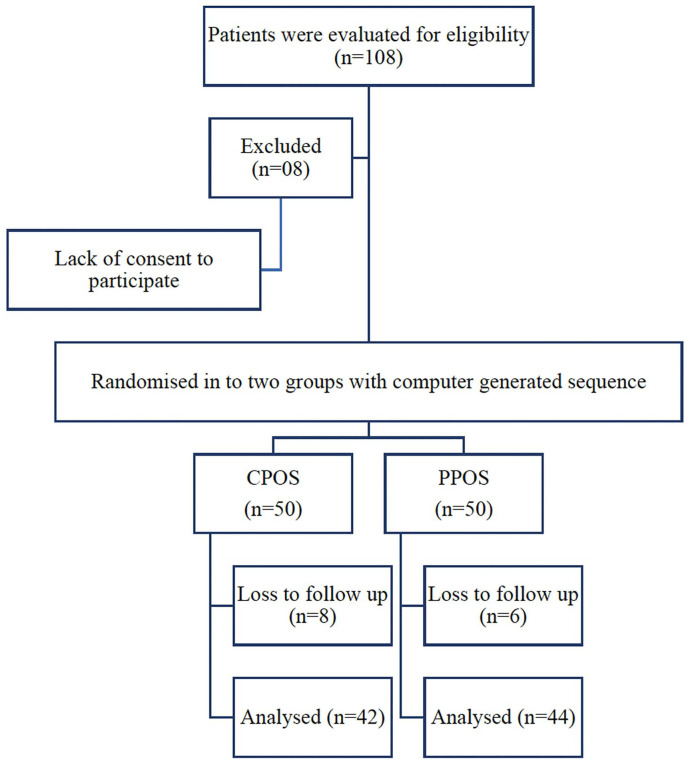 Figure 1
Peer Reviews
No public reviews on file for this paper yet. If you reviewed it on a platform where reviews are public (OpenReview, ICLR, NeurIPS, ICML), you can paste yours below so the community can read it here.
Videos
No videos yet. Explain this paper in a talk, walkthrough, or lecture? Add one.
Taxonomy
TopicsOvarian function and disorders