Successful desensitization to horse antithymocyte globulin for aplastic anemia: two case reports and literature review
Satoshi Yuyama, Mitsuaki Oura, Tatsuya Isezaki, Daisuke Ikeda, Kanayuki Kitahara, Ryohkan Funakoshi, Kosei Matsue

TL;DR
Two patients with positive skin tests to horse antithymocyte globulin (hATG) successfully underwent desensitization and received the treatment for aplastic anemia without allergic reactions.
Contribution
Demonstrates successful hATG desensitization in patients with positive skin tests, expanding treatment options for aplastic anemia.
Findings
Two patients with positive intradermal tests to hATG underwent successful desensitization without systemic allergic reactions.
Desensitization protocol included gradual dose escalation and premedication, allowing full hATG administration.
Desensitization was completed safely in a high-care unit with close monitoring of vital signs.
Abstract
Horse antithymocyte globulin (hATG) is an important therapeutic option for aplastic anemia (AA). However, hATG carries the risk of fatal anaphylaxis, and skin tests are performed to identify high-risk patients. We report on the successful desensitization of two AA patients with positive skin tests to hATG. Case 1: A 72-year-old man with a history of successful treatment with rabbit ATG was referred for pancytopenia. Neutrophil, reticulocyte, and platelet counts were 546 /µL, 32,000 /µL, and 19,000 /µL, despite the oral administration of eltrombopag and cyclosporine. Bone marrow biopsy showed hypocellularity, and he was diagnosed with relapsed severe AA. Case 2: A 69-year-old man was referred for anemia and thrombocytopenia, and diagnosed with non-severe AA. Neutrophil, reticulocyte, and platelet counts were 2,044 /µL, 23,000 /µL, and 37,000 /µL. Bone marrow biopsy revealed…
Genes, proteins, chemicals, diseases, species, mutations and cell lines named across the full text — each resolved to its canonical identifier and authoritative record.
Click any figure to enlarge with its caption.
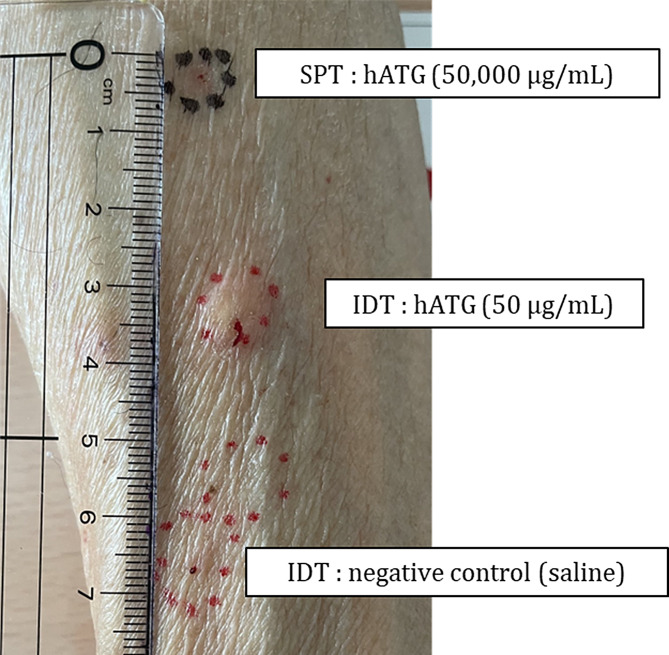 Figure 1
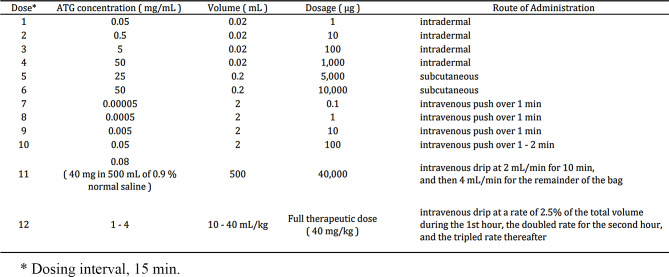 Figure 2
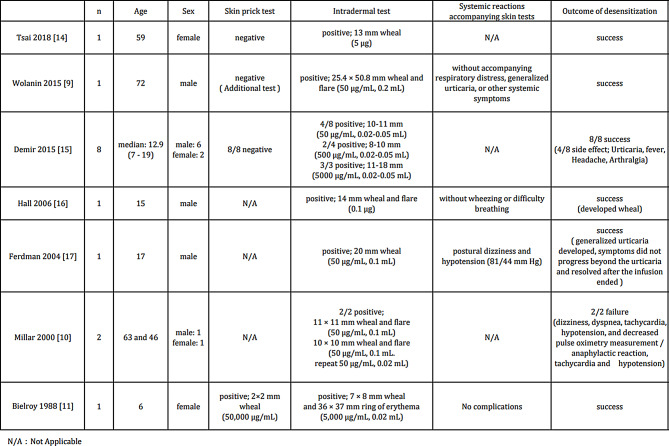 Figure 3
Peer Reviews
No public reviews on file for this paper yet. If you reviewed it on a platform where reviews are public (OpenReview, ICLR, NeurIPS, ICML), you can paste yours below so the community can read it here.
Videos
No videos yet. Explain this paper in a talk, walkthrough, or lecture? Add one.
Taxonomy
TopicsDrug-Induced Adverse Reactions · Food Allergy and Anaphylaxis Research · Mast cells and histamine