Changing Tactics? Optimizing ECT in difficult-to-treat depression (ChaT): study protocol
L. Van den Eynde, K. Vansteelandt, K. Hebbrecht, J. Obbels, S. Verspecht, L. Gistelinck, P.-J. Geerts, D. Schrijvers, P. Sienaert

TL;DR
This study compares two ECT strategies for treating depression when initial treatment isn't effective, focusing on balancing recovery speed and cognitive side effects.
Contribution
The ChaT-trial is the first randomized controlled trial comparing the efficacy and cognitive impact of continuing RUL ECT versus switching to BT ECT in non-responders.
Findings
The trial will assess whether continuing RUL ECT is non-inferior to switching to BT ECT in reducing depressive symptoms.
It will evaluate if continuing RUL ECT causes fewer cognitive side effects than switching to BT ECT.
Results may guide clinical decisions to optimize recovery while minimizing cognitive risks.
Abstract
Electroconvulsive therapy (ECT) is an evidence-based treatment for difficult-to-treat depression, in which an electrical stimulus is applied via right unilateral (RUL) (Fig 1) or bitemporal (BT) electrodes (Fig 2). Current guidelines recommend to start ECT with RUL placement, except for cases where rapid response is needed. BT ECT has the reputation of exerting a stronger and faster antidepressive effect, but is associated with more pronounced cognitive side effects, as compared to RUL ECT. Recent studies, however, suggest comparable outcomes. In patients responding to ECT, most of the improvement in depressive symptom severity is witnessed early in the treatment course. In case of non-response, it is common practice to switch from RUL to BT electrode placement, although scientific evidence is lacking. As an answer to this research gap, the ChaT-trial was designed: a randomized…
Genes, proteins, chemicals, diseases, species, mutations and cell lines named across the full text — each resolved to its canonical identifier and authoritative record.
Click any figure to enlarge with its caption.
 Figure 8
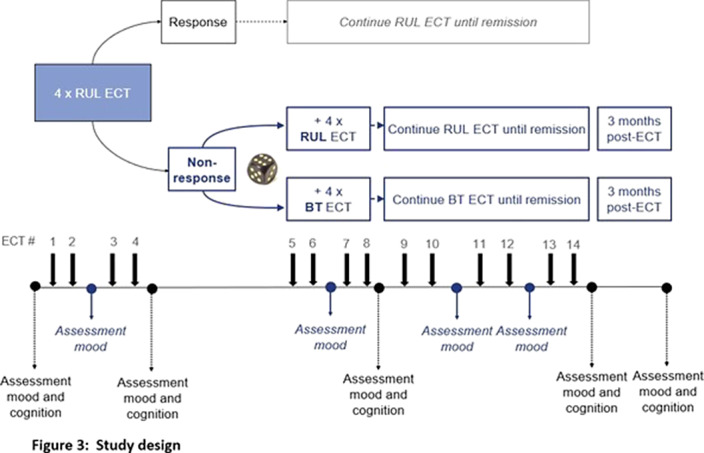 Figure 9
Peer Reviews
No public reviews on file for this paper yet. If you reviewed it on a platform where reviews are public (OpenReview, ICLR, NeurIPS, ICML), you can paste yours below so the community can read it here.
Videos
No videos yet. Explain this paper in a talk, walkthrough, or lecture? Add one.
Taxonomy
TopicsElectroconvulsive Therapy Studies