A technique for penetrating the bile duct wall using a guidewire during endoscopic ultrasound-guided hepaticogastrostomy
Takeshi Ogura, Kimi Bessho, Takafumi Kanadani, Nobuhiro Hattori, Hiroki Nishikawa

Abstract
Genes, proteins, chemicals, diseases, species, mutations and cell lines named across the full text — each resolved to its canonical identifier and authoritative record.
Click any figure to enlarge with its caption.
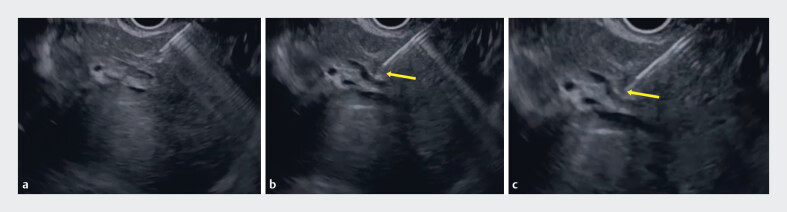 Fig. 1
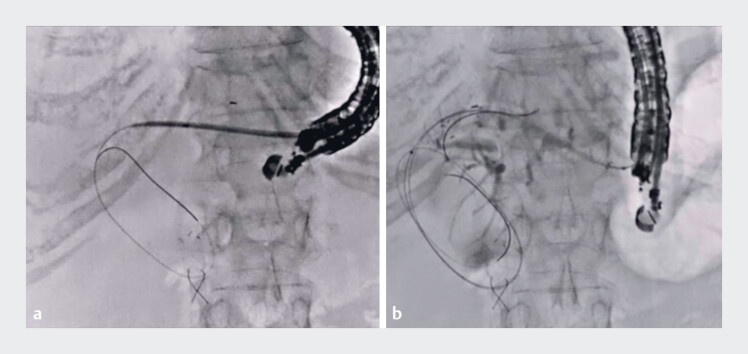 Fig. 2
Peer Reviews
No public reviews on file for this paper yet. If you reviewed it on a platform where reviews are public (OpenReview, ICLR, NeurIPS, ICML), you can paste yours below so the community can read it here.
Videos
No videos yet. Explain this paper in a talk, walkthrough, or lecture? Add one.
Taxonomy
TopicsPediatric Hepatobiliary Diseases and Treatments · Gallbladder and Bile Duct Disorders · Esophageal and GI Pathology
Endoscopic ultrasound-guided hepaticogastrostomy (EUS-HGS) involves several technical steps, such as intrahepatic bile duct puncture, guidewire insertion into the biliary tract, tract dilation, and stent deployment 1 2 3 . Intrahepatic bile duct puncture is usually performed using a 19-G needle because use of a 22-G needle also requires the use of a 0.018-inch guidewire. However, when using a 19-G needle, puncturing the bile duct wall may be challenging if it is extremely thick. In such cases, the Seldinger technique combined with the door knocking method is sometimes used, but there is a risk of vessel injury. To overcome this, a technique for penetrating the bile duct wall using a guidewire is described.
An 88-year-old patient underwent EUS-guided antegrade metal stent deployment for distal biliary obstruction because of surgically altered anatomy due to cancer of the head of the pancreas, and EUS-HGS was performed using a plastic stent. However, 6 months later, recurrent biliary obstruction was observed due to antegrade metal stent obstruction and EUS-HGS stent dislocation. Therefore, EUS-HGS was attempted.
On EUS imaging, a thickened bile duct wall was observed because an EUS-HGS stent had been previously deployed ( Fig. 1 a ), and intrahepatic bile duct puncture with standard puncture and the Seldinger technique using a 19-G needle failed. Therefore, a 19-G needle was advanced to the bile duct wall ( Fig. 1 b ), and the bile duct wall was successfully penetrated using a 0.025-inch guidewire ( Fig. 1 c ). To prevent guidewire insertion into the hepatic parenchyma or vessels, the guidewire should be continuously identified on EUS imaging. After guidewire deployment, a double-lumen dilator was inserted into the biliary tract ( Fig. 2 a ). An additional guidewire was inserted through this dilator to perform a double-guidewire technique, and the stent delivery system was inserted. Finally, metal stent deployment from the intrahepatic bile duct to the stomach was successfully performed without any adverse events ( Fig. 2 b , Video 1 ).
Endoscopic ultrasound images. a A thickened bile duct wall was observed. b A 19-G needle (arrow) was advanced to the bile duct wall. c The bile duct wall was successfully penetrated using a 0.025-inch guidewire (arrow).
Fluoroscopic images. a A double-lumen dilator was inserted into the biliary tract. b Metal stent deployment from the intrahepatic bile duct to the stomach was successfully performed.
A technique for penetrating the bile duct wall using a guidewire during endoscopic ultrasound-guided hepaticogastrostomy.Video 1
In conclusion, the technique described may facilitate guidewire insertion for cases in which bile duct puncture is challenging.
Endoscopy_UCTN_Code_TTT_1AS_2AH
The reference list from the paper itself. Each links out to its DOI / PubMed record.
- 1Ogura T Higuchi K Technical review of developments in endoscopic ultrasound-guided hepaticogastrostomy Clin Endosc 20215465165933896154 10.5946/ce.2021.020-KDDWPMC 8505184 · doi ↗ · pubmed ↗
- 2Ogura T Higuchi K Endoscopic ultrasound-guided hepaticogastrostomy: technical review and tips to prevent adverse events Gut Liver 20211519620532694240 10.5009/gnl 20096 PMC 7960972 · doi ↗ · pubmed ↗
- 3Canakis A Tyberg A Endoscopic ultrasound-guided biliary drainage (EUS-BD)Gastrointest Endosc Clin N Am 20243448750038796294 10.1016/j.giec.2023.12.002 · doi ↗ · pubmed ↗