Awareness and perceptions of managing recovery in psychiatric patients in a rehabilitation center: an observational study
F. Franza, R. Croce, C. Esposito, I. Ferrara, R. Iannaccone, M. Imbimbo, M. Pizzano, S. Sanseverino, R. Silvestro, V. Vecchione

TL;DR
This study evaluates the Recovery Assessment Scale – Domains and Stages (RAS-DS) in a psychiatric rehabilitation center to assess its usefulness in tracking patient recovery.
Contribution
The study explores the practical application of RAS-DS as a routine tool in psychiatric rehabilitation settings.
Findings
The RAS-DS total score did not show significant change over one year, but specific subdomains like 'Doing things I value' improved significantly.
Results from RAS-DS were comparable to those from established scales like SLOF and GAF.
The study suggests RAS-DS could be useful in managing psychiatric rehabilitation programs by reflecting patient well-being.
Abstract
In mental health prevention, person-centered, and rights-based approaches, the role of recovery is highlighted (WHO, 2021). Various evaluation tools are used in rehabilitation objectives and programs, including the Specific Levels of Functioning Scale (SLOF) (Mucci et al. Schizophr Res 2014;159 144-50) and the Recovery Assessment Scale – Domains and Stages (RAS-DS), a self-measure of mental health recovery. It includes 38 items clustered into four recovery domains and meets two functions. In addition to measuring self-reported outcomes, it increases service-user control towards objectives and recovery action plans (Honey et al. BMC Psychiatry 2023;23 500). To evalue the efficacy of RAD-DS in a psychiatric rehabilitation facility to be used as a routine tool in daily rehabilitation activity. In our observational study, we recruited 103 inpatients (total: 103 patients, females: 38…
Genes, proteins, chemicals, diseases, species, mutations and cell lines named across the full text — each resolved to its canonical identifier and authoritative record.
Click any figure to enlarge with its caption.
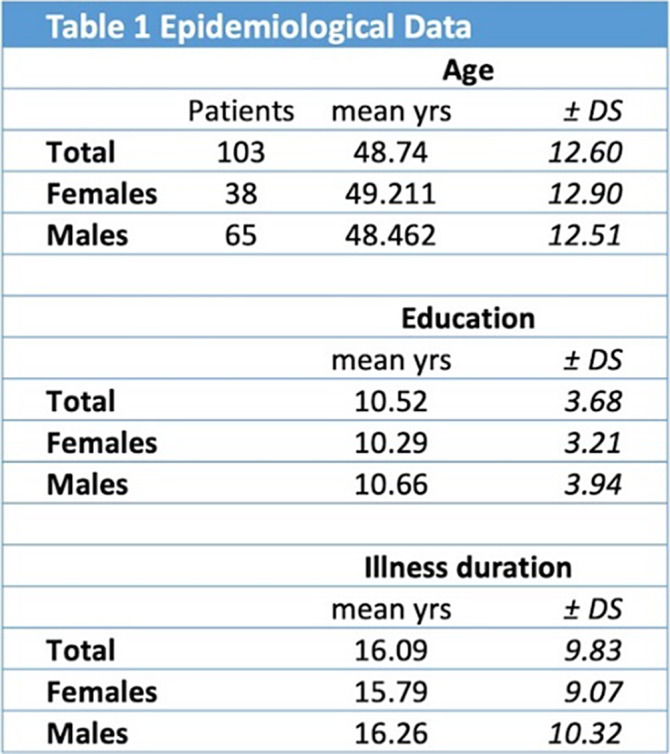 Figure 166
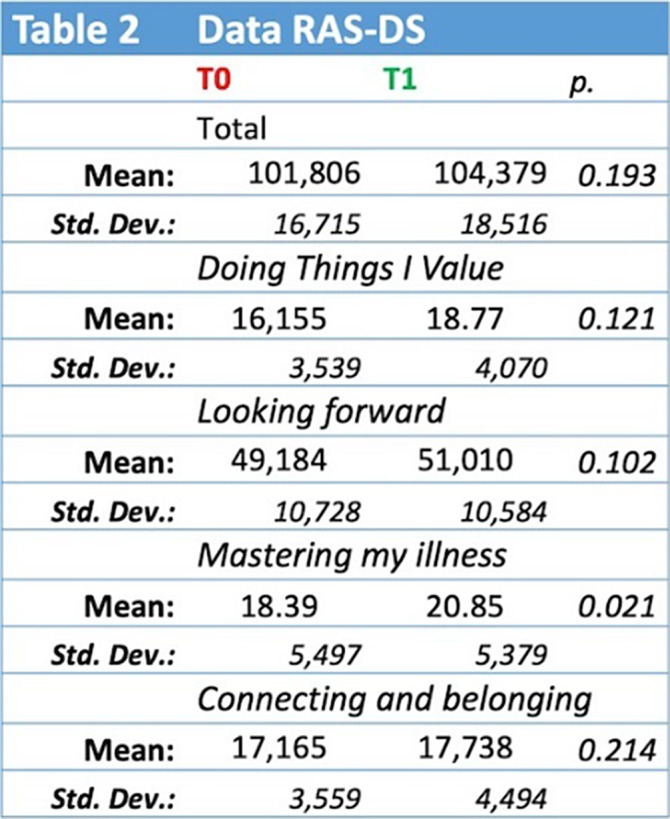 Figure 167
Peer Reviews
No public reviews on file for this paper yet. If you reviewed it on a platform where reviews are public (OpenReview, ICLR, NeurIPS, ICML), you can paste yours below so the community can read it here.
Videos
No videos yet. Explain this paper in a talk, walkthrough, or lecture? Add one.
Taxonomy
TopicsMental Health and Patient Involvement · Psychiatric care and mental health services · Family Caregiving in Mental Illness