The role of long-acting antipsychotics in illness relapse: an observational study
I. Berardelli, I. Mancinelli, E. Rogante, D. Erbuto, M. A. Trocchia, L. Longhini, L. Rapisarda, A. Bruzzese, S. Sarubbi, M. Pompili

TL;DR
This study finds that long-acting antipsychotics reduce relapse in schizophrenia and bipolar disorder, but some patients still experience symptoms.
Contribution
The study provides real-world evidence on the effectiveness of long-acting antipsychotics in preventing relapse.
Findings
Only 8.7% of patients on long-acting antipsychotics experienced a relapse within a year.
Patients who relapsed had higher rates of prior hospitalization and suicidal behavior.
Relapsed patients reported more side effects like parkinsonism and tremor.
Abstract
In patients affected by Schizophrenia and Bipolar Disorder disorders the use of antipsychotic drugs is essential in preventing the exacerbation of symptoms. The use of long-acting injectable (LAI) antipsychotics is considered an important treatment option. The aim of this study was to evaluate the incidence and predictors of relapse during antipsychotic treatment with LAIs in a sample of psychiatric outpatients up to a year after the start of long-acting therapy. The study included 103 adult patients admitted to the psychiatric unit of Sant’Andrea University Hospital in Rome. We evaluated duration of untreated illness, previous treatments, substance abuse, suicidal status, LAI dose, and use of other medicines for association with new episodes of illness or of symptomatic worsening as well as hospitalization, using bivariate and multivariate analyses. Seventy-three patients were…
Genes, proteins, chemicals, diseases, species, mutations and cell lines named across the full text — each resolved to its canonical identifier and authoritative record.
Click any figure to enlarge with its caption.
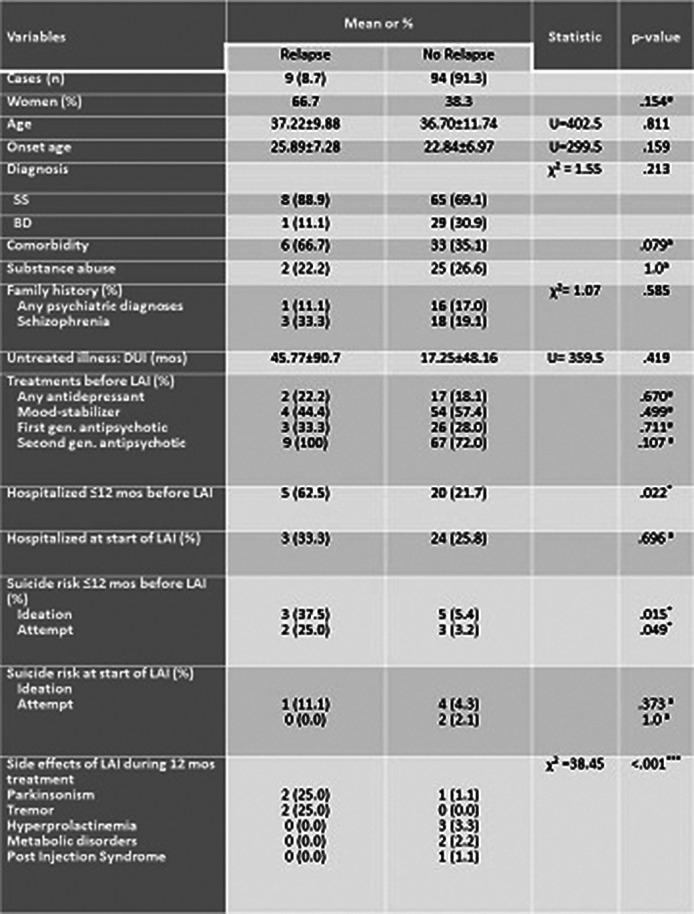 Figure 99
Peer Reviews
No public reviews on file for this paper yet. If you reviewed it on a platform where reviews are public (OpenReview, ICLR, NeurIPS, ICML), you can paste yours below so the community can read it here.
Videos
No videos yet. Explain this paper in a talk, walkthrough, or lecture? Add one.
Taxonomy
TopicsSchizophrenia research and treatment