Aberrant Functional Connectivity Between Regions Involved in Belief Evaluation and Processing of Bodily Information in Patients with Somatic Delusions
Y. Panikratova, E. Abdullina, A. Dudina, A. Andrushchenko, G. Kostyuk, D. Romanov, E. Ilina, M. Magomedagaev, P. Iuzbashian, I. Lebedeva

TL;DR
This study finds that patients with somatic delusions have abnormal brain connectivity between areas involved in bodily sensation and belief evaluation, which may explain their delusional beliefs.
Contribution
The study identifies specific brain connectivity patterns unique to somatic delusions, linking them to bodily sensation processing.
Findings
Patients with somatic delusions showed higher connectivity between r-VF/AI and sensory brain regions.
These regions are involved in tactile, proprioceptive, and visceral information processing.
Aberrant connectivity may disrupt belief evaluation related to bodily sensations in these patients.
Abstract
According to the two-factor theory of delusional belief (Coltheart. Ann N Y Acad Sci 2010; 1191 16-26), explaining the presence of a delusion requires a combination of two neuropsychological impairments. The first deficit initially prompts the delusional belief and defines its content, whereas the second deficit – aberrant belief evaluation – interrupts the rejection of a delusional belief and is common for different types of delusions. The second deficit is associated with compromised functioning of the right ventral frontal/anterior insular cortex (r-VF/AI; Darby et al. Brain 2017; 140 497-507). However, neural correlates of the first deficit in different types of delusions remain obscure. The aim of the study was to search for regions whose functional connectivity with r-VF/AI is different between patients with somatic delusions (SD) and persecutory delusions (PD) and to further…
Genes, proteins, chemicals, diseases, species, mutations and cell lines named across the full text — each resolved to its canonical identifier and authoritative record.
Click any figure to enlarge with its caption.
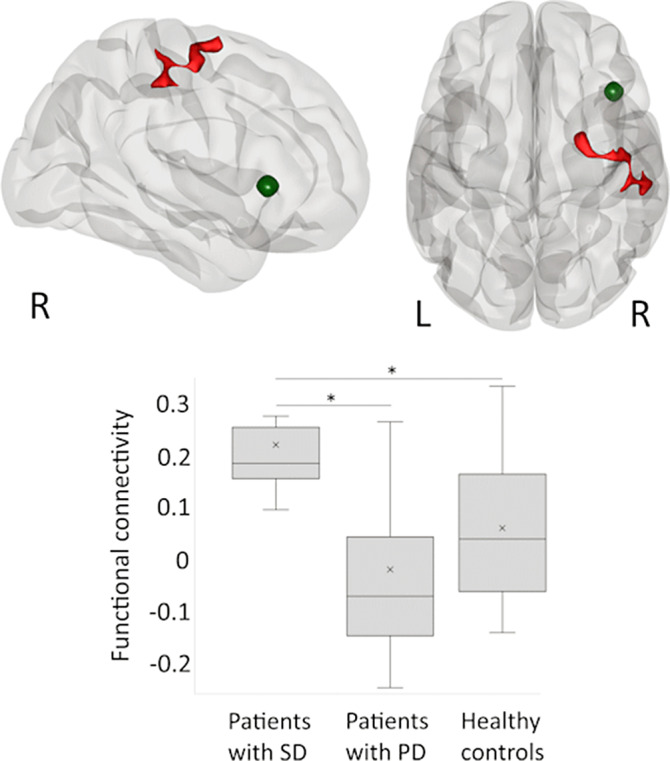 Figure 180
Peer Reviews
No public reviews on file for this paper yet. If you reviewed it on a platform where reviews are public (OpenReview, ICLR, NeurIPS, ICML), you can paste yours below so the community can read it here.
Videos
No videos yet. Explain this paper in a talk, walkthrough, or lecture? Add one.
Taxonomy
TopicsPsychotherapy Techniques and Applications · Psychosomatic Disorders and Their Treatments · Psychological Testing and Assessment