Genomic and Proteomic Analyses of Bacterial Communities of Ixodes scapularis Ticks from Broome County, New York
Michel Shamoon-Pour, Emily H. Canessa, John Macher, Amaan Fruitwala, Emma Draper, Benjamin Policriti, Matthew Chin, Matthew Nunez, Paul Puccio, Yuan Fang, Xin-Ru Wang, Yetrib Hathout

TL;DR
This study explores the bacterial communities in Ixodes scapularis ticks from New York, revealing new insights into their microbiomes and potential effects on disease transmission.
Contribution
The first comprehensive characterization of I. scapularis microbiomes in the Southern Tier region of New York, including novel findings on Rickettsia buchneri and pathogen co-occurrence.
Findings
Rickettsia buchneri was most abundant, with higher levels in female ticks compared to males.
Borreliella burgdorferi and Anaplasma phagocytophilum were detected in ticks with notable relative abundances.
Proteomic analysis identified R. buchneri-specific proteins and detected Babesia microti in some female ticks.
Abstract
The microbial communities of Ixodes scapularis, the primary vector of Lyme disease in North America, exhibit regional variations that may affect pathogen transmission and vector competence. We analyzed bacterial communities in I. scapularis ticks collected from Broome County, New York, using 16S rRNA gene sequencing (18 ticks) as well as mass spectrometry-based proteomics (36 ticks). According to the 16S rRNA analysis, the endosymbiont Rickettsia buchneri was the most abundant species, with significantly higher (p = 0.0011) abundance in females (54.76%) compared to males (31.15%). We detected Borreliella burgdorferi in 44.44% of ticks and Anaplasma phagocytophilum in two nymphs but in high relative abundances (12.73% and 46.46%). Male ticks exhibited higher bacterial diversity, although the community composition showed no significant clustering by sex or life stage. Co-occurrence…
Genes, proteins, chemicals, diseases, species, mutations and cell lines named across the full text — each resolved to its canonical identifier and authoritative record.
Click any figure to enlarge with its caption.
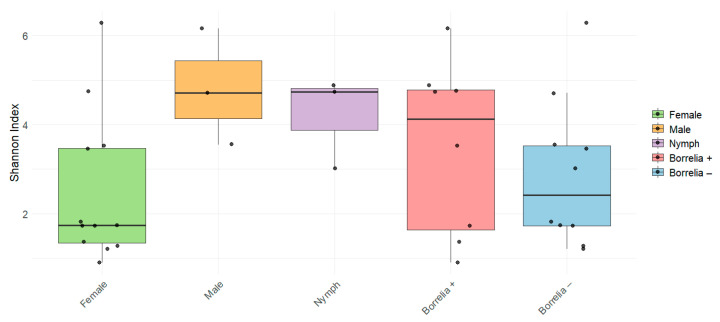 Figure 1
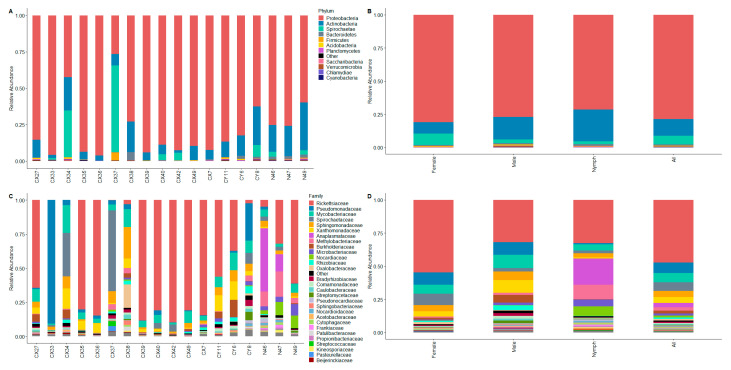 Figure 2
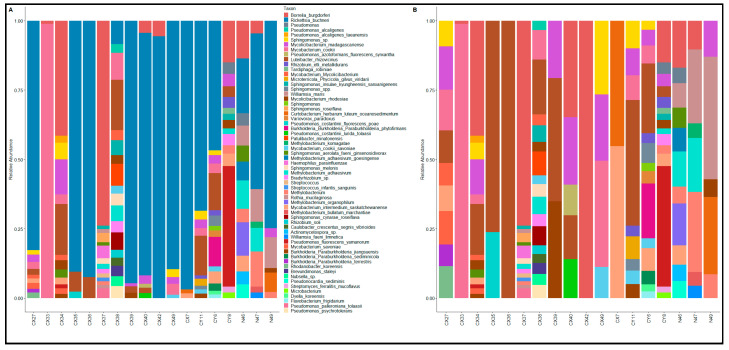 Figure 3
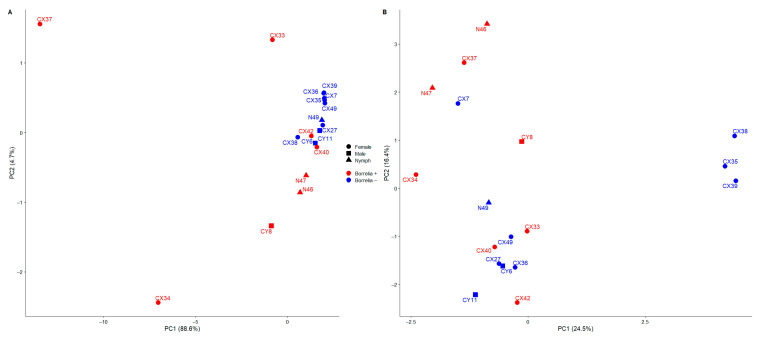 Figure 4
Peer Reviews
No public reviews on file for this paper yet. If you reviewed it on a platform where reviews are public (OpenReview, ICLR, NeurIPS, ICML), you can paste yours below so the community can read it here.
Videos
No videos yet. Explain this paper in a talk, walkthrough, or lecture? Add one.
Taxonomy
TopicsVector-borne infectious diseases · Insect symbiosis and bacterial influences · Mosquito-borne diseases and control