A New, Validated GC-PICI-MS Method for the Quantification of 32 Lipid Fatty Acids via Base-Catalyzed Transmethylation and the Isotope-Coded Derivatization of Internal Standards
Petr Vodrážka, Lucie Řimnáčová, Petra Berková, Jan Vojtíšek, Miroslav Verner, Martin Moos, Petr Šimek

TL;DR
This paper introduces a new and validated GC-MS method to quantify 32 esterified fatty acids in human serum, offering a reliable tool for lipidomics and disease biomarker research.
Contribution
A validated GC-PICI-MS method for quantifying 32 esterified fatty acids using base-catalyzed transmethylation and isotope-coded internal standards.
Findings
The base-catalyzed transmethylation was efficient for major esterified lipids under mild conditions.
The method was validated using NIST SRM 2378 and showed consistent results with reference data.
The approach is suitable for analyzing membrane fatty acids in dry blood spots and red blood cells.
Abstract
Background: Fatty acids (FAs) represent a ubiquitous class of nonpolar alkyl carboxylate metabolites with diverse biological functions. Nutrition, metabolism, and endogenous and exogenous stress influence the overall FA metabolic status and transport via the bloodstream. FAs esterified in lipids are of particular interest, as they represent promising biomarkers of pathological diseases and nutritional status. Methods: Here, we report a validated gas chromatographic-mass spectrometric (GC-MS) method for the quantitative analysis of 32 FAs exclusively bound in esterified lipids. The developed sample preparation protocol comprises three steps using only 5 µL of human serum for Folch extraction, sodium methoxide-catalyzed transesterification in tert-butyl methyl ether, and re-extraction in isooctane prior to a quantitative GC-MS analysis with positive ion chemical ionization (PICI) and…
Genes, proteins, chemicals, diseases, species, mutations and cell lines named across the full text — each resolved to its canonical identifier and authoritative record.
Click any figure to enlarge with its caption.
 Figure 1
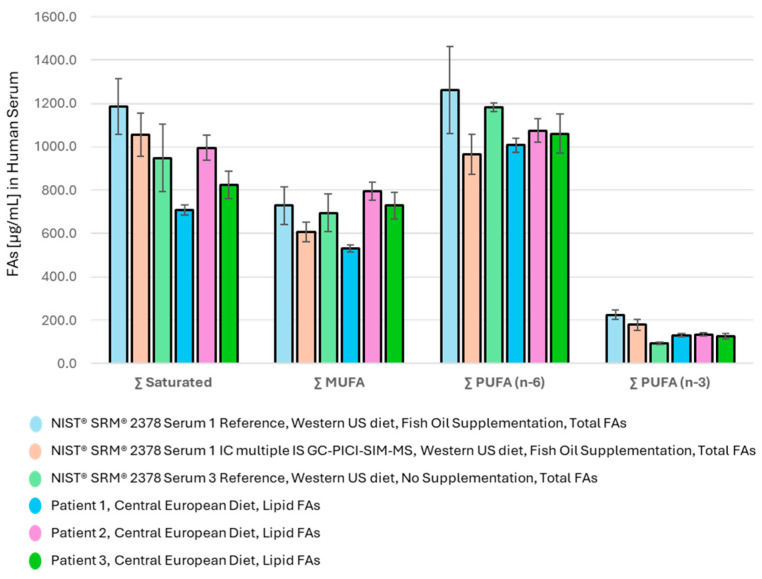 Figure 2
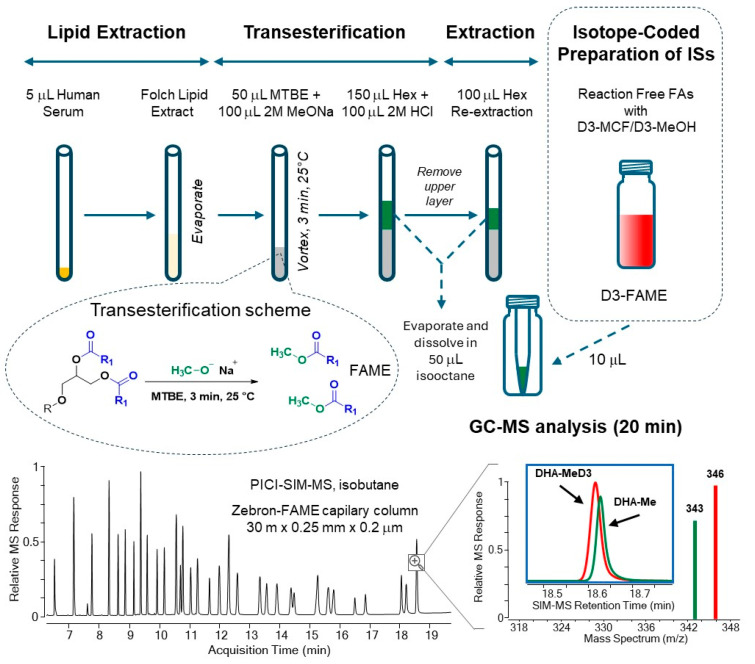 Figure 3
Peer Reviews
No public reviews on file for this paper yet. If you reviewed it on a platform where reviews are public (OpenReview, ICLR, NeurIPS, ICML), you can paste yours below so the community can read it here.
Videos
No videos yet. Explain this paper in a talk, walkthrough, or lecture? Add one.
Taxonomy
TopicsFatty Acid Research and Health · Metabolomics and Mass Spectrometry Studies · Eicosanoids and Hypertension Pharmacology