Osteometric Study of the Dorsal (Lister’s) Tubercle of the Radius in Relation to the Neighboring Anatomical Elements: Suprastyloid, Accessory, and Oblique Crests
Laura Octavia Grigoriță, Cătălin Prodan Bărbulescu, Norberth-Istvan Varga, Andreea Grigoriță, Monica Adriana Vaida, Loredana Gabriela Stana, Adelina Maria Jianu

TL;DR
This study examines the anatomy of the radius bone to better understand its structure and implications for surgical treatments.
Contribution
The study provides new osteometric correlations between the dorsal radial tubercle and neighboring anatomical elements.
Findings
The length of the radius correlates positively with the width of the distal epiphysis.
The distance from the suprastyloid crest to the dorsal radial tubercle is strongly associated with the development of the distal radial epiphysis.
Distances between the dorsal radial tubercle and other anatomical ridges correlate with the distal epiphysis width.
Abstract
Background: The radius, a crucial bone in the human forearm, supports and facilitates complex movements like pronation and supination. Its anatomical landmarks, including Lister’s tubercle, provide vital attachment points for muscles, tendons, and ligaments involved in upper limb mobility. This study provides a detailed osteometric analysis of the dorsal radial tubercle of the radius, aiming to improve our understanding of its anatomy and clinical significance. Material and Methods: The study was conducted in the Department of Anatomy and Embryology, using 56 radius bones from cadavers. After applying inclusion and exclusion criteria, 46 bones remained in the study group. Results: The study found a significant positive correlation between the length of the radius and the width of the distal epiphysis. The distance from the suprastyloid crest to the dorsal radial tubercle (SC-DT) and the…
Genes, proteins, chemicals, diseases, species, mutations and cell lines named across the full text — each resolved to its canonical identifier and authoritative record.
Click any figure to enlarge with its caption.
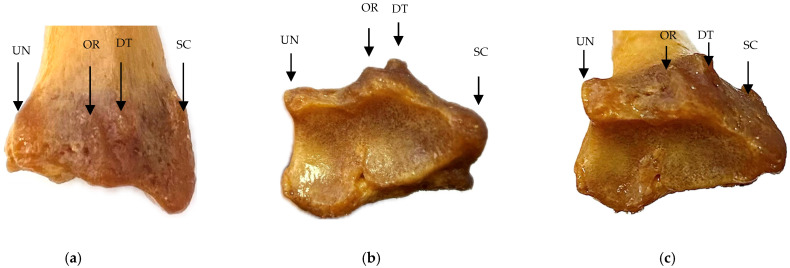 Figure 1
 Figure 2
 Figure 3
 Figure 4
Peer Reviews
No public reviews on file for this paper yet. If you reviewed it on a platform where reviews are public (OpenReview, ICLR, NeurIPS, ICML), you can paste yours below so the community can read it here.
Videos
No videos yet. Explain this paper in a talk, walkthrough, or lecture? Add one.
Taxonomy
TopicsOrthopedic Surgery and Rehabilitation · Elbow and Forearm Trauma Treatment · Bone fractures and treatments