A Preliminary Study on Identifying the Predator Community of Invasive Bactericera cockerelli (Hemiptera: Triozidae) and Developing Molecular Identification Tools for Testing Field Predation
Shovon Chandra Sarkar, Stephen Paul Milroy, Wei Xu

TL;DR
This study identifies natural predators of the invasive tomato potato psyllid in Western Australia and uses molecular tools to confirm their predation, supporting potential biological control strategies.
Contribution
The study is the first to confirm field predation on Bactericera cockerelli by native predators in Australia using molecular techniques.
Findings
Green lacewings and ladybirds were the most abundant predators of B. cockerelli in Solanaceous crop fields.
Molecular analysis showed 45% of tested predators consumed B. cockerelli, with Coleopteran predators having the highest positivity rate.
Predatory spiders were common but their populations varied between years.
Abstract
This study investigated generalist predators in Solanaceous crop fields across Western Australia to understand their role in controlling the invasive pest Bactericera cockerelli. A diverse range of predator species, including insects from Neuroptera, Coleoptera, Diptera and Hemiptera, as well as spiders, was identified. Laboratory feeding trials and molecular analysis confirmed that many of these predators consumed B. cockerelli in the field. Notably, green lacewings and ladybirds were the most abundant predators, with capsicum fields supporting the largest populations due to floral resources. Molecular techniques revealed that 45% of the tested predators consumed the pest, with Coleopteran predators showing the highest positivity rates, followed by Neuroptera and Hemiptera. Predatory spiders were also common, though their populations varied between years. This study emphasizes the…
Genes, proteins, chemicals, diseases, species, mutations and cell lines named across the full text — each resolved to its canonical identifier and authoritative record.
Click any figure to enlarge with its caption.
 Figure 1
 Figure 2
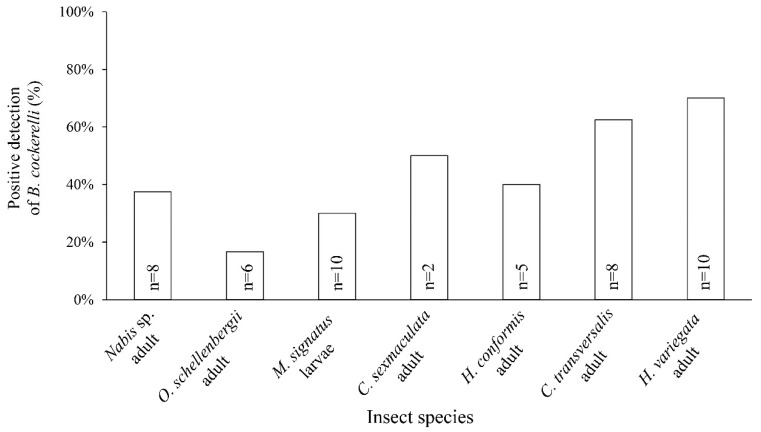 Figure 3
Peer Reviews
No public reviews on file for this paper yet. If you reviewed it on a platform where reviews are public (OpenReview, ICLR, NeurIPS, ICML), you can paste yours below so the community can read it here.
Videos
No videos yet. Explain this paper in a talk, walkthrough, or lecture? Add one.
Taxonomy
TopicsPhytoplasmas and Hemiptera pathogens · Insect-Plant Interactions and Control · Plant Virus Research Studies