Laparoendoscopic Rendezvous: An Effective and Safe Approach in the Management of Cholecysto-Choledocholithiasis in Selected Patients
Rossana Percario, Paolo Panaccio, Maria Pia Caldarella, Marco Trappoliere, Maria Marino, Maira Farrukh, Carla Di Giacomo, Giuseppe Di Martino, Giovanni De Nobili, Raffaella Marina di Renzo, Tommaso Grottola, Pierluigi Di Sebastiano, Fabio Francesco di Mola

TL;DR
Laparoendoscopic Rendezvous is a one-step surgical method that safely and effectively removes gallbladder and bile duct stones with fewer complications than traditional two-step approaches.
Contribution
The study demonstrates that LERV is a safer and more efficient one-stage alternative to the two-stage sequential approach for treating cholecysto-choledocholithiasis.
Findings
LERV achieved a 97% success rate in clearing the common bile duct, compared to 93% for the two-stage approach.
LERV had shorter operative times and hospital stays, and lower complication rates than the sequential approach.
Post-ERCP pancreatitis occurred in 27% of the two-stage group, but was not reported in the LERV group.
Abstract
Background: Different techniques have been proposed to manage Cholecysto-choledocholithiasis (CCL) advantageously in one stage. Among these, Laparoendoscopic Rendezvous (LERV) addresses the CCL issue with a laparoscopic cholecystectomy, with insertion of a guide wire into the common bile duct through an incision of the cystic duct, followed by the clearance of the bile duct carried out by the endoscopists. The aim of this study was to evaluate the safety and the efficacy of the one-stage vs. a two-stage approach (pre-operative ERCP followed by cholecystectomy), and to compare our results with data from the current literature. Methods: All patients that underwent LERV in our facilities between January 2018 and December 2023 were evaluated. As a control group, we included patients that underwent a two-stage technique called the “sequential approach”. The primary outcome was to evaluate…
Genes, proteins, chemicals, diseases, species, mutations and cell lines named across the full text — each resolved to its canonical identifier and authoritative record.
Click any figure to enlarge with its caption.
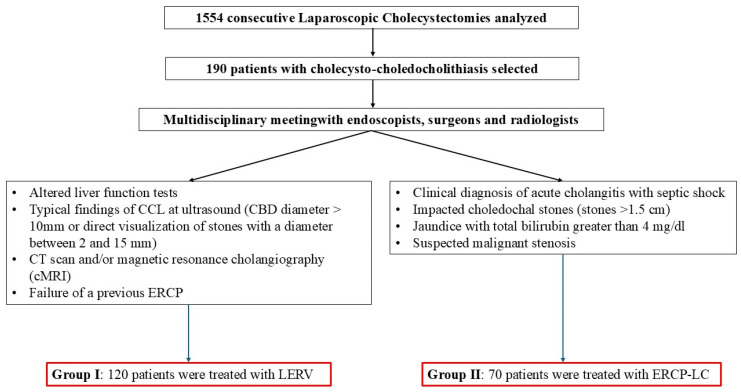 Figure 1
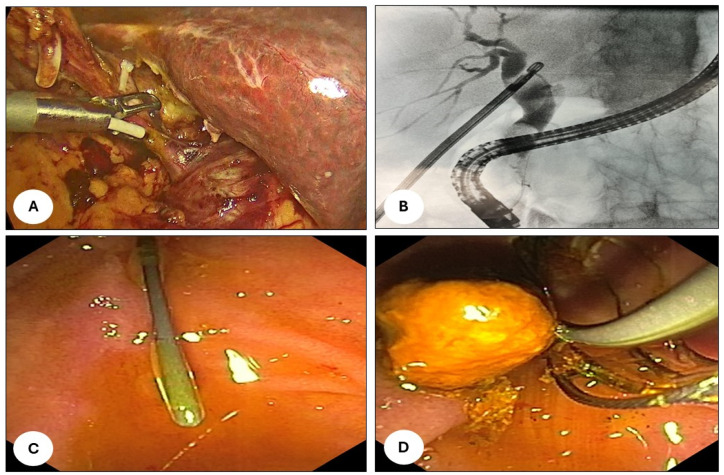 Figure 2
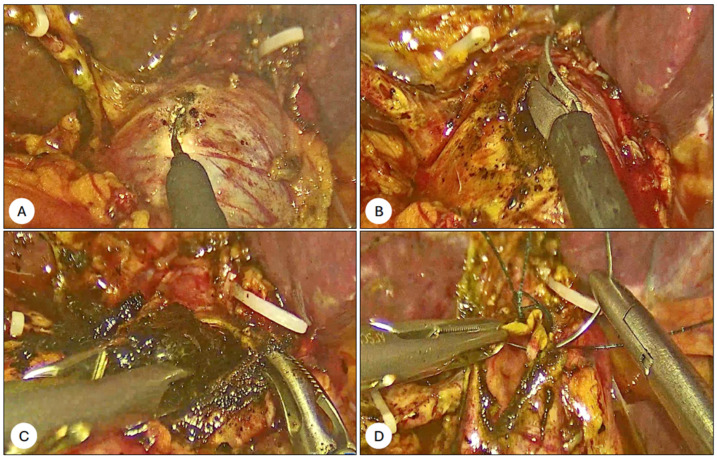 Figure 3
Peer Reviews
No public reviews on file for this paper yet. If you reviewed it on a platform where reviews are public (OpenReview, ICLR, NeurIPS, ICML), you can paste yours below so the community can read it here.
Videos
No videos yet. Explain this paper in a talk, walkthrough, or lecture? Add one.
Taxonomy
TopicsGallbladder and Bile Duct Disorders · Pediatric Hepatobiliary Diseases and Treatments · Biliary and Gastrointestinal Fistulas