Exploring the Muscle-to-Fat Ratio of Pediatric Patients with Thyroid Disorders and Its Interaction with Thyroid Function and Metabolic Syndrome Components
Avivit Brener, Yuval Stark, Gal Friedman Miron, Shay Averbuch, Erella Elkon-Tamir, Ophir Borger, Yael Lebenthal

TL;DR
This study examines how thyroid function affects body composition in children with thyroid disorders, finding that higher TSH levels correlate with higher BMI and lower muscle-to-fat ratios.
Contribution
The study introduces a novel analysis of muscle-to-fat ratios in pediatric thyroid patients and their connection to thyroid function and metabolic syndrome.
Findings
Higher TSH levels correlate with increased BMI and decreased muscle-to-fat ratio (MFR) in pediatric thyroid patients.
TSH levels are positively associated with LDL cholesterol and triglycerides, indicating a link to dyslipidemia.
Free T4 levels are negatively correlated with appendicular skeletal muscle mass (ASMM).
Abstract
Background/Objectives: The standard evaluation of children and adolescents suspected of having thyroid disorders consists of anthropometric measurements. Body composition features provide additional information for enhanced therapeutic management. We explored the muscle-to-fat ratio of pediatric patients referred for thyroid disorders and its interaction with thyroid function and metabolic syndrome components. Methods: This retrospective cross-sectional study consisted of 147 pediatric subjects (ages 5–19 years) diagnosed with childhood-onset thyroid disorders treated at a tertiary medical center. Sociodemographic, clinical and laboratory data [thyroid-stimulating hormone (TSH), free T4 (FT4), and lipid profile] were extracted from the electronic medical records. Body composition was measured using bioimpedance analysis (Tanita MC-780 MA and GMON Professional Software). Body mass index…
Genes, proteins, chemicals, diseases, species, mutations and cell lines named across the full text — each resolved to its canonical identifier and authoritative record.
Click any figure to enlarge with its caption.
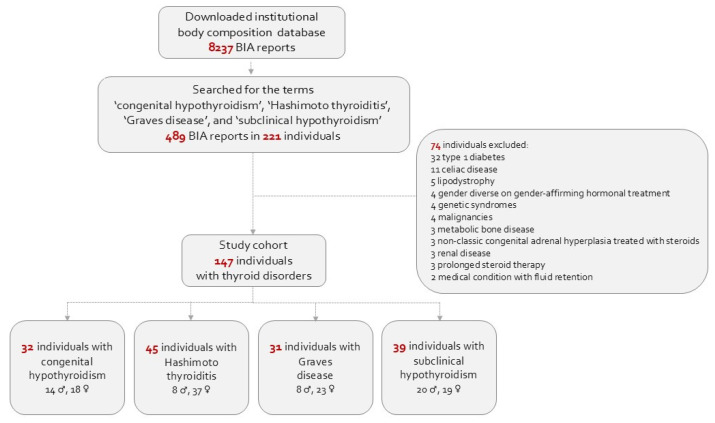 Figure 1
Peer Reviews
No public reviews on file for this paper yet. If you reviewed it on a platform where reviews are public (OpenReview, ICLR, NeurIPS, ICML), you can paste yours below so the community can read it here.
Videos
No videos yet. Explain this paper in a talk, walkthrough, or lecture? Add one.
Taxonomy
TopicsThyroid Disorders and Treatments · Human Health and Disease · Growth Hormone and Insulin-like Growth Factors