Clock Proteins Have the Potential to Improve Term Delivery Date Prediction: A Proof-of-Concept Study
Max T. Dufford, Tracey C. Fleischer, Laura J. Sommerville, Md. Bahadur Badsha, Ashoka D. Polpitiya, Jennifer Logan, Angela C. Fox, Sharon R. Rust, Charles B. Cox, Thomas J. Garite, J. Jay Boniface, Paul E. Kearney

TL;DR
This study explores how clock proteins like ADA12 in maternal serum could help predict term delivery dates more accurately than current methods.
Contribution
The study identifies 15 serum proteins, including ADA12, associated with time to birth, with 11 being newly linked to gestational age.
Findings
High levels of ADA12 in maternal serum were associated with earlier term births compared to low levels.
Fifteen serum proteins, including ADA12, showed statistically significant associations with time to birth.
Eleven of the identified proteins had not previously been linked to gestational age.
Abstract
Our ability to accurately predict the delivery date of term pregnancies is limited by shortcomings of modern-day clinical tools and due date estimation methods. The pregnancy clock is a series of coordinated and harmonized signals between mother, fetus, and placenta that regulate the length of gestation. Clock proteins are thought to be important mediators of these signals, yet few studies have investigated their potential utility as predictors of term delivery date. In this study, we performed a cross-sectional proteome analysis of 2648 serum samples collected between 18 and 28 weeks of gestation from mothers who delivered at term. The cohort included pregnancies both with and without complications. A total of 15 proteins of diverse functionalities were shown to have a direct association with time to birth (TTB), 11 of which have not been previously linked to gestational age. The…
Genes, proteins, chemicals, diseases, species, mutations and cell lines named across the full text — each resolved to its canonical identifier and authoritative record.
Click any figure to enlarge with its caption.
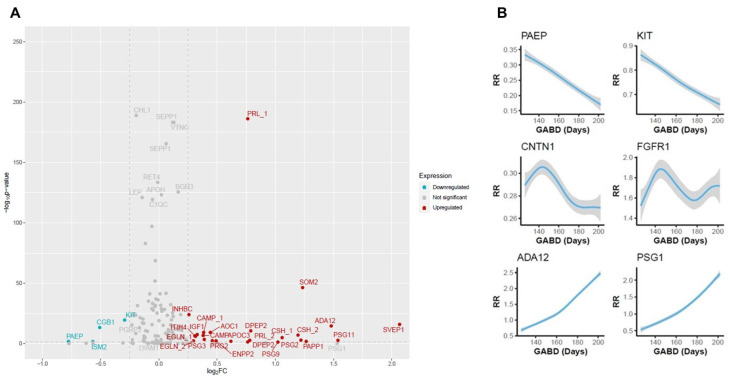 Figure 1
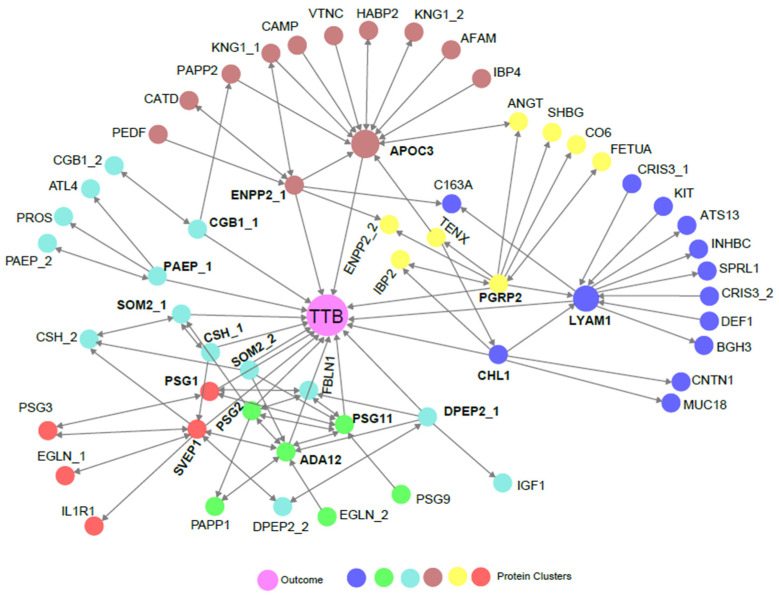 Figure 2
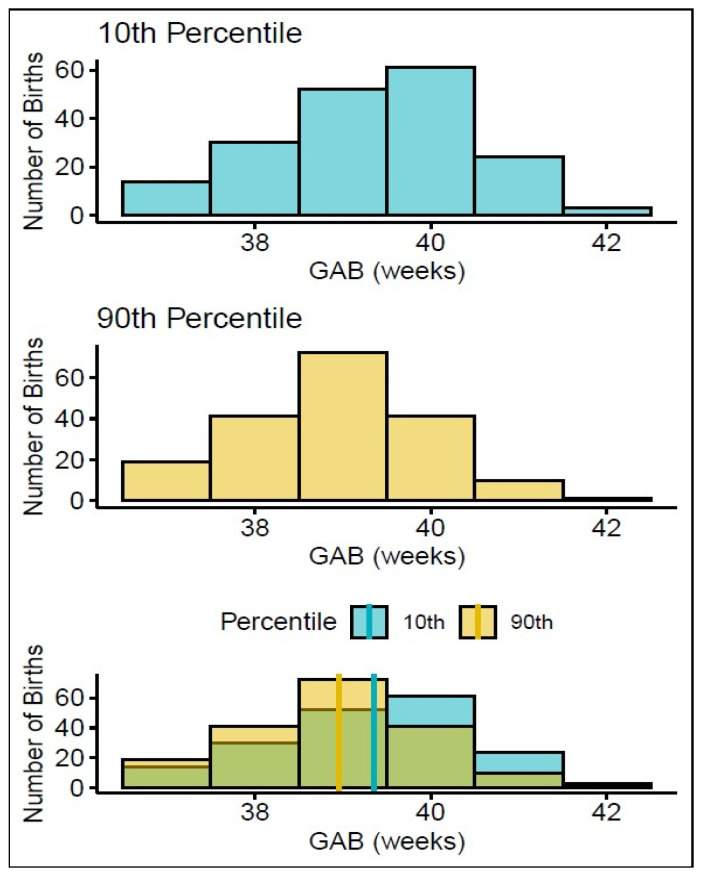 Figure 3
Peer Reviews
No public reviews on file for this paper yet. If you reviewed it on a platform where reviews are public (OpenReview, ICLR, NeurIPS, ICML), you can paste yours below so the community can read it here.
Videos
No videos yet. Explain this paper in a talk, walkthrough, or lecture? Add one.
Taxonomy
TopicsPreterm Birth and Chorioamnionitis · Pregnancy and preeclampsia studies · Circadian rhythm and melatonin