Practical Preparation of (3S)-Hydroxy-5-Phenylpentanoic Acid: Asymmetric Synthesis of (S)-Daphneolone and (S)-Dihydroyashabushiketol, and Formal Synthesis of (3S,5S)-Yashabushidiol B
So-Yeon Nam, Joungmo Cho, Simon MoonGeun Jung, Hyun-Jun Lee, Hyung Won Ryu, Sei-Ryang Oh, Kee-In Lee

TL;DR
This paper presents an efficient method for synthesizing specific natural products using a key compound prepared through asymmetric synthesis.
Contribution
A practical and convergent asymmetric synthesis strategy for diarylpentanoids and diarylheptanoids using (3S)-hydroxy-5-phenylpentanoic acid.
Findings
The (3S)-hydroxy-5-phenylpentanoic acid was efficiently prepared and separated into diastereomers.
Three natural products were synthesized with high optical purity using a common Weinreb amide intermediate.
The method offers a rapid and convergent approach for constructing complex diarylpentanoid and diarylheptanoid structures.
Abstract
Many linear diarylpentanoids and diarylheptanoids contain a β-hydroxy ketone or 1,3-diol functionality as the structural motif. Reported herein is the asymmetric synthesis of (S)-daphneolone, (S)-dihydroyashabushiketol, and formal synthesis of (3S,5S)-yashabushidiol B as represented examples, employing readily accessible (3S)-hydroxy-5-phenylpentanoic acid. The (3S)-hydroxy-5-phenylpentanoic acid was conveniently prepared by the aldol addition of (R)-acetyloxazolidinone with 3-phenylpropanal affording two diastereomers which were cleanly separated by silica gel column chromatography, followed by the removal of Evans auxiliary of (3′R,4S)-imide. Then, the (S)-acid was converted to Weinreb amide as a privileged acylating agent. Three natural products with the uppermost optical purity were prepared by the treatment of organolithium or organomagnesium reagents, respectively, to the Weinreb…
Genes, proteins, chemicals, diseases, species, mutations and cell lines named across the full text — each resolved to its canonical identifier and authoritative record.
Click any figure to enlarge with its caption.
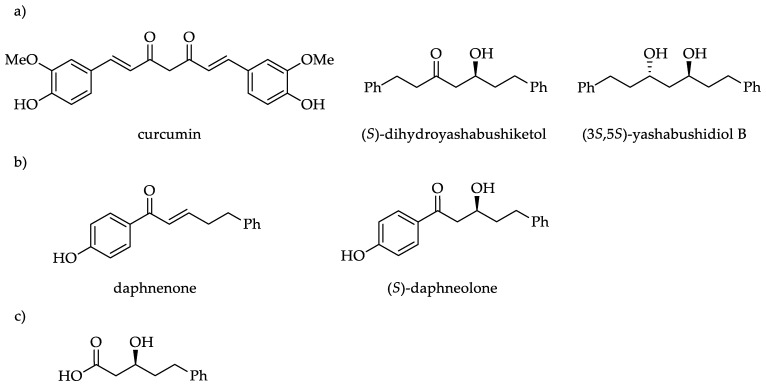 Figure 1
 Figure 2
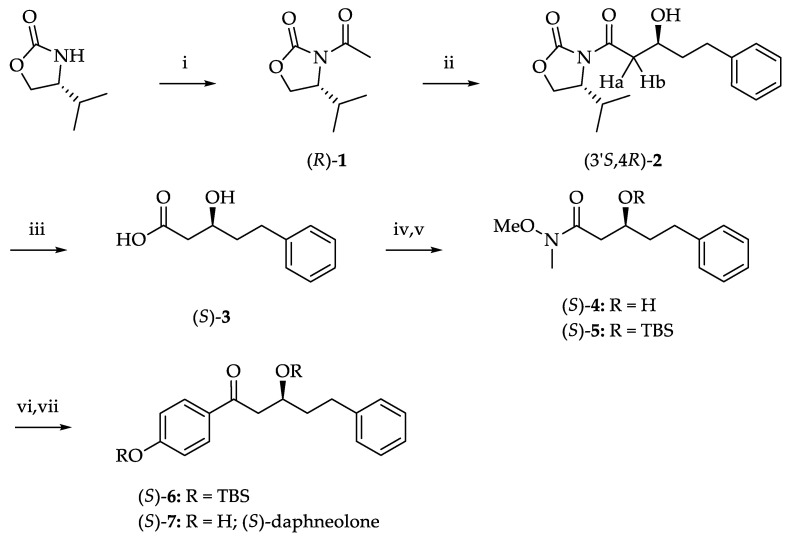 Figure 3
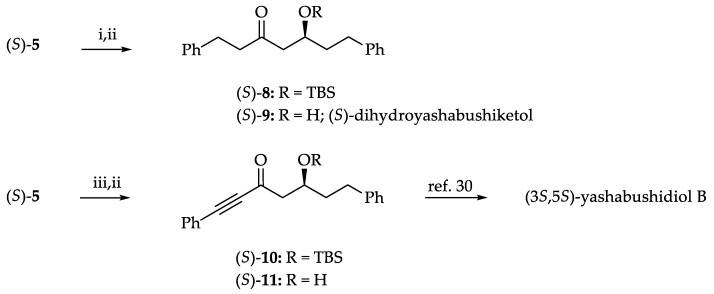 Figure 4
Peer Reviews
No public reviews on file for this paper yet. If you reviewed it on a platform where reviews are public (OpenReview, ICLR, NeurIPS, ICML), you can paste yours below so the community can read it here.
Videos
No videos yet. Explain this paper in a talk, walkthrough, or lecture? Add one.
Taxonomy
TopicsCarbohydrate Chemistry and Synthesis · Synthetic Organic Chemistry Methods · Asymmetric Synthesis and Catalysis