The Rosencrantz Coin: Predictability and Structure in Non-Ergodic Dynamics—From Recurrence Times to Temporal Horizons
Dimitri Volchenkov

TL;DR
The paper studies a system with unpredictable sticking behavior, revealing new ways to understand complex dynamics beyond traditional models.
Contribution
A novel framework for analyzing non-ergodic systems using block probabilities and combinatorial structures.
Findings
Block lengths in sequences grow logarithmically, indicating non-ergodic behavior.
Stirling numbers of the second kind peak at block size n/logn, revealing structural patterns.
Combinatorial growth dominates probability decay for large n, leading to deterministic-like structures.
Abstract
We examine the Rosencrantz coin that can “stick” in states for extended periods. Non-ergodic dynamics is highlighted by logarithmically growing block lengths in sequences. Traditional entropy decomposition into predictable and unpredictable components fails due to the absence of stationary distributions. Instead, sequence structure is characterized by block probabilities and Stirling numbers of the second kind, peaking at block size n/logn. For large n, combinatorial growth dominates probability decay, creating a deterministic-like structure. This approach shifts the focus from predicting states to predicting temporal horizons, providing insights into systems beyond traditional equilibrium frameworks.
Genes, proteins, chemicals, diseases, species, mutations and cell lines named across the full text — each resolved to its canonical identifier and authoritative record.
Click any figure to enlarge with its caption.
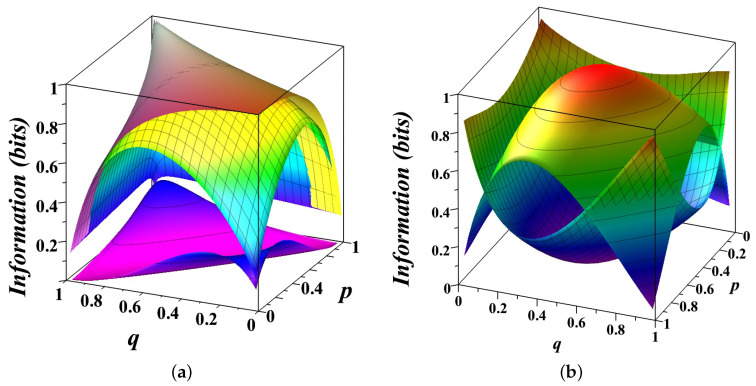 Figure 1
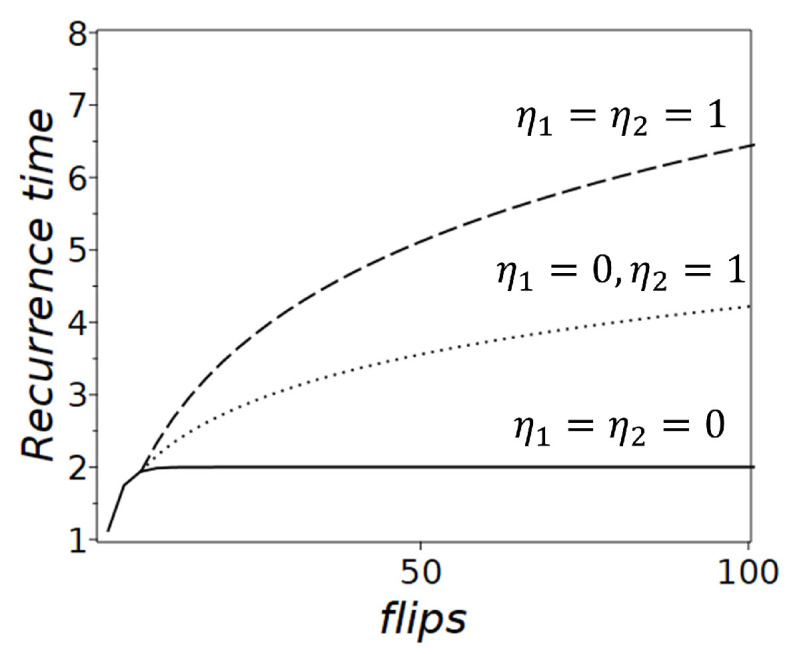 Figure 2
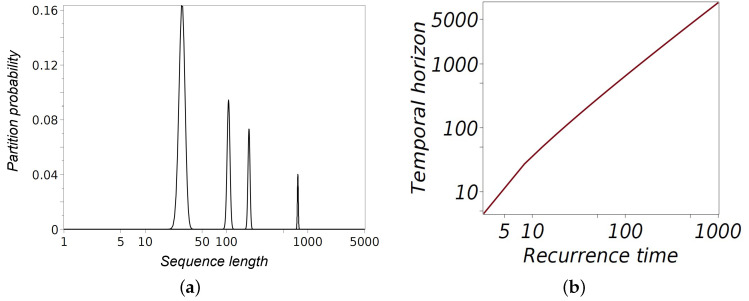 Figure 3
Peer Reviews
No public reviews on file for this paper yet. If you reviewed it on a platform where reviews are public (OpenReview, ICLR, NeurIPS, ICML), you can paste yours below so the community can read it here.
Videos
No videos yet. Explain this paper in a talk, walkthrough, or lecture? Add one.
Taxonomy
TopicsComplex Systems and Time Series Analysis · Statistical Mechanics and Entropy · Advanced Thermodynamics and Statistical Mechanics