NPA Hierarchy and Extremal Criterion in the Simplest Bell Scenario
Satoshi Ishizaka

TL;DR
This paper explores the boundaries of quantum correlations in a basic Bell scenario using the NPA hierarchy and confirms a plausible analytical criterion.
Contribution
The paper verifies a plausible criterion for quantum correlations by analyzing the NPA hierarchy in the simplest Bell scenario.
Findings
The 1+AB level and second level for correlations were found to be equal in the simplest Bell scenario.
The extremal condition was confirmed to be equivalent to the 1+AB level.
The plausible criterion was verified as correct and explained its simplicity.
Abstract
It is difficult to establish an analytical criterion to identify the boundaries of quantum correlations, even for the simplest Bell scenario. Here, we briefly reviewed the plausible analytical criterion, and we found a way to confirm the extremal conditions from another direction. For that purpose, we analyzed the Navascués-Pironio-Acín (NPA) hierarchy to study the algebraic structure and found that the problem could not be simplified using the 1+AB level. However, considering the plausible criterion, the 1+AB and second levels for correlations were equal, and the extremal condition in the simplest Bell scenario was replaced by that in the 1+AB level. Thus, the correctness of the plausible criterion was verified, and the results demonstrated that the plausible criterion held, thereby explaining its simplicity. It seemed plausible, but now it becomes more certain.
Genes, proteins, chemicals, diseases, species, mutations and cell lines named across the full text — each resolved to its canonical identifier and authoritative record.
Click any figure to enlarge with its caption.
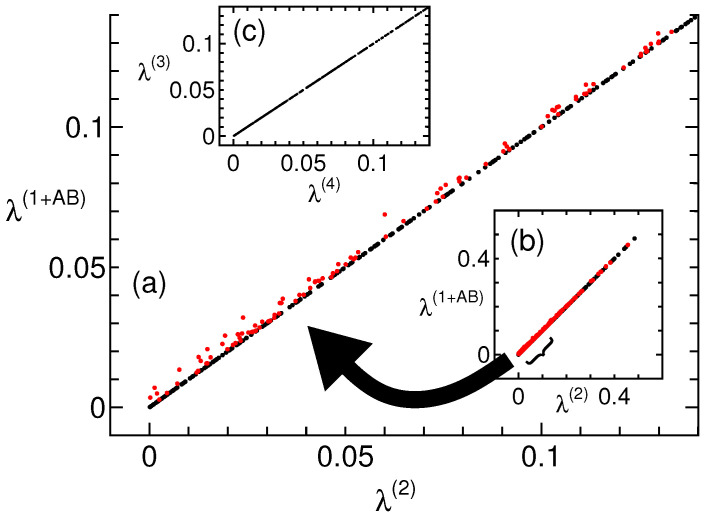 Figure 1
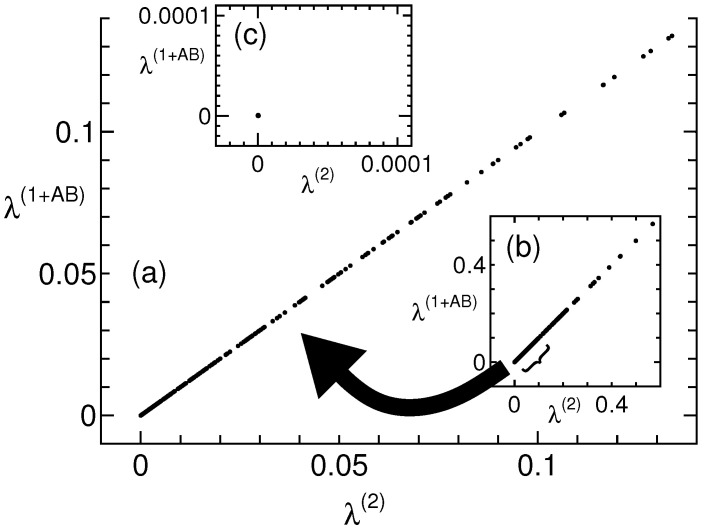 Figure 2
Peer Reviews
No public reviews on file for this paper yet. If you reviewed it on a platform where reviews are public (OpenReview, ICLR, NeurIPS, ICML), you can paste yours below so the community can read it here.
Videos
No videos yet. Explain this paper in a talk, walkthrough, or lecture? Add one.
Taxonomy
TopicsQuantum Mechanics and Applications · Quantum Information and Cryptography · Advanced Thermodynamics and Statistical Mechanics