Severe Intracranial Infection
Shinnosuke Fukushima, Takumi Fujimori, Koji Iio, Hideharu Hagiya

Abstract
Genes, proteins, chemicals, diseases, species, mutations and cell lines named across the full text — each resolved to its canonical identifier and authoritative record.
Click any figure to enlarge with its caption.
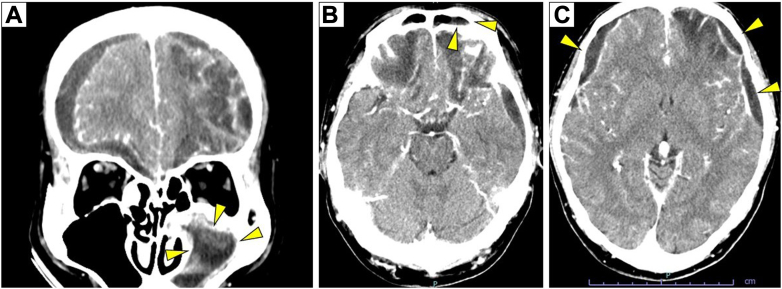 Figure 1
Peer Reviews
No public reviews on file for this paper yet. If you reviewed it on a platform where reviews are public (OpenReview, ICLR, NeurIPS, ICML), you can paste yours below so the community can read it here.
Videos
No videos yet. Explain this paper in a talk, walkthrough, or lecture? Add one.
Taxonomy
TopicsBacterial Infections and Vaccines · Infectious Diseases and Tuberculosis · Otolaryngology and Infectious Diseases
Case Presentation
1
A 59-year-old man with a history of alcoholism presented to our hospital with a sudden onset of consciousness disorder. Head contrast-enhanced computed tomography showed multiple subdural abscesses and space-occupying lesions in the maxillary and frontal sinuses (Fig). Blood cultures drawn on the second day detected Streptococcus constellatus and Gram-negative bacilli, the latter of which was identified as Dialister pneumosintes by matrix-assisted laser desorption/ionization time-of-flight mass spectrometry (MALDI Biotyper; Bruker Daltonics) with an identification score of 2.29. A 16S ribosomal RNA gene analysis using the Basic Local Alignment Search Tool demonstrated a high concordance rate of 99.91% with the reference strain (GenBank accession number: LC037225.1). The patient underwent surgical drainage of the brain abscesses and was consequently transferred to another hospital.FigureContrast-enhanced computed tomography of the head. Contrast-enhanced computed tomography imaging demonstrates left-sided maxillary and frontal sinusitis (A, B), with evidence of multiple subdural abscess formations (C).
Diagnosis: Severe Intracranial Infection Caused by Dialister Pneumosintes
2
D pneumosintes is an anaerobic or microaerophilic Gram-negative coccobacillus that often requires 16S ribosomal RNA gene sequencing for accurate identification.1^,^2 D pneumosintes is rarely detected in blood cultures and has been reported to cause head and neck infections such as brain abscesses and Lemierre’s syndrome.2, 3, 4 A previous case of brain abscesses was diagnosed as a mixed infection involving D pneumosintes and Streptococcus anginosus.3 In the present case, polybacteremia mixed with D pneumosintes was observed, and the brain abscesses were suspected to have originated from the sinuses. Our case highlights the pathogenicity of D pneumosintes in brain abscess formation.
Funding and Support
By JACEP Open policy, all authors are required to disclose any and all commercial, financial, and other relationships in any way related to the subject of this article as per ICMJE conflict of interest guidelines (see www.icmje.org). The authors have stated that no such relationships exist.
Data Availability
The datasets used during the current study are available from the corresponding author on reasonable request.
Conflict of Interest
All authors have affirmed they have no conflicts of interest to declare.
The reference list from the paper itself. Each links out to its DOI / PubMed record.
- 1Jumas-Bilak E.Jean-Pierre H.Carlier J.P.Dialister micraerophilus sp. nov. and Dialister propionicifaciens sp. nov., isolated from human clinical samples Int J Syst Evol Microbiol 55Pt 62005247124781628051210.1099/ijs.0.63715-0 · doi ↗ · pubmed ↗
- 2Morio F.Jean-Pierre H.Dubreuil L.Antimicrobial susceptibilities and clinical sources of Dialister species Antimicrob Agents Chemother 51122007449845011792349210.1128/AAC.00538-07PMC 2167981 · doi ↗ · pubmed ↗
- 3Rousée J.M.Bermond D.Piémont Y.Dialister pneumosintes associated with human brain abscesses J Clin Microbiol 40102002387138731235490510.1128/JCM.40.10.3871-3873.2002 PMC 130909 · doi ↗ · pubmed ↗
- 4Hirai J.Kuruma T.Sakanashi D.Lemierre syndrome due to Dialister pneumosintes: a case report Infect Drug Resist 152022276327713566885310.2147/IDR.S 359074 PMC 9166905 · doi ↗ · pubmed ↗