Acute Biomechanical Effects of Cardiac Contractility Modulation in Living Myocardial Slices from End-Stage Heart Failure Patients
Mark F. A. Bierhuizen, Jorik H. Amesz, Sanne J. J. Langmuur, Bobby Lam, Paul Knops, Kevin M. Veen, Olivier C. Manintveld, Jolanda Kluin, Natasja M. S. de Groot, Yannick J. H. J. Taverne

TL;DR
This study shows that cardiac contractility modulation can improve heart muscle strength in patients with severe heart failure, depending on the stimulation settings used.
Contribution
The study demonstrates the acute biomechanical effects of CCM on myocardial slices from end-stage heart failure patients.
Findings
CCM increased maximum contractile force and area under the contractile curve in heart failure myocardial slices.
The positive inotropic response to CCM increased with higher stimulation delay, duration, and amplitude.
CCM attenuated the negative force-frequency relationship in heart failure myocardial slices.
Abstract
Proof-of-concept to determine the direct biomechanical effects of cardiac contractility modulation (CCM) on living myocardial slices (LMS) from patients with end-stage heart failure (HF). Left ventricular LMS from patients with end-stage HF were produced and cultured in a biomimetic system with mechanical loading and electrical stimulation. CCM stimulation (80 mA, 40 ms delay, 21 ms duration) enhanced maximum contractile force (CCM: 1229 µN (587–2658) vs. baseline: 1066 µN (529–2128), p = 0.05) and area under the contractile curve (CCM: 297 (151–562) vs. baseline: 243 (129–464), p = 0.05) but did not significantly impact contractile duration, time to peak, or time to relaxation. Increasing CCM stimulation delay, duration, and amplitude resulted in a higher fraction of LMS with a positive inotropic response. Furthermore, CCM attenuated the negative force-frequency relationship in HF-LMS.…
Genes, proteins, chemicals, diseases, species, mutations and cell lines named across the full text — each resolved to its canonical identifier and authoritative record.
Click any figure to enlarge with its caption.
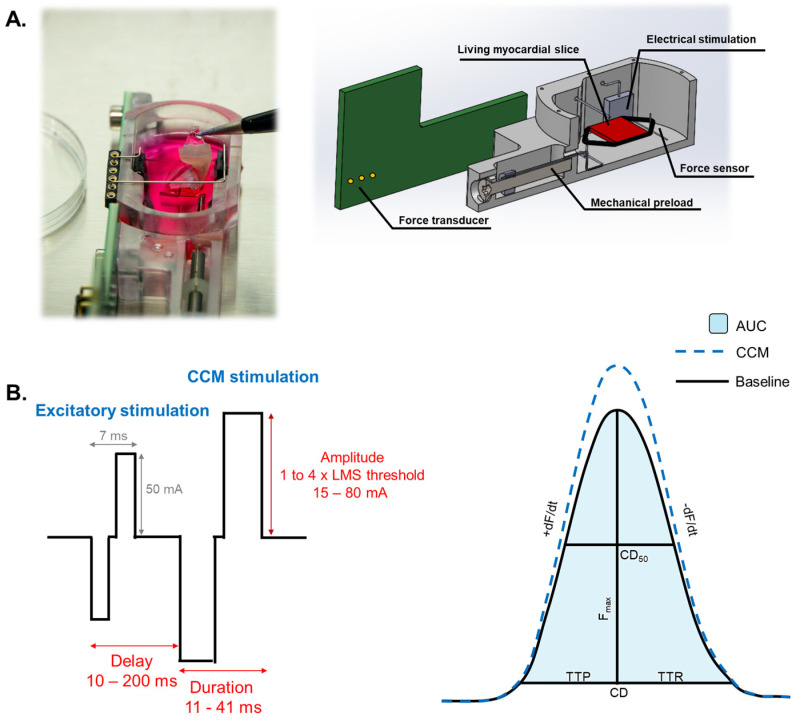 Figure 1
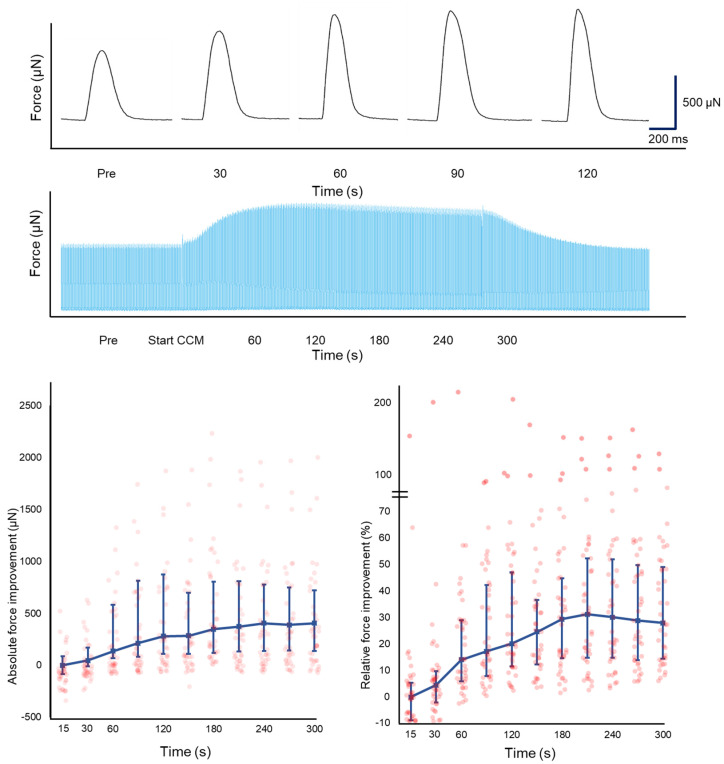 Figure 2
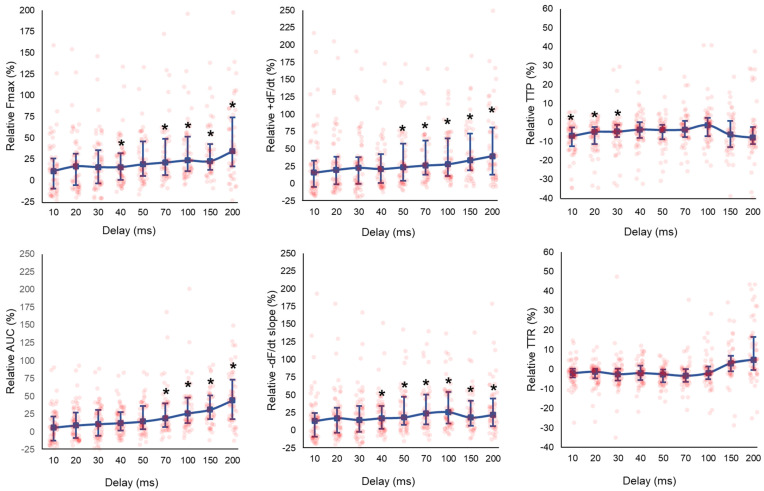 Figure 3
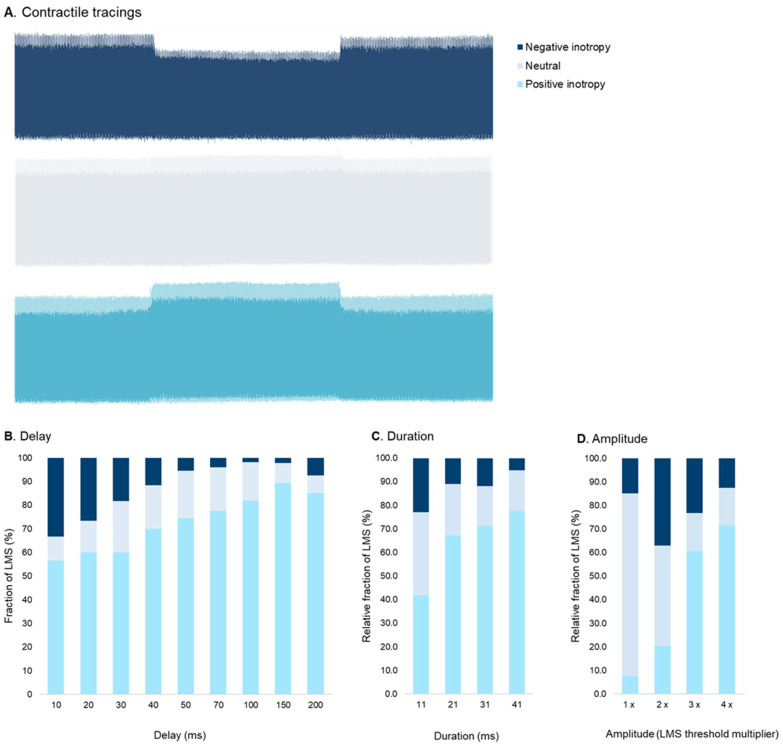 Figure 4
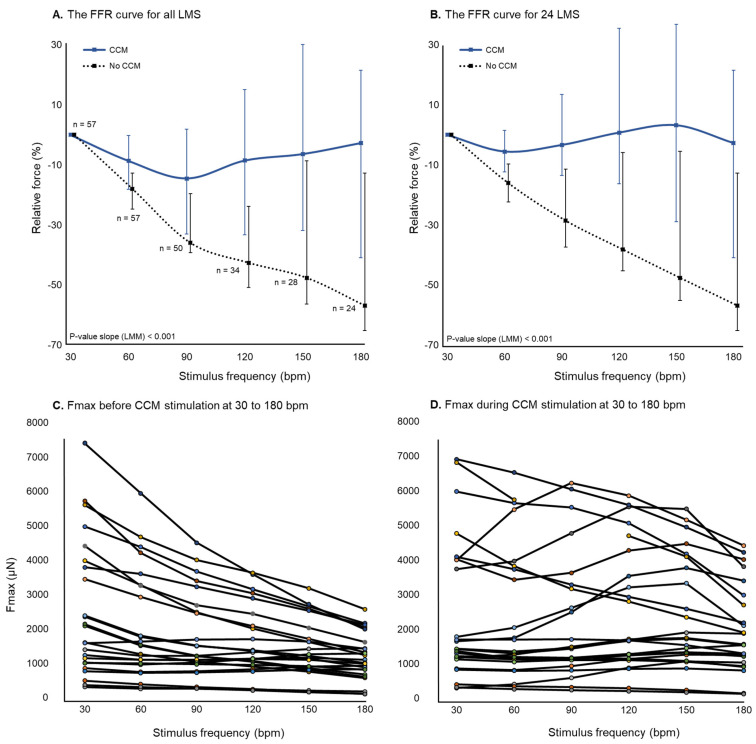 Figure 5
Peer Reviews
No public reviews on file for this paper yet. If you reviewed it on a platform where reviews are public (OpenReview, ICLR, NeurIPS, ICML), you can paste yours below so the community can read it here.
Videos
No videos yet. Explain this paper in a talk, walkthrough, or lecture? Add one.
Taxonomy
TopicsCardiovascular Function and Risk Factors · Cardiac pacing and defibrillation studies · Cardiomyopathy and Myosin Studies