A Clinical Study of Precision Chemoablation for Hypertrophic Obstructive Cardiomyopathy Without Large Interventricular Septal Branches
Xinnan Cao, Rong Huang, Haihua Geng, Hu Liu, Yi Gu, Peishu Xu, Yufeng Chen, Jian Yao, Hongzhuan Sheng

TL;DR
This study shows that a new ultrasound-guided chemical ablation method safely reduces heart obstruction in patients with a specific heart condition.
Contribution
The study introduces a precision chemical ablation technique for HOCM patients without large septal branches.
Findings
Ultrasound-guided ablation significantly reduced left ventricular outflow tract gradient in HOCM patients.
Patients showed improved quality of life and heart function one year after the procedure.
No significant change in septal thickness or ejection fraction was observed post-treatment.
Abstract
This study aims to evaluate the clinical efficacy and safety of ultrasound‐guided percutaneous septal precision chemical ablation in the treatment of hypertrophic obstructive cardiomyopathy (HOCM). From December 2020 to July 2024, 27 patients with HOCM without large target septal branches (diffuse multiple branches, all less than 1 mm in diameter) were enrolled and underwent ultrasound‐guided percutaneous septal chemical ablation. Intraoperative left ventricular outflow tract gradient (LVOTG), postoperative cardiac troponin I (cTnI), complications, and changes in the 36‐Item Short Form Survey (SF‐36) score, New York Heart Association (NYHA) functional classification and echocardiography parameters in 1 year post‐PTSMA were monitored and analyzed. Immediate postoperative LVOTG values monitored by catheter and echocardiography were both significantly decreased (both p < 0.05) in the 27…
Genes, proteins, chemicals, diseases, species, mutations and cell lines named across the full text — each resolved to its canonical identifier and authoritative record.
Click any figure to enlarge with its caption.
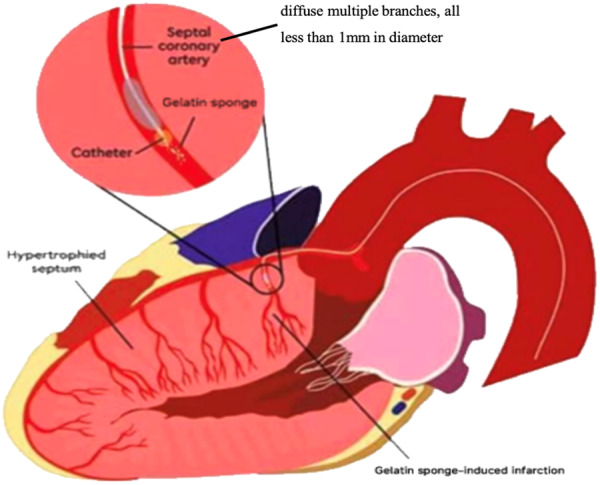 Figure 1
Peer Reviews
No public reviews on file for this paper yet. If you reviewed it on a platform where reviews are public (OpenReview, ICLR, NeurIPS, ICML), you can paste yours below so the community can read it here.
Videos
No videos yet. Explain this paper in a talk, walkthrough, or lecture? Add one.
Taxonomy
TopicsCardiomyopathy and Myosin Studies · Cardiovascular Function and Risk Factors · Congenital Heart Disease Studies