Long-term impacts of salinity and temperature changes on Brachionus calyciflorus populations: understanding the role of intraspecific variability
Lishani Wijewardene, Cátia Venâncio, Rui Ribeiro, Isabel Lopes

TL;DR
This study explores how long-term exposure to increased salinity and temperature affects the population resilience of the rotifer Brachionus calyciflorus.
Contribution
The study reveals that intraspecific variability influences long-term population responses to combined salinity and temperature stressors.
Findings
Some salinity-tolerant clonal lineages of Brachionus calyciflorus were extirpated earlier under long-term salinity exposure.
Negative effects of salinity were enhanced at lower and higher temperatures, leading to earlier extirpation of tolerant lineages.
Short- and long-term salinity sensitivity of clonal lineages showed no consistent association, indicating complex adaptation dynamics.
Abstract
Worldwide, many coastal freshwater ecosystems suffer from seawater intrusion. In addition to this stressor, it is likely that the biota inhabiting these ecosystems will also need to deal with climate change-related temperature fluctuations. The resilience of populations to long-term exposure to these stressors will depend on their genetic diversity, a key for their adaptation to changing environments. Accordingly, this study aimed to understand the long-term effects of salinity and temperature on the population density dynamics of the rotifer Brachionus calyciflorus by considering intra-specific variability. Six clonal lineages of B. calyciflorus, exhibiting differential lethal sensitivity (LC50,24 h) to salinity, were exposed for at least 34 days, to a control and to artificial seawater (at a conductivity corresponding to the LC70,24 h for the most tolerant clonal lineage = 9.89…
Genes, proteins, chemicals, diseases, species, mutations and cell lines named across the full text — each resolved to its canonical identifier and authoritative record.
Click any figure to enlarge with its caption.
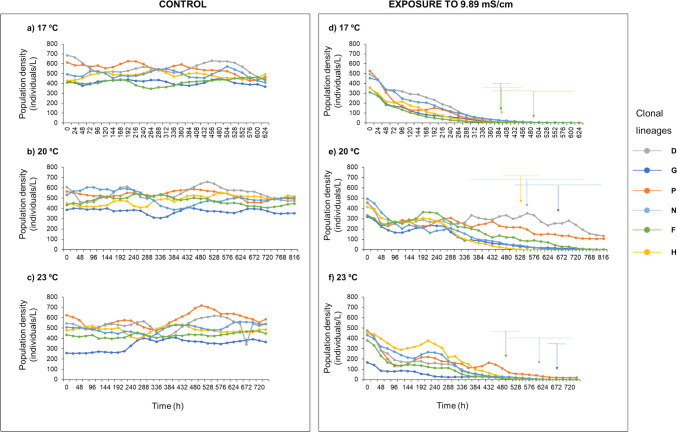 Figure 1
 Figure 2
 Figure 3
Peer Reviews
No public reviews on file for this paper yet. If you reviewed it on a platform where reviews are public (OpenReview, ICLR, NeurIPS, ICML), you can paste yours below so the community can read it here.
Videos
No videos yet. Explain this paper in a talk, walkthrough, or lecture? Add one.
Taxonomy
TopicsAquatic Ecosystems and Phytoplankton Dynamics · Environmental Toxicology and Ecotoxicology · Aquatic Invertebrate Ecology and Behavior