Safety and outcome of elective synthetic mesh repair for incisional ventral hernias in immunosuppressed patients – a retrospective propensity-score-matched analysis
Ramin Raul Ossami Saidy, Yvonne May Callister, Luca Dittrich, Dennis Eurich, Christian Denecke, Johann Pratschke, Jonas Raakow

TL;DR
This study examines the safety and outcomes of using synthetic mesh for hernia repair in patients with weakened immune systems, finding that while complications can occur, the overall results are favorable.
Contribution
The study provides new evidence on the safety and outcomes of mesh hernia repair in immunosuppressed patients using propensity-score-matching.
Findings
Immunosuppression was linked to increased postoperative complications in univariate but not multivariate analysis.
Use of more than two immunosuppressive agents and a history of immunosuppression over 48 months significantly impacted postoperative complications.
Age, surgery duration, hernia type, and number of immunosuppressive agents were risk factors for recurrence in immunocompromised patients.
Abstract
Incisional hernia remain an important complication after abdominal surgery. Repair often includes use of synthetic mesh, but certain risk factors for complication after mesh hernia repair have been described. Among these, immunosuppression due to co-existing conditions is hypothesized to increase postoperative complications, but data is scarce and contradicting. Therefore, the aim was to assess outcome after mesh hernia repair in immunosuppressed patients. Patients with and without immunosuppression undergoing elective incisional hernia repair at our clinic between 2010 and 2019 were analyzed in this retrospective study. Pre-existing conditions, details of immunosuppression, postoperative course and outpatient follow-up for hernia recurrence were collected and impact of clinical variables on outcome was analyzed. Propensity score matching was performed for comparison of cohorts.…
Genes, proteins, chemicals, diseases, species, mutations and cell lines named across the full text — each resolved to its canonical identifier and authoritative record.
Click any figure to enlarge with its caption.
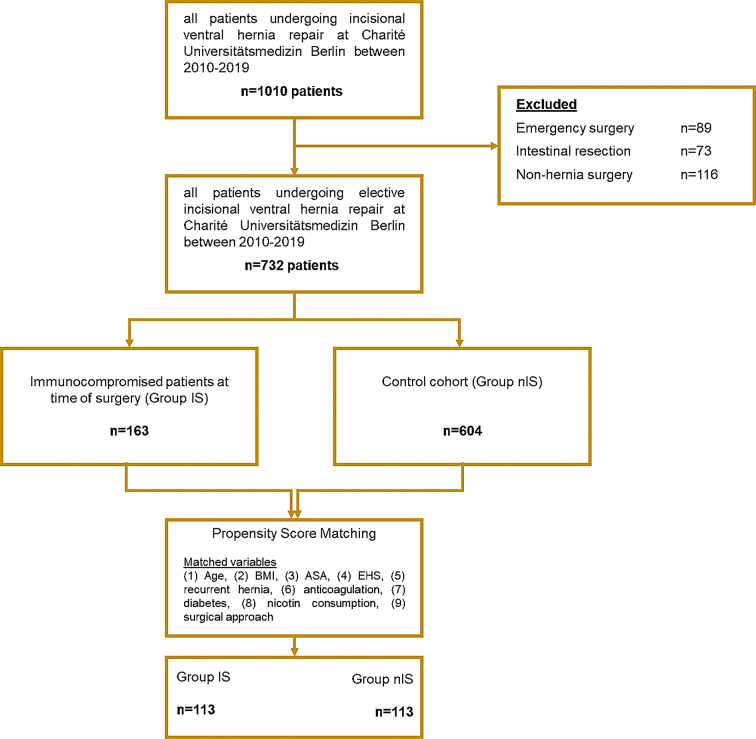 Figure 1
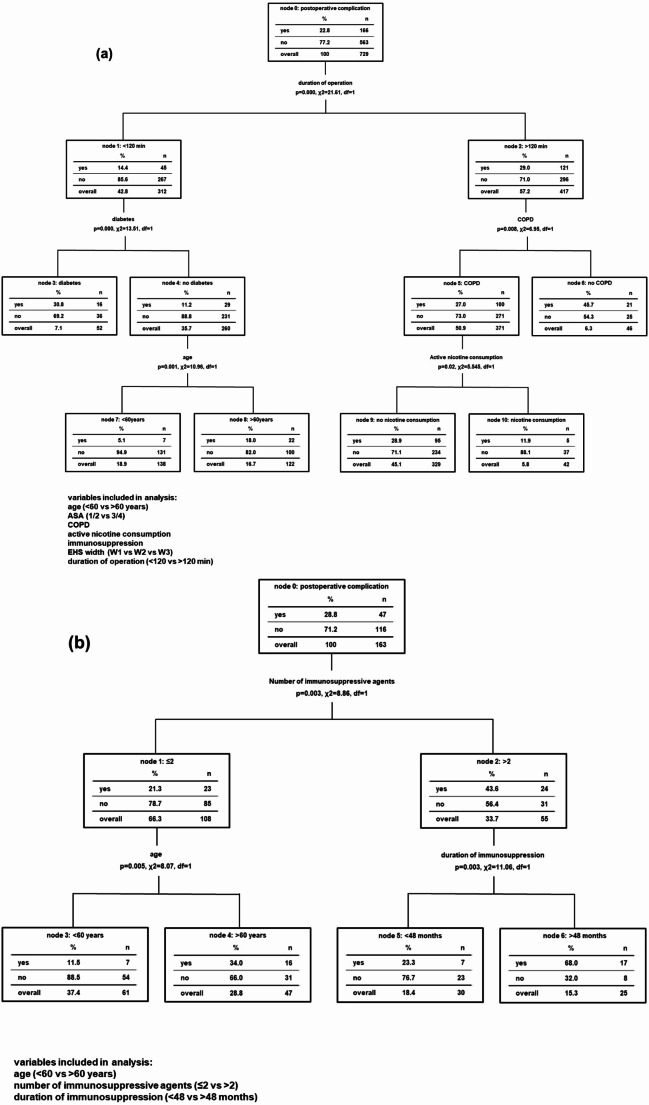 Figure 2
Peer Reviews
No public reviews on file for this paper yet. If you reviewed it on a platform where reviews are public (OpenReview, ICLR, NeurIPS, ICML), you can paste yours below so the community can read it here.
Videos
No videos yet. Explain this paper in a talk, walkthrough, or lecture? Add one.
Taxonomy
TopicsHernia repair and management · Pelvic and Acetabular Injuries · Surgical site infection prevention