Adults with reading difficulties demonstrate selective impairments in the fine neural tuning for print
Tongjie Zhuang, Yaowen Li, Yufei Tan, Jiuju Wang, Xiuyue Yue, Licheng Xue, Jing Zhao

TL;DR
Adults with reading difficulties show specific problems in how their brains process written Chinese characters at a detailed level.
Contribution
This study identifies persistent fine neural tuning impairments in Chinese adults with reading difficulties.
Findings
High-level readers showed both coarse and fine neural tuning for print.
Low-level readers had intact coarse tuning but impaired fine tuning for real vs. pseudo vs. false characters.
Impaired fine tuning suggests persistent issues in neural processing among poor readers.
Abstract
Neural tuning for print, reflected in differential responses of the N170 component of event-related potentials to orthographic forms and other visual stimuli, serves as the neural basis for efficient visual word reading. Impaired neural tuning for print is well established in dyslexic children. Although many adults also experience reading difficulties, relatively few studies have examined whether such impairments exist in adults, particularly those who read Chinese, which differs markedly in visual and linguistic characteristics from alphabetic scripts. To fill this gap, we assessed 20 high-level and 16 low-level adult readers who were the two extremes of the best and poorest readers of a database, which consisted of 308 college students. Using ERP techniques, we investigated two levels of neural tuning for print: coarse tuning (i.e., real, pseudo, false characters vs. stroke…
Genes, proteins, chemicals, diseases, species, mutations and cell lines named across the full text — each resolved to its canonical identifier and authoritative record.
Click any figure to enlarge with its caption.
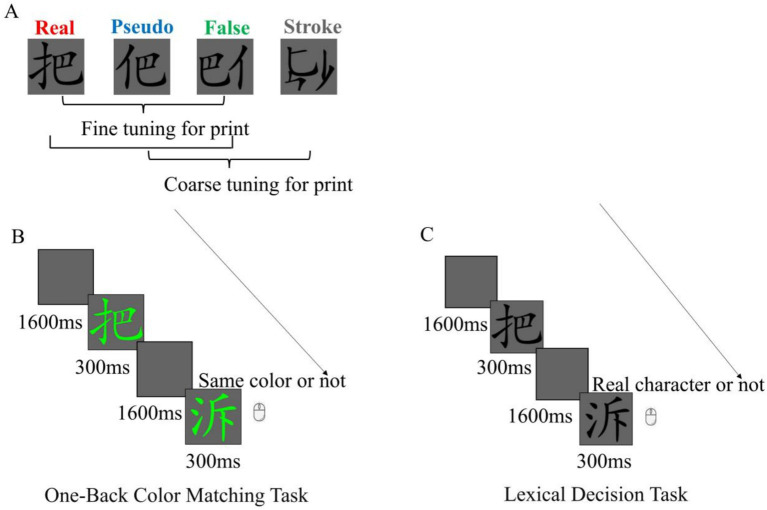 Figure 1
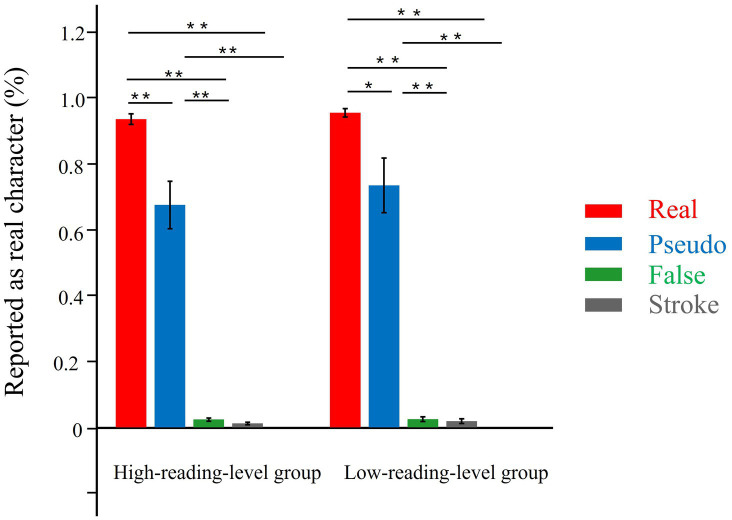 Figure 2
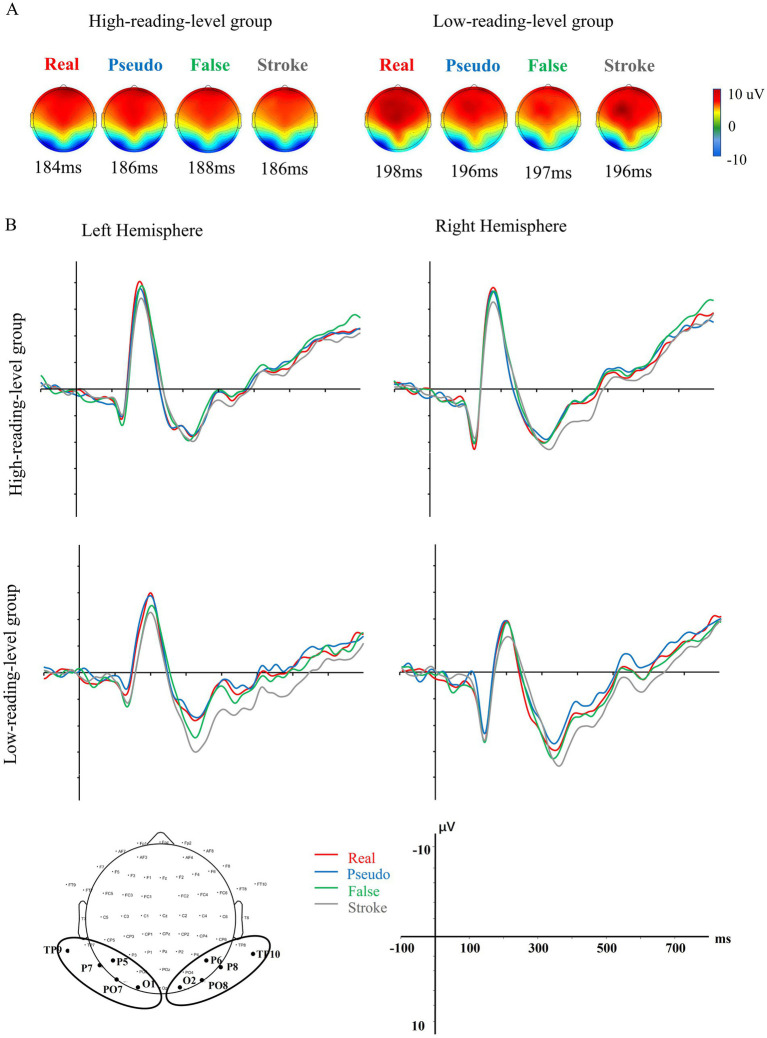 Figure 3
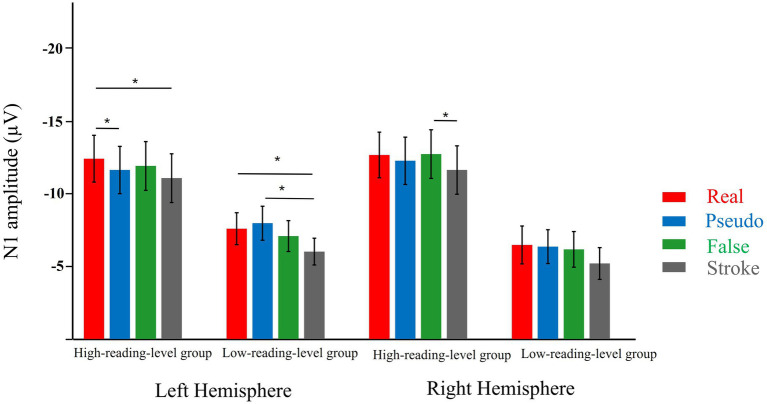 Figure 4
 Figure 5
 Figure 6
Peer Reviews
No public reviews on file for this paper yet. If you reviewed it on a platform where reviews are public (OpenReview, ICLR, NeurIPS, ICML), you can paste yours below so the community can read it here.
Videos
No videos yet. Explain this paper in a talk, walkthrough, or lecture? Add one.
Taxonomy
TopicsReading and Literacy Development · Tactile and Sensory Interactions · Cognitive and developmental aspects of mathematical skills