Homologous recombination deficiency test validation in patients with high-grade advanced ovarian cancer
Angelica Nogueira Rodrigues, Andreza Karine de Barros Almeida Souto, Diocésio Alves Pinto de Andrade, Larissa Müller Gomes, Sandra Satie Koide, Renata de Godoy e Silva, Bruno Batista de Souza, Juliana Doblas Massaro, Andréia Cristina de Melo, Andrea Morais Borges, Camila Giro

TL;DR
This study validates a new test for homologous recombination deficiency in ovarian cancer patients, showing it performs well compared to an existing test.
Contribution
The study validates a new NGS-based HRD test for diagnostic use in Brazil.
Findings
The GS Focus HRD test showed high concordance (kappa: 0.8) with the reference MyChoice® HRD Plus CDx test.
The new test achieved 90% overall accuracy, sensitivity, and specificity in HRD classification.
All BRCA1/2 mutations detected by the reference test were also identified by the GS Focus HRD test.
Abstract
Along with BRCA mutation status, homologous recombination deficiency (HRD) testing is a prognostic and predictive biomarker for poly-ADP-ribose polymerase (PARP) inhibitor therapy indication in high-grade epithelial ovarian, fallopian tube, or peritoneal cancer. Approximately 50% of high-grade serous ovarian cancers exhibit HRD, even in the absence of germline or somatic BRCA1/2 loss-of-function mutations. In this scenario, access to a validated diagnostic HRD test can optimize treatment selection and increase the effectiveness of the intervention. To technically validate an in-house next-generation sequencing (NGS)-based HRD test, QIAseq Custom Panel (QIAGEN), by comparing it with the reference assay, MyChoice CDx® Plus HRD (Myriad Genetics), which is used in routine care. This is a prospective cohort study conducted at the Oncoclínicas Precision Medicine (OCPM) laboratory using…
Genes, proteins, chemicals, diseases, species, mutations and cell lines named across the full text — each resolved to its canonical identifier and authoritative record.
Click any figure to enlarge with its caption.
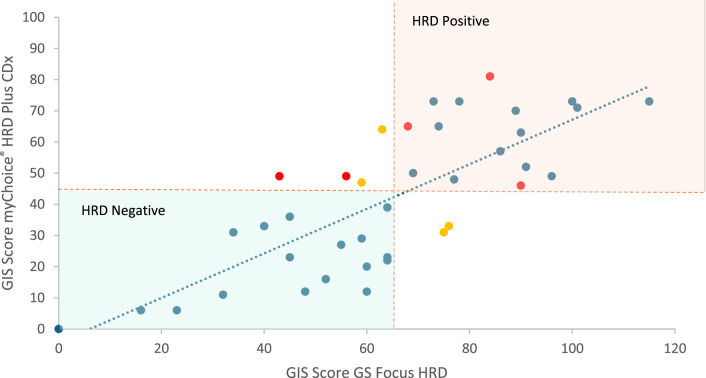 Figure 1
Peer Reviews
No public reviews on file for this paper yet. If you reviewed it on a platform where reviews are public (OpenReview, ICLR, NeurIPS, ICML), you can paste yours below so the community can read it here.
Videos
No videos yet. Explain this paper in a talk, walkthrough, or lecture? Add one.
Taxonomy
TopicsPARP inhibition in cancer therapy · DNA Repair Mechanisms · CRISPR and Genetic Engineering